
TABLE OF CONTENTS
- The Denim Supply Chain Isn’t What It Used to Be
- Finding Suppliers Who Actually Deliver (Not Just Promise)
- MOQ Realities: What Manufacturers Won’t Tell You Upfront
- Quality Control That Doesn’t Cost a Fortune
- Fabric Sourcing: The Make-or-Break Decision
- Communication Breakdowns That Kill Deadlines
- Building Relationships That Scale with Your Brand
The Denim Supply Chain Isn’t What It Used to Be
The old model of denim sourcing was straightforward: pick a fabric, get a quote, place your order, wait three months, and hope the jeans showed up. That path doesn’t exist anymore—and honestly, it never really did. I’ve spent twelve years running Lianwang Garment, and the one constant is that the supply chain always has surprises.
Here’s what most sourcing guides won’t tell you: your success depends less on finding the cheapest supplier and more on finding partners who communicate when things go sideways. And they will go sideways. Fabric arrives with color mismatches. Washing machines break in week two. Customs holds shipments for paperwork errors nobody anticipated.
This isn’t theoretical for me. Last month, a client’s order got stuck in Ningbo port because their freight forwarder misclassified the HS code. Two weeks of storage fees—$8,000—accumulated before they even knew there was a problem. The difference between a nightmare and a manageable delay comes down to your supplier’s transparency.
By the end of this guide, you’ll know exactly what to ask, who to trust, and what red flags should make you walk away immediately. If you’re planning to launch a clothing brand, mastering supply chain management is non-negotiable.
Finding Suppliers Who Actually Deliver (Not Just Promise)
You need suppliers who ship what they promise. Sounds obvious, right? You’d be shocked how many “denim specialists” are just middlemen with zero manufacturing oversight. In our industry, we see this constantly—suppliers who look great on paper but subcontract everything without disclosure.
Where to Look Beyond Alibaba
Trade shows still matter more than you think. Première Vision in Paris, Kingpins in NYC, and Intertextile in Shanghai—these are where the real players show their fabrics. I meet startups at Kingpins every spring who say “we found our supplier on Alibaba and it was great.” Six months later, they’re in my factory trying to salvage a doomed order because the fabric weight was 15% lighter than sample.
The problem with online platforms: anyone can list. That “10-year experience” claim? Often fabricated. That glossy portfolio? Could be someone else’s work. We had a client bring in fabric swatches that were supposedly from their “established supplier.” We identified the mill—it was a different grade entirely. The supplier had substituted cheaper fabric after the client approved samples and didn’t check subsequent rolls.
Your time is better spent getting referrals from brands you respect. Ask other founders directly—most are happy to share their vendor list if you’re not a direct competitor. Then verify. Call the references. Ask about responsiveness, not just quality.
If you’re considering US-based production, read our analysis of Denim Jeans Manufacturers in USA to understand the trade-offs.
The “Factory Visit” Myth
Yes, visiting facilities matters. But here’s the twist: how the factory responds to your visit request tells you everything. A legitimate factory will:
- Schedule visits within 3-5 business days (they’re busy, but accessible)
- Show you relevant production lines (not just a model clean room)
- Introduce you to quality control staff, not just sales
- Provide batch traceability on the spot
If a supplier deflects or makes excuses—”we’re too busy” or “our clients don’t allow visits”—that’s your answer. They’re hiding something.
I once walked into a “factory” that was basically a storage unit with three sewing machines. They had 2,000 Instagram followers and claimed 200 workers. The whole operation was a middleman marking up prices 40% while subcontracting to actual factories we already use. That’s not unusual.
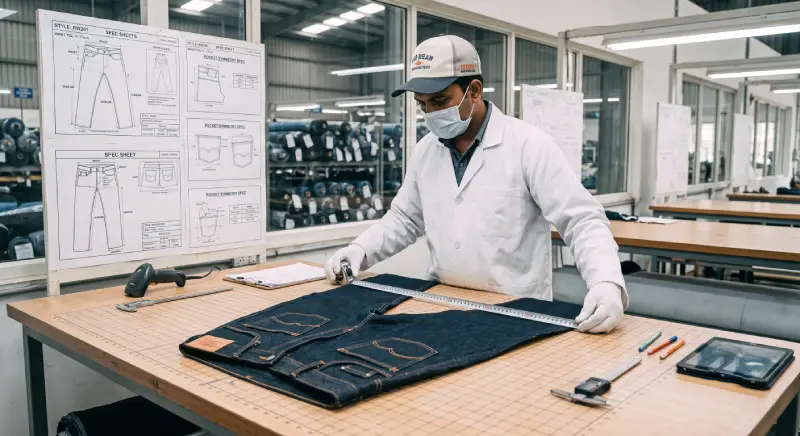
Three-step verification process:
- Request recent factory audit reports (BSCI, ISO, WRAP) dated within 12 months
- Ask for their main fabric mill partners and contact those mills directly to confirm the relationship
- Run a small trial order before committing to anything substantial
When you finally choose a partner, make sure you understand How to Choose the Best Jeans Manufacturer—it could save you from costly mistakes.
MOQ Realities: What Manufacturers Won’t Tell You Upfront
Minimum order quantities are where most startups get squeezed. They hear “500 pieces minimum” and think that’s the floor. Sometimes it is. But often MOQs are negotiable if you understand the economics.
Why the Numbers Are What They Are
Fabric suppliers operate on narrow margins. They won’t cut fabric for less than 1,000 meters because setup costs (dyeing, finishing) need to amortize across enough yardage to make it worthwhile. Garment manufacturers calculate MOQs differently—it’s about labor efficiency. Switching styles on a production line costs 2-3 hours of downtime. They want enough pieces to justify that changeover.
Here’s what I mean: making 200 jeans of style A, then switching to 150 of style B, then back to style A—that’s chaos. They lose money on every change. So they set minimums that keep lines running on one style for days, not hours.
How to reduce your MOQ burden:
→ Use stock fabrics when possible (keeps fabric MOQ at 0)
→ Commit to a single wash across multiple styles (larger total volume, same setup)
→ Negotiate “rising MOQ” clauses: start at 200, scale to 800 within 12 months
→ Join a consolidation program—some manufacturers pool multiple small brands to hit fabric minimums together
Our factory runs a small-brand incubator program. We aggregate orders from 4-6 startups to hit fabric mill minimums, then distribute the fabric to each brand’s production run. The cost per meter drops 15-20% versus individual orders. That model only works with committed growth—otherwise, you’re penalized for falling behind.
One success story: a streetwear brand needed 350 hoodies for their first drop. Our minimum was 500. They agreed to produce 350 now and commit to 500 additional units over 6 months. That got them in the door. Six months later, they’re ordering 2,000 pieces quarterly and expanding into denim jackets. If you’re interested in white label denim options, we can discuss flexible MOQ structures.
The “Hidden MOQ” Everyone Forgets
Lead time minimums. Some suppliers won’t schedule your production unless you can commit to their production calendar. Chinese New Year? You’re looking at 90+ day lead times because everything’s backed up. If you need product in 8 weeks, you may pay rush fees that effectively double your unit cost.
Always ask: “What’s your earliest possible production start date?” Then work backward from that. Need a faster turnaround? Check if your manufacturer offers express options—some do for an additional fee.
Quality Control That Doesn’t Cost a Fortune
Quality control isn’t optional. It’s part of your cost structure. But you don’t need to spend a fortune on every unit to maintain standards.
The Three-Stage Inspection System
Stage 1: Fabric approval (before cutting)
- Test color fastness (AATCC 61 or similar)
- Verify fabric weight (±5% tolerance)
- Check grain alignment and defects per meter
- Approval required before cutting begins
This costs $500-1,500 depending on fabric volume. That’s cheap compared to a $50,000 scrap run because the indigo was wrong.
Stage 2: First article inspection (after sewing, before washing)
- Inspect 30 units off the line (not 5)
- Check measurements against spec sheet (+/- 3/4″ tolerance typical)
- Verify stitching, button/zipper functionality, pocket alignment
- If >5% fail rate, halt production and investigate
Stage 3: Pre-shipment inspection (random 2% check)
- Inspect 100-200 units depending on order size
- Carton weight and quantity verification
- Final packaging QC
What Inspectors Actually Look For
Most startups think inspectors check “if jeans look good.” That’s too vague.
Here’s what separates serious QC from checkbox exercises:
- Stitch count per inch: 12-14 SPI standard for jeans, 8-10 for heavy denim jackets
- Button/buttonhole alignment: misalignment >2mm = fail
- Pocket curve symmetry: pockets should mirror each other
- Washing consistency: no streaks, patches where color bled unevenly
- Seam strength: pull test on critical seams (pockets, fly, belt loops)
One client asked me “why did my inspector pass these?”—the pockets were sagging because the bar tacks weren’t tight enough. The inspector didn’t know to check that. You need to specify exactly what matters to your brand.
Free QC tip: Ask your supplier to send you daily production photos. Not just one sample—multiple units across the batch. Look for variation in washing, stitching tension, and panel alignment. Most quality issues are systemic and show up early if you’re actually looking.
When something goes wrong, understanding How to Distress Jeans properly or How to Dye Jeans without uneven results becomes critical. These processes aren’t just artistic—they require technical control.
Fabric Sourcing: The Make-or-Break Decision
Fabric is 50-70% of your garment cost. Yet most brands treat fabric selection as an afterthought. They pick a swatch they like visually, without understanding how it behaves in production.
Understanding Fabric Construction Basics
Denim weight matters. Light denim (8-10 oz) drapes nicely but wears out faster. Mid-weight (11-13 oz) is the sweet spot for most jeans. Heavyweight (14+ oz) gives that premium feel but requires industrial sewing equipment and stiffer wearing experience.
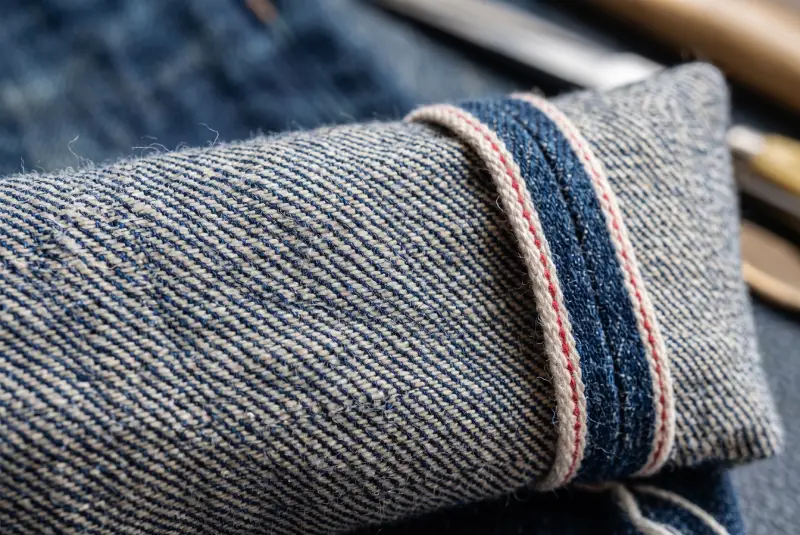
But here’s where people mess up: they weight only and ignore yarn quality. A 12 oz denim made from 100% core-spun cotton (with elastane in the core) behaves completely differently from 12 oz made from ring-spun cotton. The former stretches 15-20%, the latter maybe 3-5%. If you’re designing “comfort fit” jeans, you need the stretch. If you want vintage rigid denim, stay away from core-spun.
Ask your supplier for: yarn count (Ne or Tex), weave type (3×1 twill standard), and fabric composition (cotton/polyester/spandex percentages). One client ordered “95% cotton, 5% spandex” denim and got 98% cotton, 2% spandex. Guess what—the stretch was wrong, the fit was off, and they had 300 units they couldn’t sell. Get spec sheets in writing.
For specialty fabrics, see What is Selvedge Denim—it’s a whole different ballgame with its own sourcing challenges.
The Washing Connection
You can’t separate fabric from washing. That 14 oz selvedge you love? It shrinks up to 5% in sanforization. If you don’t account for that, your 32×32 jeans could be 30×30 after first wash.
Always order fabric that’s been sanforized unless you want customers complaining about shrinkage. Non-sanfor denim is for purists who expect 2-5% shrink and are willing to size up. That’s not most wearers.
If you’re doing special washes (stone wash, enzyme, acid, etc.), test on actual garment—not just fabric swatches. The same indigo reacts differently on 10 oz versus 14 oz. We batch-test every wash formula on full garments before running production. It adds 2-3 days but prevents entire batches from coming out wrong.
To understand the technical side of fabric preparation, check out Denim Wash processes and how they interact with different fabric weights.
One horror story: a client wanted “light stone wash” look. We did 5 iterations on sample jeans—looked perfect. Then we ran the bulk order and the washing machine’s water temperature dropped 15°F that day (summer vs winter municipal water). The jeans came out 20% darker. Full batch reject. Now we control water temperature precisely and always do a full production run test before releasing the batch.
Communication Breakdowns That Kill Deadlines
Language barriers are real. But it’s not about English proficiency—it’s about clarity of communication.
The Spec Sheet Is Your Bible
We’ve had clients email “make it look like this photo” with a screenshot. That’s not a spec. That’s a gamble.
A proper spec sheet includes:
- Measurement chart with tolerance ranges (+/- 3/4″ or +/- 1cm)
- Construction details (stitch type, bar tack locations, rivet placement)
- Trims specification (button style, zipper brand/model, label artwork)
- Wash instructions (color level, distress placement, grinding patterns)
- Packaging requirements (fold method, polybag size, hangtags)
Send this as a PDF, not a Word doc. Word files get reformatted and information gets lost. One client sent us measurements in a spreadsheet that we couldn’t read properly—decimal versus fraction confusion. Batch was wrong size. Cost: $12,000 in mistakes.
Weekly updates matter. Set expectation: your supplier sends you production numbers every Monday—units completed, units in progress, next week’s schedule. Not “everything’s fine.” Numbers. If they won’t provide this, find someone who will.
I had a client in June who got ghosted for three weeks by their “reliable” supplier. No responses to emails. We later found out the factory owner had a family emergency and left production unattended. The client had no visibility until they called us in panic for help. Had they demanded weekly check-ins, they would’ve caught the delay two weeks earlier.
Time Zone Math Actually Matters
Most brands operate on “gotcha” time: they email at 5 PM their time, expect response by midnight supplier time, and get frustrated when that doesn’t happen. A 12-hour time gap means their “urgent” email arrives when the factory is closed.
Set overlaps:
- US West Coast → China: 9 AM-3 PM PST overlap
- US East Coast → China: midnight-6 AM EST (terrible)
- Europe → China: afternoon overlap workable
If your supplier won’t adjust to your working hours for critical issues, they’re not invested.
Building Relationships That Scale with Your Brand
The suppliers who matter won’t work with you as a transaction. They’ll work with you as a partner.
When to Stay, When to Go
A good factory will:
- Tell you when your design isn’t manufacturable as specified
- Suggest cost-saving alternatives proactively
- Alert you to fabric shortages before you order
- Give you priority during peak season if you’ve been loyal
- Offer flexible payment terms after first two orders clear
A bad factory will:
- Say “yes” to everything then fail to deliver
- Disappear when problems arise
- nickel-and-dime you for every change
- Blame “the fabric mill” or “the washing plant” for quality issues (shifting responsibility)
Loyalty runs both ways. We have clients who pay on time, communicate clearly, and don’t change specs last-minute. They get 10% priority during Chinese New Year rush when others wait 90+ days. We’ll move their orders to the front of the line because we know they’re solid.
The Growth Relationship
When you’re doing 500 units per quarter, suppliers tolerate your learning curve. When you’re doing 5,000 per month, they expect you to know what you want. The transition happens around 2,000-3,000 units per style.
Here’s what we look for in growing clients:
- They have a tech pack (not just sketches)
- They understand lead times and don’t ask for miracles
- They’re willing to lock fabric prices for 6 months to avoid market volatility
- They don’t change designs every other season (inventory planning matters)
One client of ours started at 300 units in year one. By year three, they’re at 8,000 units monthly across 4 core styles. They invested in proper tech packs and hired a part-time production manager. That maturity made us willing to give them better payment terms and extended credit lines. That trust compounds.
When You Need Multiple Sources
Don’t put all your eggs in one factory basket. Once you’re consistently above 2,000 units per style, dual-source critical items.
Why? One factory burns down (happened to a friend’s supplier in 2021). Another gets behind on your order because they took on a larger client. You need backup capacity ready to go.
Start sourcing second suppliers by year two of your brand. Not because your current one is bad—because risk management is part of scaling. We’ve had clients who kept 30% of production at their original factory and moved 70% to us for capacity. That way they maintain the relationship but gain scale.
If you’re exploring different denim styles for women’s denim, men’s denim, or even kids denim, having multiple suppliers becomes essential for avoiding bottlenecks.
What to Do Now
The denim supply chain doesn’t get easier as you grow—it gets more complex. The brands that succeed are the ones who treat suppliers as partners from day one.
Your immediate next steps:
- Audit your current supplier relationships (if any). Do you have written specs? Third-party inspection? Or are you just hoping for the best?
- If starting fresh, attend a trade show or get 3 referrals from brands you respect. Don’t choose based on price alone.
- Build a spec sheet—even if it’s basic. Templates are available online or ask us for ours.
- Budget for QC: 3-5% of your unit cost should go to inspection and testing.
- Plan your first order to be 200-300 units max. Treat it as a paid test, not your full launch.
We work with brands at every stage—some come to us with nothing but sketches, others have full tech packs and want to optimize existing supply chains. The common thread? They realized early that sourcing isn’t a one-time transaction. It’s ongoing relationship management.
That’s the part nobody tells you. Whether you’re exploring private label denim jeans, selvedge denim, or just getting started with your first custom jeans jacket, the principles here apply.
Questions about your specific denim project? We consult with brands on sourcing strategy even if you’re not ready to produce with us. Contact us to discuss your challenges.
Start with industry trade shows like Première Vision or Kingpins, then request samples and visit factories in person. I’ve found that suppliers who let you audit their facilities tend to deliver better quality. Ask for at least three references from current clients—not just testimonials, but actual contact information you can verify. Online platforms like Alibaba can work for small orders, but expect to wade through many suppliers who misrepresent their capabilities. The best relationships come from personal introductions in the industry network.
Never skip third-party inspection. I’ve seen $500K orders get rejected because the buyer trusted factory photos. Hire an independent inspector (SGS, QIMA, or similar) before production starts—check fabric weight, color fastness, and stitch density. Inspect the first 30 pieces off the line before approving full run. Article sample approval is non-negotiable: request a pre-production sample with your exact fabric, trim, and washing. If a supplier resists any of these, walk away. One client of ours learned this the hard way—their “OEM” substituted cheaper fabric mid-production without telling them. The shipment got held at customs for three weeks. Costly lesson.
Focusing solely on price. I get it—startups need to watch costs. But chasing the lowest quote almost always backfires. That $2.50/meter denim versus $4.20/meter? It’s not the same material. Lower grades pill, fade unevenly, and tear at stress points. By piece 50, customers are complaining. Returns and brand damage far exceed the initial savings. One brand we worked with saved $12,000 on fabric by switching suppliers. Their return rate jumped from 3% to 18% in six months. The $2.10/meter difference evaporated in reverse logistics and lost customer trust. Source for value, not price. To understand the full cost picture, see Do Expensive Jeans Fade?—it’s not just about the price tag.

Recent Comments