
So, you’re launching your own denim line. That’s exciting—honestly, it’s the kind of project that keeps you up at night sketching pocket designs and debating whether to go with a copper or gunmetal rivet. But here’s the reality check nobody likes to talk about: if you get your production economics wrong, you can burn through your entire working capital before the first box even leaves the factory.
I’ve seen it happen. Brands that nailed their marketing, had killer lookbooks, and then… poof. Gone. Because they didn’t account for wash development surprises or shipping costs that ballooned overnight.
Understanding your unit economics from day one isn’t just smart—it’s survival. At Kaiping Lianwang Garment Co., LTD, we’ve been in the garment game for over two decades, handling everything from development to production to export. This guide is basically everything I wish someone had told me when I started navigating the denim manufacturing maze.
The True Anatomy of Custom Denim Production Costs
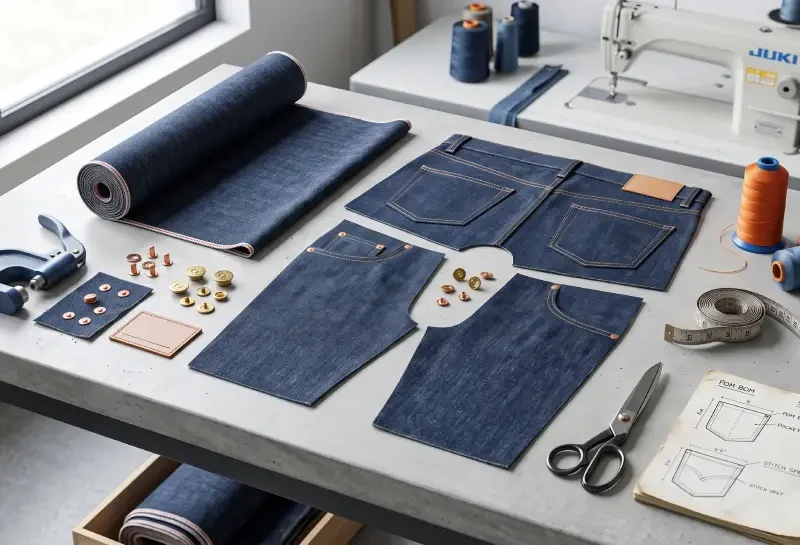
Let’s clear something up right away: a pair of jeans isn’t just fabric stitched together. That’s like saying a car is just four wheels and a steering wheel. A commercially viable jean is an engineered product—raw yardage, heavy-duty hardware, skilled labor, and those complex chemical washes that give denim its soul.
Total Per-Unit Production Cost =
Raw Denim Yardage + Cut-and-Sew Labor + Hardware/Trims + Wet Processing (Washes)
Total Landed Cost =
Per-Unit FOB + Allocated Freight + Import Duties + Final Packaging & Compliance BufferBreaking Down the BOM: Raw Denim Fabric vs. Yield Efficiency
Fabric is your biggest line item—typically 40% to 55% of your Cut, Make, and Trim base. And trust me, this is where a lot of founders get blindsided.
- Fabric Weight & Composition: If you’re working with mid-weight rigid denim (say, 10oz to 12oz), you’re looking at roughly $3.20 to $5.50 per yard. But go heavier—think 13oz to 15oz shuttle-loom selvedge or high-stretch dual-core fabrics—and that number jumps to $6.50 or even $11.00 per yard. Stretch blends? They cost more upfront because the raw materials and dye-fixation processes are pricier.
- Marker Yield & Waste: A standard pair of pants eats up about 1.4 to 1.6 meters of fabric. But here’s the kicker: professional cutting tables always factor in 5% to 8% wastage from edges and selvedge. And if you’re producing loose-fit carpenter pants or wide-leg silhouettes? You can kiss that estimate goodbye—fabric consumption can surge past 1.85 meters per unit easily.
Cut-and-Sew Labor: Structural Complexity and Seam Engineering
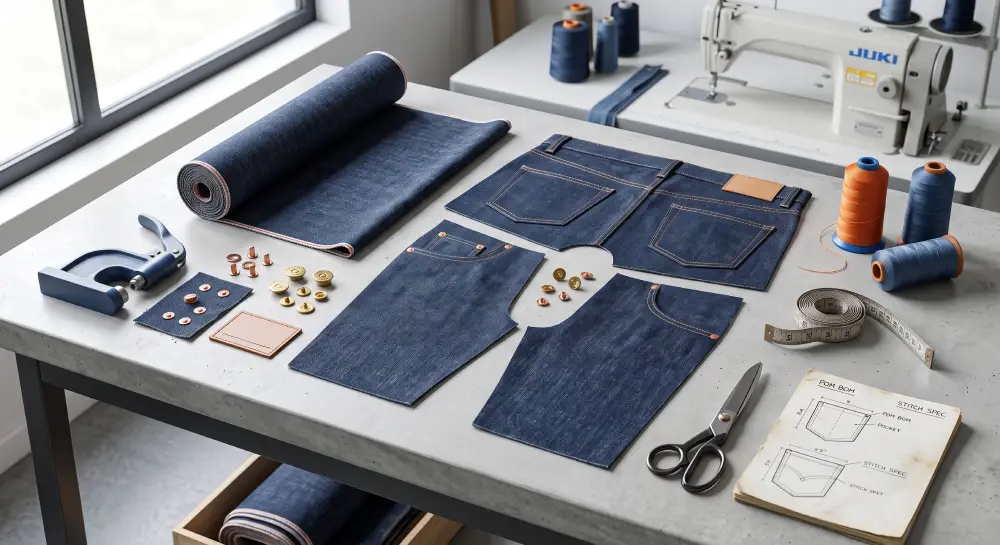
Construction fees depend on machine setups, operator touch-times, and how complex your seam engineering is.
- Basic 5-Pocket vs. Complex Silhouettes: A standard straight-leg jean usually requires 18 to 22 assembly steps. Sounds manageable, right? But if you’re doing multi-panel streetwear designs—think articulated knees, darted back-yokes, modular pockets—you’re suddenly staring at 35 to 45 steps. That essentially doubles your labor costs.
- Specialized Stitching Overhead: Heavy denim is unforgiving. You can’t just use any old sewing machine. Factories need specialized equipment for flat-felled inseams, continuous waistband chains, and heavy bar-tacking on stress points. Every time we swap out machines for a custom setup, there’s an added charge—and that adds up.
Hardware, Trims, and the Custom Branding Dilemma
I love custom hardware. It makes your brand feel real. But let me tell you, those little metal pieces come with their own set of headaches.
- Unit Cost vs. Mold Fees: A generic zinc-alloy shank button? Cheap—maybe $0.06 to $0.12. But if you want something custom-embossed with your logo, you’re looking at a $250 to $500 upfront mold fee. That’s a tough pill to swallow for a first run.
- Leather & Jacron Patches: Standard faux-leather patches cost about $0.35 to $0.60 each. But if you’re dreaming of vegetable-tanned genuine leather with custom foil stamping? That’ll run you $1.20 to $2.50 per unit. Worth it? Sometimes. But you have to decide where your brand identity really shines.
The Wet Processing Factor: Why Denim Wash Costs Fluctuate
Here’s the thing about denim fresh off the sewing table: it’s stiff. Like, cardboard stiff. Wet processing is what transforms that rigid fabric into something you’d actually want to wear. But it’s also the most volatile part of your bill of materials.
| Wash Style | Process Complexity | Chemical / Eco Footprint | Added Cost Per Unit (USD) |
|---|---|---|---|
| Rinse / Raw Desize | Light water soak, starch removal | Minimal | $0.80 – $1.50 |
| Enzyme & Silicone Wash | Drum washing, bio-polishing | Low-to-medium | $1.80 – $3.20 |
| Medium Stone Wash | Pumice stones, enzymatic wash | Moderate water/sludge | $2.50 – $4.50 |
| Acid / Bleach Wash | Chemical stripping, neutralizing | High chemical treatment | $3.50 – $5.80 |
| Potassium Spray (PP) | Manual hand-spray, localized highlight | High labor, hazardous handling | $4.00 – $7.00 |
| Laser Fading & Ozone | Digital burning, ozone gas stripping | Zero water waste, high machine amort. | $4.50 – $8.50 |
Shrinkage Drift and Prototype Loops: The Silent Budget Killer
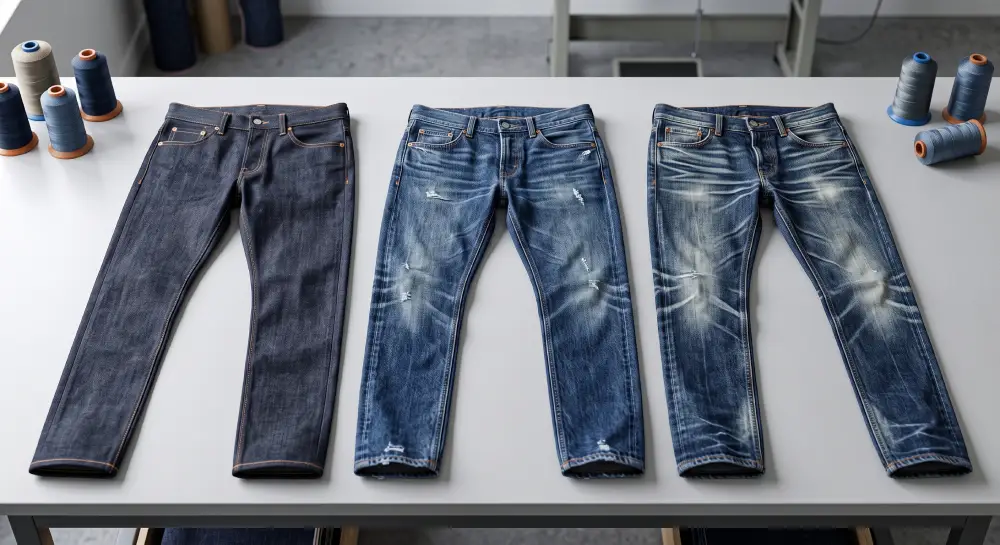
Denim shrinks. That’s just a fact of life. Depending on the weave density and wash intensity, you can expect 3% to 8% shrinkage across the warp and weft.
And here’s where I see inexperienced brands make the same mistake over and over: they change their wash style without recalibrating their CAD patterns. Suddenly, the fit is completely off. Then you’re doing two or three rounds of sampling adjustments—each one eating into your prototyping budget—and you end up with off-size inventory that you can’t sell. It’s painful, and it’s completely avoidable.
Eco-Tech & Compliance Surcharges in Modern Laundries
Environmental regulations have completely changed how laundries operate. The old-school approach of dumping toxic effluents? That’s a lawsuit waiting to happen—or at least a hefty fine.
Advanced facilities now use closed-loop systems, water-recycling loops, and certified chemicals (think OEKO-TEX or GOTS). At our facility, we’ve invested in energy-saving lighting and steam exhaust recovery systems—not just because it’s the right thing to do, but because it protects our clients from sudden supply chain shutdowns. Yes, these add $0.75 to $1.80 per unit. But it’s peace of mind, and frankly, it’s becoming table stakes.
Low-MOQ vs. Scale: Where Startup Budgets Get Trapped
Use up and down arrow keys to resize the meta box pane.
Let’s talk volume, because this is where the math gets real.
| Production Volume | Estimated Unit Cost (USD) |
|---|---|
| 100 units | ~$38 – $42 |
| 300 units | ~$26 – $29 |
| 500 units | ~$19 – $22 |
| 1,000+ units | ~$14 |
First-Run Production Reality Check (100–300 Units vs. 1,000+ Units)
Manufacturing 100 units per style is expensive. You’re paying for CAD pattern digitizing ($150 to $300), cutting marker preparations, and—here’s the kicker—industrial wash drums that are designed for 400 pieces. If you’re only washing 100 garments, you’re still paying for the whole batch.
But when you scale to 1,000 pieces or more, those fixed preparation fees drop to pennies per garment. It’s a completely different ballgame.
Hardware Overhang: Dead Stock Sunk into Trim MOQs
Here’s a story for you: I once worked with a brand that produced 150 pairs of jeans with custom buttons and rivets. Sounds reasonable, right? Except the hardware supplier required a minimum order of 2,000 sets. So they bought 2,000 shanks and 9,000 rivets. They used maybe 1,000 pieces total. The rest sat in a box, gathering dust—hundreds of dollars in custom metal that they couldn’t return or repurpose.
- Strategic Workaround: For your initial launch, stick with neutral, unbranded antique-brass or gunmetal hardware from the factory’s stock catalog. Save your custom branding for laser-engraved rear patches or high-density screen-printed pocket bags. Trust me, your wallet will thank you.
Use up and down arrow keys to resize the meta box pane.
Direct Domestic Sourcing vs. Overseas Full-Package Manufacturing
Domestic sampling offers fast turnaround—I get it, the appeal is real. But scaling domestically? That’s a quick way to crush your retail margins.
| Criteria | Domestic Cut & Sew (US / UK / EU) | Overseas Integrated Full-Package (Asia) |
|---|---|---|
| Sample Development Lead Time | 7–14 Days | Sample development within 10–20 days |
| Bulk Production Cycle | 30–60 Days | Production period of all products is 25–35 days |
| Fully Loaded Unit Cost (CMT) | $45.00 – $80.00 | $14.00 – $24.00 |
| Wash Infrastructure Access | Highly limited, basic rinses only | Full-scale ozone, laser, enzyme, PP facilities |
| Vertical Trim & Fabric Sourcing | High markups on small yardage | Factory-direct mill volume pricing |
| Total Gross Margin Potential | 40% – 52% | 65% – 78% |
An integrated overseas factory handles everything under one roof. For context, we’re located in Jiangmen, Guangdong province—southern China—with a floor area of 7,000 square meters, over 330 garment equipment units, and more than 150 workers, including dedicated manual, sample, and production line teams.
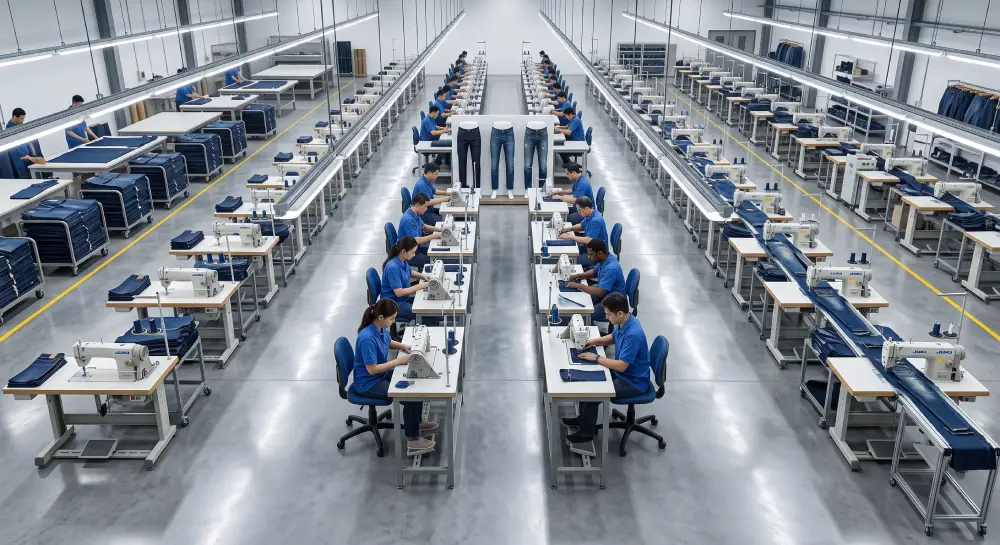
When you’re evaluating potential manufacturing partners, here are the metrics I recommend checking:
- 20+ years manufacturing experience
- 7000+ factory covers area
- 150+ production team
- 15+ people professional R&D team
- 330+ garment equipment
- 10+ production lines
From Factory Floor to Warehouse: Calculating True Landed Cost
FOB quotes are just the starting point. If you’re building a direct-to-consumer (DTC) pricing model, you need to calculate your true landed cost. Otherwise, you’re flying blind.
Direct Landed Cost Formula:
Landed Cost = (Unit FOB + Allocated Trim Costs) * (1 + Import Duty Rate)
              + (Total Freight Cost / Order Volume)
              + Per-Unit Packaging, Insurance & Drayage Surcharges
Heavyweight Denim Shipping: Air Freight vs. Ocean Logistics
Denim is heavy. A single pair of 14oz wide-leg cargo jeans tips the scales at 750 to 900 grams—that’s about 1.6 to 2.0 pounds.
- Air Courier Express: If you ship 300 units via air (roughly 250 kg volumetric weight), you’re looking at $7.50 to $11.00 per unit. That’s a huge chunk of your margin gone.
- Ocean Freight (FCL / LCL): Same batch, but shipped via ocean container? Freight drops to $1.20 to $2.10 per unit. The trade-off? It takes 25 to 35 days. But for most startups, that’s worth the wait.
Tariffs, HS Codes, and Import Duties Demystified
Import tariffs trip up a lot of new operators. Under standard US and EU tariff codes (like HS Code 6203.42 for men’s cotton trousers or 6204.62 for women’s denim):
Use up and down arrow keys to resize the meta box pane.
- Cotton-rich jeans typically face baseline import duties of 10% to 17% on the total transaction value.
- Always budget an extra 1.5% for harbor maintenance fees, customs bond broker fees, and inland drayage buffers. It’s not exciting, but it’s necessary.
Real-World Case Study: 300-Unit Capsule Financial Breakdown
Let’s make this concrete. Here’s a financial breakdown for a DTC brand running a first-edition 300-piece production run of custom 13.5oz straight-leg denim:
Use up and down arrow keys to resize the meta box pane.
| Production Line Item | Cost (USD) |
|---|---|
| 13.5oz Ring-Spun Cotton Denim (1.55 yds @ $4.20/yd) | $6.51 |
| Cut-and-Sew Labor (5-pocket construction) | $5.80 |
| Medium Stone Wash + Hand Scrape Whiskers | $3.80 |
| Branded Trims (Stock shank/rivets + custom patch) | $1.45 |
| Unit Packaging, Polybag, UPC Hangtag | $0.65 |
| Subtotal: Unit FOB Base Cost | $18.21 |
| Ocean Freight LCL Allocation ($1.80/unit) | $1.80 |
| US Customs Import Duty (16.6% on FOB) | $3.02 |
| Marine Cargo Insurance & Drayage Clearance | $0.45 |
| True Landed Cost Per Unit | $23.48 |
| DTC Retail MSRP Target (4.5x – 5.5x Multiplier) | $110 – $130 |
| Final Gross Product Margin | 78.6% – 81.9% |
Use up and down arrow keys to resize the meta box pane.
Actionable Strategies to Slash Denim Production Costs
Emerging brands can use these proven tactics to protect capital without compromising quality:
1. Leverage Stock-Supported Mill Rolls
Don’t order custom-milled yardage with 2,000-meter minimums if you don’t have to. Instead, ask your manufacturer to recommend fashionable fabrics from active, stock-supported mill lines. You skip mill setup delays, shorten raw development periods, and can buy exact roll lengths that match your cut markers. Simple, but effective.
2. Standardize Core Fit Blocks Across Finishes
Pattern development, fit validation, and sample grading cost real money—often $150 to $300 just for CAD engineering. Here’s my advice: perfect a single core block pattern (say, a relaxed tapered cut). Once it’s validated, use that same silhouette across three distinct finishes—raw rinse, vintage stone wash, and tinted black wash. You eliminate redundant sampling charges and unify factory sewing setups. It’s a no-brainer.
3. Choose Agile Full-Package Partners
Pick manufacturers who reduce friction. For example, we make sure client inquiries get a reply within 30 minutes, and engineers provide updated quotations and specific product specifications within 3 hours. That kind of responsiveness preserves momentum.
Also, look for vendors who offer free samples—and refund the sample cost when you hit the order quantity. That’s a big help for early-stage budgets.
Critical Questions to Ask Your Manufacturer Before Paying a Deposit
Use up and down arrow keys to resize the meta box pane.
Before you wire that initial 30% development deposit, get written clarification on these three production risks:
Use up and down arrow keys to resize the meta box pane.
- Subcontracted Laundries: “Is all wet-processing handled in-house, or do you transfer units to third-party sub-contractors? And if you do use subcontractors, who guarantees wash consistency between sample approval and bulk output?”
- Dimensional Measurement Tolerances: “What’s your contractual sewing tolerance margin after wet processing? Industry standard is ±0.5 inches on waist and inseam across the graded size run. Don’t accept anything looser.”
- Defect Allowances and Compensation: “What’s your AQL standard? And if defective goods show up during selling, will you replace them without charging extra shipping?”
Frequently Asked Questions (FAQ)
What’s the minimum budget to launch a custom denim collection?
For a focused single-style run of 200 to 300 units, you’re typically looking at $6,500 to $9,500 in initial manufacturing costs. This covers tech-pack digitizing, pre-production prototyping, fabric, cut-and-sew labor, wet processing, tariffs, and logistics.
Why are prototype samples so expensive compared to bulk units?
A single sample pair can cost $100 to $250. Why? Pattern engineers manually input CAD profiles, cutters hand-slice fabric, and wash technicians process single garments in massive wash wheels. That said, reputable factories often refund the sample cost once you hit the order quantity—so it’s not as painful as it seems.
How long does custom denim production take?
Sample development typically takes about 10–20 days. Once your pre-production sample is approved, an integrated factory can turn around bulk production in 25–35 days. That’s excluding ocean freight time, of course.
How do I ensure consistent quality across bulk runs?
Don’t rely on random spot checks. Work with producers who do full inspections before shipment—and insist on receiving relevant quality certificates and reports before your goods leave the factory. It’s your insurance policy.

Recent Comments