
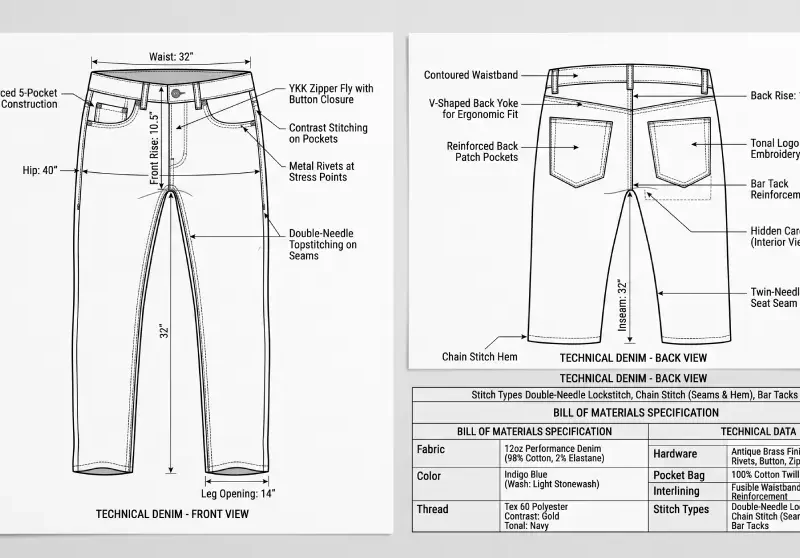
Let’s be real for a second—if you’re coming from a background in T-shirts or basic button-downs, denim is going to knock you on your ass. It behaves like a completely different animal. And I don’t say that to scare you; I say it because I’ve seen too many promising denim lines get derailed by tech packs that look pretty but fall apart under real factory conditions.
The moment your specs ignore shrinkage, wash chemistry, or seam strength, you’re basically inviting your manufacturer to play guessing games with your samples. And guess what? You’re paying for every one of those wrong guesses. According to Kaiping Lianwang Garment Co., LTD—a solid B2B denim operation with over two decades in the trenches, a 7,000+ square meter facility, and more than 330 machines churning out 600,000+ pieces annually—a proper industrial-grade tech pack isn’t just paperwork. It’s the difference between hitting your launch window and watching it slip away.
So let’s walk through this together. I’ve distilled their factory-floor knowledge into something actionable, something that’ll actually help you streamline your sampling cycle instead of getting stuck in revision purgatory.
1. Why Denim Tech Packs Require Factory-Level Precision
The Cost of Ambiguity in Denim Production
Here’s the thing about knitwear: it’s forgiving. You can fudge measurements by half a centimeter and nobody notices. Denim, though? Denim doesn’t forgive. It shrinks, it stretches, it twists, and it does all of that differently depending on which direction you’re measuring.
Warp yarns pull lengthwise; weft yarns shift crosswise. Throw in a wet wash, a hot tumble dry, and some stone abrasion, and your “perfectly graded” size 32 might come out fitting like a 30—or worse, a 34.
When your tech pack leaves these variables open to interpretation, the factory has no choice but to guess. And factory guesses are expensive. One rejected sample round can tack on three to six weeks and eat through thousands of dollars in development budget. That’s not just annoying; it’s the kind of delay that kills momentum. On the flip side, crystal-clear specs help manufacturers lock in those 15-to-25-day production windows and actually hit them.
Denim vs. Standard Apparel: The Structural Gap
Let me break this down in practical terms. Denim isn’t just woven fabric with a nice texture—it’s a whole different engineering challenge.
- Weight Metrics: Forget GSM. Denim speaks in ounces per square yard, and it’s not being cute about it. You’ve got lightweight 8 oz shirting on one end and heavyweight 16+ oz raw selvedge that feels almost like cardboard on the other. And every weight behaves differently through the wash.
- Structural Layering: Yokes, crotch intersections, pocket corners—these areas stack multiple plies of heavy fabric on top of each other. Standard needles snap like toothpicks if you’re not careful.
- High-Tension Construction: Commercial washers aren’t gentle. They tumble, agitate, and pound garments with stones and enzymes. Your thread and stitch architecture need to survive that, not just look pretty on a hanger.
2. Core Components of an Industrial-Grade Denim Tech Pack
+-------------------------------------------------------------------------+
|                  INDUSTRIAL DENIM TECH PACK ARCHITECTURE                |
+------------------------------------+------------------------------------+
| 1. TECHNICAL SKETCHES & CALLOUTS   | 2. BILL OF MATERIALS (BOM)         |
| • Front, Back, Inseam/Outseam Flat | • Ounce Weight & Twill Direction   |
| • Coin Pocket & Yoke Alignments    | • Shank Buttons & Certified Rivets |
| • Stitch Path & Tension Notations  | • Thread Ticket Size (Tex 80/105)  |
+------------------------------------+------------------------------------+
| 3. TWO-TIER MEASUREMENT SPEC SHEET | 4. QUANTIFIABLE WASH RECIPES       |
| • Target Finished Dimensions       | • Enzyme, Stonewash & Ozone Data   |
| • Warp & Weft Shrinkage Allowances | • Distressing Maps & Laser Vector  |
| • Panel Tolerances (Rise vs Inseam)| • Pocket Bag Integrity Safeguards  |
+------------------------------------+------------------------------------+
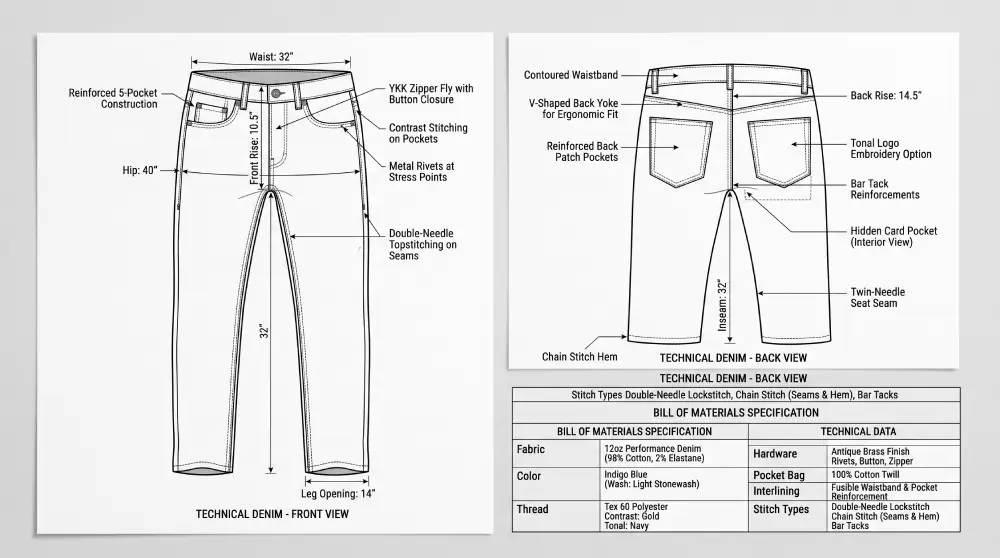
Technical Flat Sketches & Critical Denim Callouts
Your sketches need to tell the whole story—front, back, side, and even flipped inside-out views. Factory patternmakers shouldn’t have to guess what’s happening behind a seam.
Pay special attention to the yoke. Is it a straight V-shape? A deep saddle? A curved arch? That choice changes how the seat drapes and where the pockets land. And speaking of pockets, don’t just drop them onto the sketch arbitrarily. Define the coin pocket’s exact distance from the scoop pocket opening. Specify back pocket spacing—industry standard is about 2.5 to 3 inches apart at the yoke join. And for God’s sake, provide vector art for your arcuate stitching. Describing it in words is a recipe for miscommunication.
Topstitching callouts deserve special mention. If you want single-needle here, double-needle there, and triple-needle somewhere else, map it out explicitly. Otherwise, your factory will default to whatever’s easiest, and that’s rarely what you actually wanted.
The Denim Bill of Materials (BOM) & Hardware Specs
This is where the rubber meets the road. Your BOM needs to be obsessively detailed.
- Fabric Construction: Don’t just say “12.5 oz denim.” Specify the weave direction—3/1 Right-Hand Twill, Left-Hand Twill, or Broken Twill. Call out the selvedge ID color. And if there’s elastane in the blend, nail down the tolerance. For example, “99% Cotton / 1% Elastane with 18%–22% stretch capacity” gives your mill something concrete to work with.
- Heavy-Duty Hardware: Button fly or zip fly? Either way, hardware needs serious specs. Shank buttons should be cast-iron or brass, and rivets need to pass pull tests with a minimum 30 kg retention. Don’t forget surface finishes: Antique Brass, Matte Nickel, Black Oxide—be specific.
- Thread & Reinforcement: Core-spun poly-wrapped polyester is your friend. Heavy Tex 105 or Tex 120 for prominent topstitching, Tex 60 or Tex 80 for structural joining seams. And aim for 7 to 9 Stitches Per Inch (SPI). It’s a sweet spot that balances strength and aesthetics.
3. The Shrinkage Dilemma: Before-Wash vs. After-Wash Specs
Why Standard Size Charts Fail
Here’s a hard truth: if your tech pack has only one measurement chart, you’re already behind. Denim doesn’t come out of the wash looking the same as it went in. It’s not like cotton jersey, which might shrink a predictable 5% across the board and call it a day.
Denim shrinks anisotropically—meaning it’s directional. Warp (length) can lose 5% to 12%; weft (width) might lose only 2% to 5%. And it gets trickier: left-hand twill behaves differently under agitation than right-hand twill. So if you’re using a one-size-fits-all shrinkage factor, you’re gambling with your fit.
RAW FABRIC PATTERN CUT
  │ (Compensates for +5% to +12% Warp Length Loss)
  │ (Compensates for +2% to +5% Weft Width Loss)
  ▼
GARMENT ASSEMBLY
  ▼
WET WASH & LAUNDRY CYCLE (Enzyme, Stones, Heat)
  ▼
TARGET FINISHED DIMENSIONS (Graded Brand Size Chart)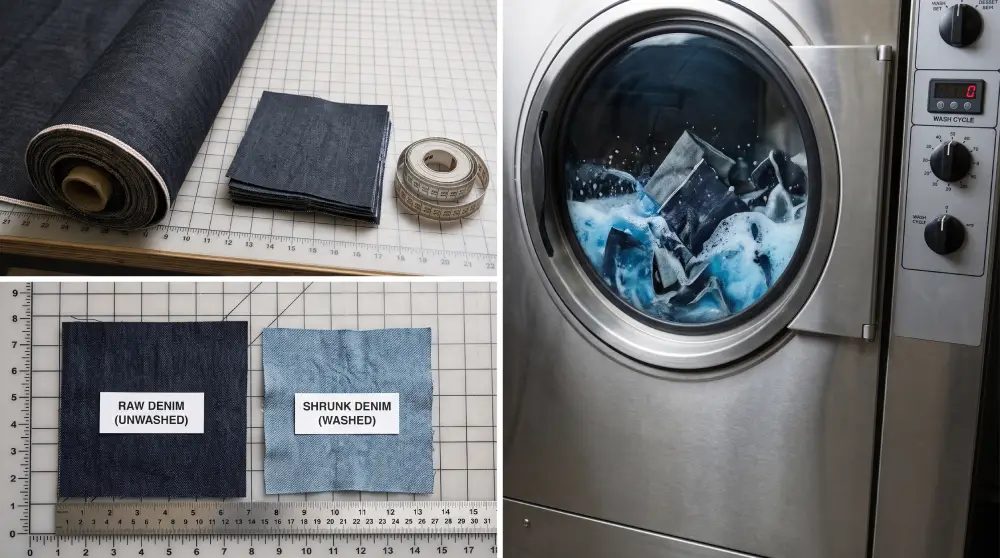
How to Build a Two-Tier Measurement Spec Sheet
The solution is elegant but requires discipline. Your tech pack needs two operational layers:
- Target Finished Dimensions (After Wash): This is your brand’s customer-facing fit chart—the measurements that matter when someone tries on the jeans in a store or at home.
- Raw Fabric Shrinkage Parameters: Instead of forcing your patternmakers to reverse-engineer raw cuts, give them certified warp/weft shrinkage test swatches. For example: “Warp: -8.5%, Weft: -3.0%.” Facilities with strong R&D sample departments—like the one at Lianwang Garment with its 15+ person sample team—scale raw patterns using these exact figures. The result? Post-wash dimensions that actually match your target.
- Engineering Practical Tolerances: Let’s be realistic. Curved yokes, back rises, and thick felled inseams shift under steam tunnels. While standard wovens can get away with ±0.5 cm tolerances, denim needs breathing room: ±1.0 cm on curved waistbands, ±1.5 cm on total inseam length.
4. Translating Denim Washes & Distressing into Technical Data
Moving Beyond Mood Boards
I’ll be blunt: sending your factory a Pinterest collage and saying “make it look like this” is amateur hour. Wash chemistry is science, not vibes. Industrial laundries need measurable formulas to deliver consistent results batch after batch.
Here’s a cheat sheet for turning aesthetics into technical specs:
| Wash Category | Target Aesthetic | Technical Parameters |
|---|---|---|
| Rinse / Raw | Clean, deep indigo, soft hand | 30-minute mild surfactant rinse, anti-redeposition agent, 40°C dry |
| Enzyme Stonewash | Authentic vintage fading, abraded seams | Neutral cellulase enzymes + pumice tumbling, liquor ratio 1:8, pH 6.0 |
| Ozone / Eco-Bleach | High-contrast ice-blue highlights | Gaseous ozone chamber exposure, atmospheric saturation 45 ppm, zero-water oxidation |
| Vintage Tinting | 1970s yellow cast or earthy tone | Direct or reactive dyestuff tint, exhaust cycle, fixative resin curing at 150°C |
Engineering Distress & Wear Marks
“Make it look distressed” is the kind of instruction that keeps factory reps up at night. If you want consistent results, place your wear marks with anatomical precision right on the technical flats.
- Whisker Mapping: Anchor front hip whiskers relative to the fly base and crotch cross-seam. Specify the distance from the center front rise—for instance, “5 radiating crease bands spaced 1.5 inches apart.” That’s something a laser operator can actually execute.
- Honeycomb Articulation: Position honeycomb fading behind the knee crease, centered across the horizontal knee reference line. Extend it 4 inches up and 4 inches down. No ambiguity.
- Laser Vector Guidelines: Provide 1:1 scale greyscale vector maps for industrial laser burning. Call out intensity percentages—say, 60% for mid-tone whisker fading and 95% for core pocket abrasions. Going too hot can destroy fibers, so err on the side of conservative settings and let your sample run confirm the final numbers.
- Pocket-Bag Safeguards: If you want pocket bags to stay pristine white, say so explicitly. Specify garment-wash techniques that either bag-turn or protect internal canvas from stone and dye contamination. It’s a small detail that makes a big difference in perceived quality.
5. Construction Details: Stitch Types and Seam Architecture
          FLAT-FELLED INSEAM                         SPLIT OUTSEAM WITH SELVEDGE
          (Double-Needle Chain)                      (Open Press / Bound)
               ╭─────────╮                                 ╭─────────╮
         ══════╪═════════╪══════                     ══════╪         ╪══════
               │         │                                 │         │
               ╰─────────╯                           [ID Tape]     [ID Tape]
Selecting the Right Seam for Every Panel
Your seam choices aren’t just about aesthetics—they determine how long the jeans survive actual wear.
- Inseams: Double-needle flat-felled seams (ISO 4915 Seam Type LSc-2) with structural chainstitching on the reverse side. This gives you maximum tensile strength and handles the stress of leg movement without blowing out.
- Outseams: For non-selvedge designs, go with a 5-thread safety overlock, pressed open or split-topstitched. For premium selvedge runs, an open-busted straight stitch preserves the self-finished ID edge all the way down. Don’t mess this up; selvedge enthusiasts notice.
- Hem Execution: If you’re chasing that classic jeans look, specify a Union Special-style chainstitched hem (ISO 401). When wet-processed, the directional differential feed creates authentic diagonal roping and twisting along the hem edge. It’s one of those details that separates mass-market jeans from something special.
Five Critical QC Checkpoints for Pre-Production Samples
Before you sign off on bulk production, run these five stress tests on your sample. I’ve seen too many brands skip these and regret it later.
- Crotch Cross-Seam Junction: Check the four-panel intersection thickness. Make sure tension-release bar-tacks withstand a minimum 40-pound lateral pull. If they pop, your customers will find out the embarrassing way.
- Waistband Chainstitch Recovery: Stretch the waistband over a hip frame and verify the chainstitch recovers fully without snapping. A blown waistband thread is a manufacturing defect that’s hard to miss—and even harder to fix.
- Rivet Retention & Washer Clearance: Look underneath. Test that copper rivet posts don’t pierce through internal pocket linings. Smooth internal burrs prevent skin irritation. Your customers will thank you.
- Pocket Bag Tensile Integrity: Pocket bags need to survive commercial pumice enzyme tumbling. Minimum 65/35 TC canvas at 130+ GSM. If they hole out in the wash, you’re looking at a redo.
- Post-Wash Leg Twisting: After final laundering, check the side outseams. Twill torque should not twist the outseam more than 1.5 cm forward onto the shoe arch. A little twist is character; too much is a fit failure.
6. Common Tech Pack Mistakes That Delay Denim Production
Let me share a few facepalm-worthy mistakes I’ve seen brands make repeatedly.
Ignoring Zipper Tape Shrinkage: Standard polyester zipper tapes don’t shrink. Install one into a high-shrinkage 100% cotton raw denim garment, and post-wash fabric retraction will buckle the front fly into an unsightly “wave.” It looks cheap and unfixable. Specify pre-shrunk, wash-rated zipper tapes. It’s a small line item that prevents a huge headache.
Using Subjective Color Descriptions: I can’t count how many times I’ve heard “vintage light blue” and watched three factories deliver three completely different shades. Always supply a calibrated color system—a Pantone TPX/TCX chip, or better yet, physical shade bands showing acceptable high, target, and low tolerances. Your wash house needs a visual reference, not poetry.
Leaving Branding Applications Unspecified: Leather back patches tear if attached with tight lockstitches instead of heavy perimeter chainstitching. It’s a tiny detail, but it screams quality—or lack thereof. Spell it out.
      TECH PACK ERRORS                PRODUCTION CONSEQUENCES
┌───────────────────────────┐      ┌───────────────────────────┐
│ Generic Wash Photos       │ ───> │ Inconsistent Lot Shades   │
│ Ignored Shrink Ratios     │ ───> │ Warped Leg Inseams        │
│ Vague Hardware Pull Specs │ ───> │ Failed Pull Tests         │
│ Untested Pocket Linings   │ ───> │ Shredded Bags in Wash Tub │
└───────────────────────────┘      └───────────────────────────┘
Technical Denim FAQ
How do you determine wash shrinkage without sending physical fabric?
Honestly, you can’t just eyeball it. But you can ask your mill for the fabric’s dimensional stability test report. That document tells you warp and weft shrinkage percentages straight from lab testing. Factory technicians plug those numbers into CAD patterns, and suddenly your shrinkage guesswork disappears.
What topstitching thread size works best for heavy jeans?
Most streetwear brands settle on Tex 80 or Tex 105 core-spun polyester for the balance of strength and aesthetics. Run 7 to 8 stitches per inch (SPI) along structural outseams, but switch to Tex 40 for interior pocket bags where you want cleaner, less bulky stitching.
Can modern laser files fully replace manual scraping techniques?
Yes and no. Industrial laser machines recreate whisker patterns with impressive consistency. But operators still combine laser treatments with mild ozone washes to feather out harsh pixel transitions. The best results come from a hybrid approach—laser for precision, wash for softness.
Why do raw jeans twist around the shin after machine washing?
That’s natural torsion at work. Standard 3/1 right-hand twill pulls in the direction of the weave. Skilled patternmakers correct this by counter-rotating the lower leg pattern before cutting. It’s a subtle adjustment that keeps your seams straight after the wash.

Recent Comments