
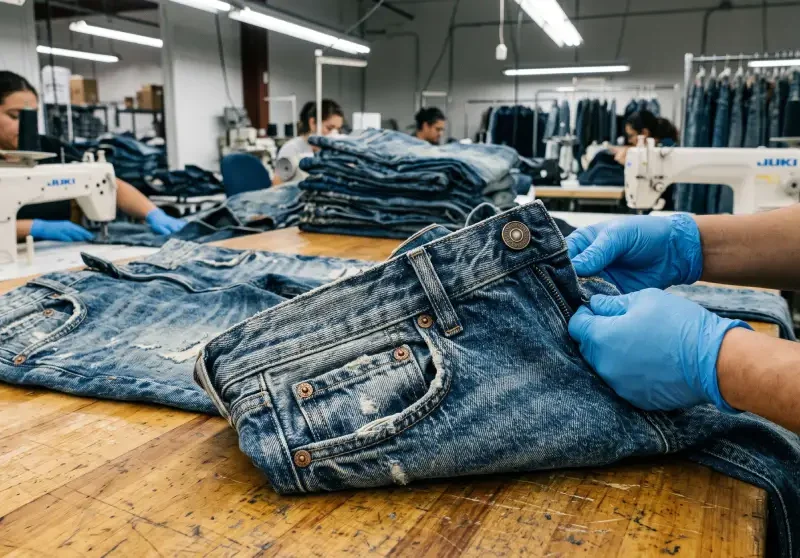
Launching a standout streetwear collection requires more than aesthetic mockups. In the DTC fashion market, custom baggy and Y2K denim demand precise engineering. When oversized fits lack structural rigor, pants end up looking sloppy, dragging on the ground, or falling apart in the wash.
Turning a 2D design into something a factory can actually produce—and that customers won’t return—means getting comfortable with the messy intersection of tech design and garment physics. We’ve spent over 20 years in high-quality denim manufacturing, running a 7,000+ square meter facility with 330+ pieces of garment equipment. Along the way, we’ve helped independent brands around the world untangle these exact problems.
Here’s an engineering blueprint for building custom oversized denim that nails vintage drape, fit, and production durability.
1. Anatomy of a High-End Baggy & Y2K Denim Tech Pack
A generic tech pack will tank your vintage Y2K production. The cut depends on dramatic proportions, so your factory tech pack has to spell out every critical millimeter. Skip this, and you’re gambling with your fit.
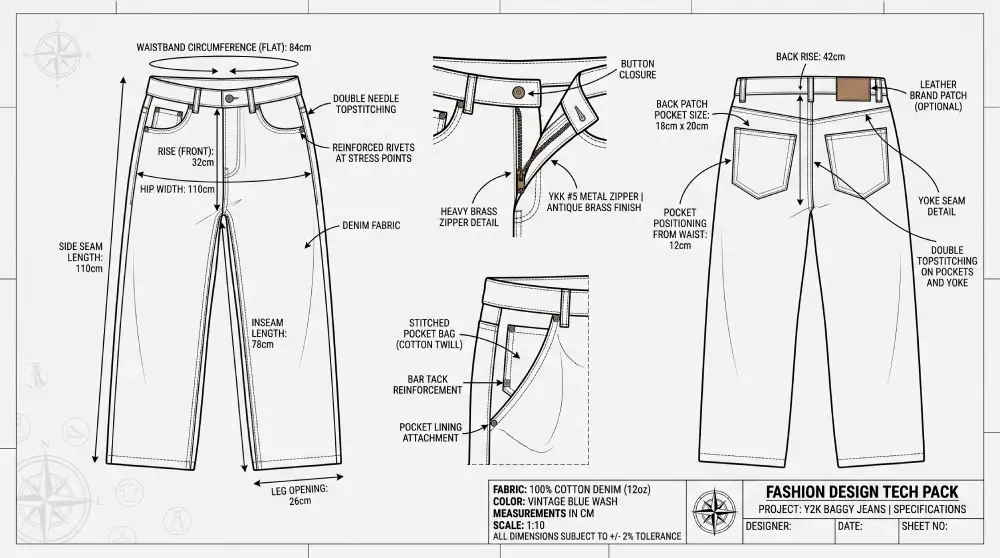
1.1 Flat Sketches & Critical Y2K Silhouette Specs
Your technical flats need clear callouts for authentic Y2K styling:
- Oversized Dropped Pockets: Drop back pockets 3–5 cm lower than standard. Scale them up too (around 18 cm x 20 cm), otherwise they’ll look tiny against those wide back panels.
- Reinforced Belt Loops: Spec belt loop widths between 5 cm and 6.5 cm—heavy skater belts will destroy anything flimsier.
- Heavy-Duty Fly: Call out a #5 brass zipper fly with an extended fly shield. Standard lightweight closures won’t survive.
- Proportion Matrix: Set a high front-to-back rise differential (Front Rise: 26–28 cm, Back Rise: 38–41 cm). This locks the seat in place while keeping that low-waisted front. Then balance a relaxed 68–74 cm low-hip with a wide 48–52 cm knee and a 26–28 cm leg opening.
1.2 Fabric Weight & Rigid Twill Selection (13oz–15oz)
Don’t use stretch denim for wide skater cuts. Stretch blends lack tensile resistance and collapse at the knees—it’s that simple. Instead, specify 100% cotton rigid denim weighing between 13oz and 15oz (360–425 GSM), 3/1 right-hand twill.
Rigid heavy cotton delivers the straight vertical drop and sculptural volume streetwear buyers expect. And it survives intense enzyme and stone washes without falling apart.
1.3 BOM Sheet for Heavyweight Streetwear Trims
Your Bill of Materials (BOM) has to handle daily heavy street wear.
- Main Closure: 20 mm zinc alloy tack buttons with a reinforced anti-pull hollow/solid core base.
- Pocket Anchors: 9 mm solid copper through-rivets.
- Stitching Infrastructure: High-tensile poly-core cotton-wrap threads. Use ticket 20/3 or 30/3 heavy-gauge thread for topstitching across outseams, yoke, and pocket edges. For interior chain-stitched seams, go with 40/2 spun polyester.
2. From Tech Pack to Zero Pattern: Shrinkage & Grading Physics
Here’s a pitfall that trips up a lot of brands: submitting post-wash target specs without accounting for cutting-table shrinkage. The numbers look fine on paper. Then bulk arrives and nothing fits.
2.1 The After-Wash vs. Cut-and-Sew Spec Gap
Denim shrinks non-linearly. To stay dimensionally accurate, our 15+ member R&D team runs a Shrinkage Test Matrix on every fabric lot before cutting.
Pattern Dimension = Post-Wash Target Spec / (1 - Fabric Shrinkage Rate %)Say your finished target for inseam length is 80 cm, and heavy wash testing confirms 8% warp shrinkage. Your cut-and-sew pattern needs to measure 86.95 cm. Skip this step, and your bulk shipment shows up a full size too short.
2.2 Constructing the “Zero Pattern” for Heavy Washes
Heavy street aesthetics often demand intensive wet processing—acid washing, vintage dirty tinting, enzyme pumice stone washing. Each one eats fabric differently.
| Dimension | Target Spec | Shrinkage Rate | Zero Pattern (Cut Spec) | Grading Tolerance Allowance |
|---|---|---|---|---|
| Waistline | 82.0 cm | 3.5% | 85.0 cm | $\pm$ 0.5 cm |
| Low Hip | 112.0 cm | 4.0% | 116.7 cm | $\pm$ 0.5 cm |
| Inseam | 78.0 cm | 7.5% | 84.3 cm | $\pm$ 0.5 cm |
| Leg Opening | 54.0 cm | 3.0% | 55.7 cm | $\pm$ 0.5 cm |
When shrinkage exceeds 6%, the garment’s balance shifts. Paper patterns then have to grade waistbands, crotch curves, and knee points along warp and weft vectors independently—not via uniform scaling.
3. Solving Y2K Pattern Geometry: The “Stack” vs. “Drag” Balance
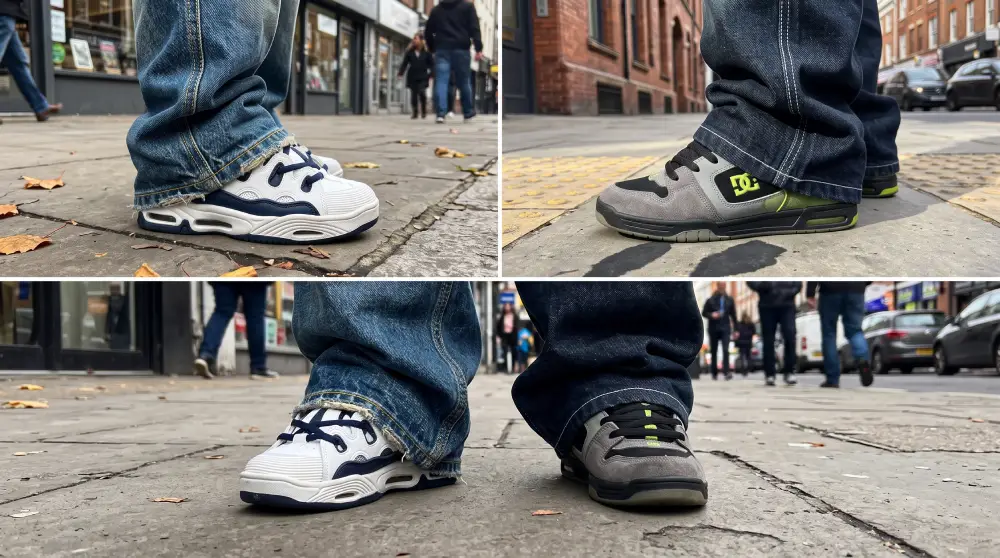
True Y2K baggy pants must stack naturally over chunky sneakers without sagging off the hips or shredding at the back heel. Sounds easy. It isn’t.
3.1 The Curved Low-Rise Waistband: Eliminating Gapping & Dropping
Straight waistbands sit poorly on low-slung streetwear pants. When the wearer sits down, a straight waistband gaps at the rear spine—every time.
The fix? Draft a contoured, 2-piece split curved waistband. Pair it with an aggressive 18-to-22 degree back yoke tilt. This contour hugs the iliac crest and pelvis securely, so the jeans stay parked on the hips during movement without needing a death-grip belt.
3.2 Engineered Leg Twist & Inseam Incline for Clean Stacking
Straight-cut wide legs often collapse inward or drag along wet sidewalks. To create the ideal streetwear drape, apply mechanical adjustments:
- Forward J-Cut Inseam: Rotate the outseam forward toward the front toe by 1.5–2 cm from the knee down. This forward sweep counteracts fabric twisting caused by right-hand twill wash tension.
- Asymmetrical Horseshoe Hem: Cut the front hem 1.5 cm shorter than the back hem, or sculpt an arch at the instep. This geometry lets the wide leg opening rest flat over sneaker tongues while keeping the back hem off wet pavement.
4. Wash Treatments, Distressing & Hardware Sequence
Executing complex washes requires sequencing each step carefully—otherwise you get broken trims and seam abrasions.
4.1 Wet Processing vs. Hardware Timing
Never install branded hardware before heavy abrasive washes.
Cut & Sew Assembly -> Wash Cycle (Stone/Enzyme/Bleach) -> Tint/Ozone Neutralization -> Hardware Application -> Final QCAttach shank buttons, metal zip pulls, or branded rivets before industrial stone churning, and the tumbling pumice rocks will chip electroplated finishes. Heavy zipper heads can also rub against wet pocket flies, leaving unsightly white abrasions.
Instead, our production line sews temporary cotton basting loops to seal the fly during processing. Once drying wraps up, our manual department punches the heavy hardware in pristine condition.
4.2 Precision Destruction: Hand Scrapes, Whiskers & Laser Mapping
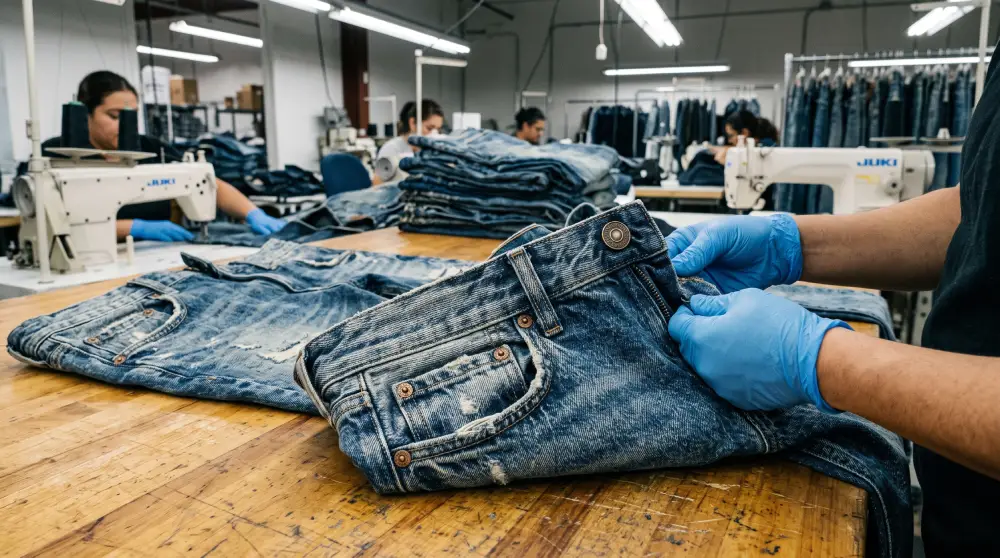
Indicate distressing placements clearly on flat mockups. Distressing must sit at least 2.5 cm away from the outseam, inseam, and crotch intersection. If grinding overlaps seam construction, high-friction washes can shred structural seam allowances.
[Safe Whisker Zone] ---> (Min. 2.5cm Clear Margin) <--- [Chainstitch Outseam]To prevent distressed knee slits from expanding uncontrollably, your tech pack should call for discrete, reinforced bartacks at both slit edges.
5. Sampling, Fit Evaluation & Scaling Production
Turning a successful tech pack into bulk production requires strict physical inspection routines and responsive partner communication.
5.1 First Prototype Inspection: Measuring Against Tolerance Rules
Rigid 100% cotton behaves differently than synthetic weaves. Even so, modern manufacturing tolerances must remain tight:
- Critical Tolerance Limits: We control waist, hip, and outseam tolerances strictly within $\pm$0.5 cm.
- Torque Testing: Lay the sample flat on a calibration table. Measure any bottom hem torque; the side seam should show less than a 1.5% skew relative to the fold axis.
- Hardware Pull Test: Zinc tack buttons must hold across a 90 N (Newtons) tension test without pulling through the fabric bed.
5.2 Streamlining Low-MOQ Sampling to Bulk Manufacturing
Launching fresh streetwear fits requires moving quickly from initial sketches to sample reviews.
- Rapid Sample Cycles: Using our dedicated R&D workflow, tech pack iterations translate into real prototype samples in hand within 10–20 days.
- Responsive Communication: Independent brands can’t afford long development delays. We answer technical inquiries within 30 minutes and provide comprehensive BOM spec quotations within 3 hours.
- Agile Bulk Scaling: Once prototype fit approval is finalized, our 10+ streamlined production lines deliver commercial bulk orders within 25–35 days.
Every bulk piece is backed by 100% full inspection standards, ensuring direct showroom-to-customer retail quality.
Frequently Asked Questions (FAQ)
Q: Why do my custom baggy jeans fit fine when raw, but hang too tight around the seat after vintage wash processing?
A: Heavy vintage washing (like pumice stone or enzyme washes) causes substantial warp and weft shrinkage in 100% cotton rigid denim. If your factory pattern didn’t add extra shrinkage volume to the hip curve and seat depth, the garment will lose 4% to 8% of its room in the wash. Always compute zero-pattern scaling using verified fabric wash swatches before bulk cutting.
Q: How do we prevent oversized wide-leg jeans from dragging and fraying at the rear heel?
A: Incorporate an asymmetrical leg opening or a forward-inclined inseam (J-cut geometry). Shortening the instep cut slightly while curving the side profile allows the front drape to break over sneakers naturally without the back hem falling under the heel.
Q: What is the ideal denim weight for Y2K styles that hold an authentic silhouette?
A: Choose 13oz to 15oz 100% cotton rigid twill. Lighter weights under 12oz tend to collapse, losing the signature architectural drape and vintage shape. Heavyweight denims (14oz+) retain wide leg openings and hold deep wash finishes, laser whiskering, and abrasion work securely.

Recent Comments