
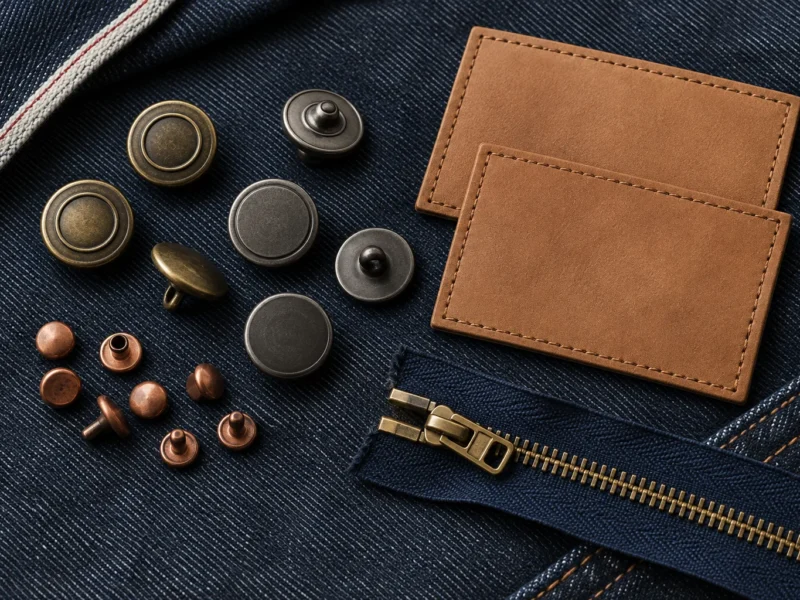
Custom denim trims give your jeans a recognizable identity through branded buttons, rivets, leather patches and zipper pulls. This guide explains how to specify materials, finishes, attachment methods and YKK zipper options, then approve samples before bulk production. If you are developing a complete collection, start with our private label jeans manufacturing services to coordinate trims with fabric, fit and finishing.
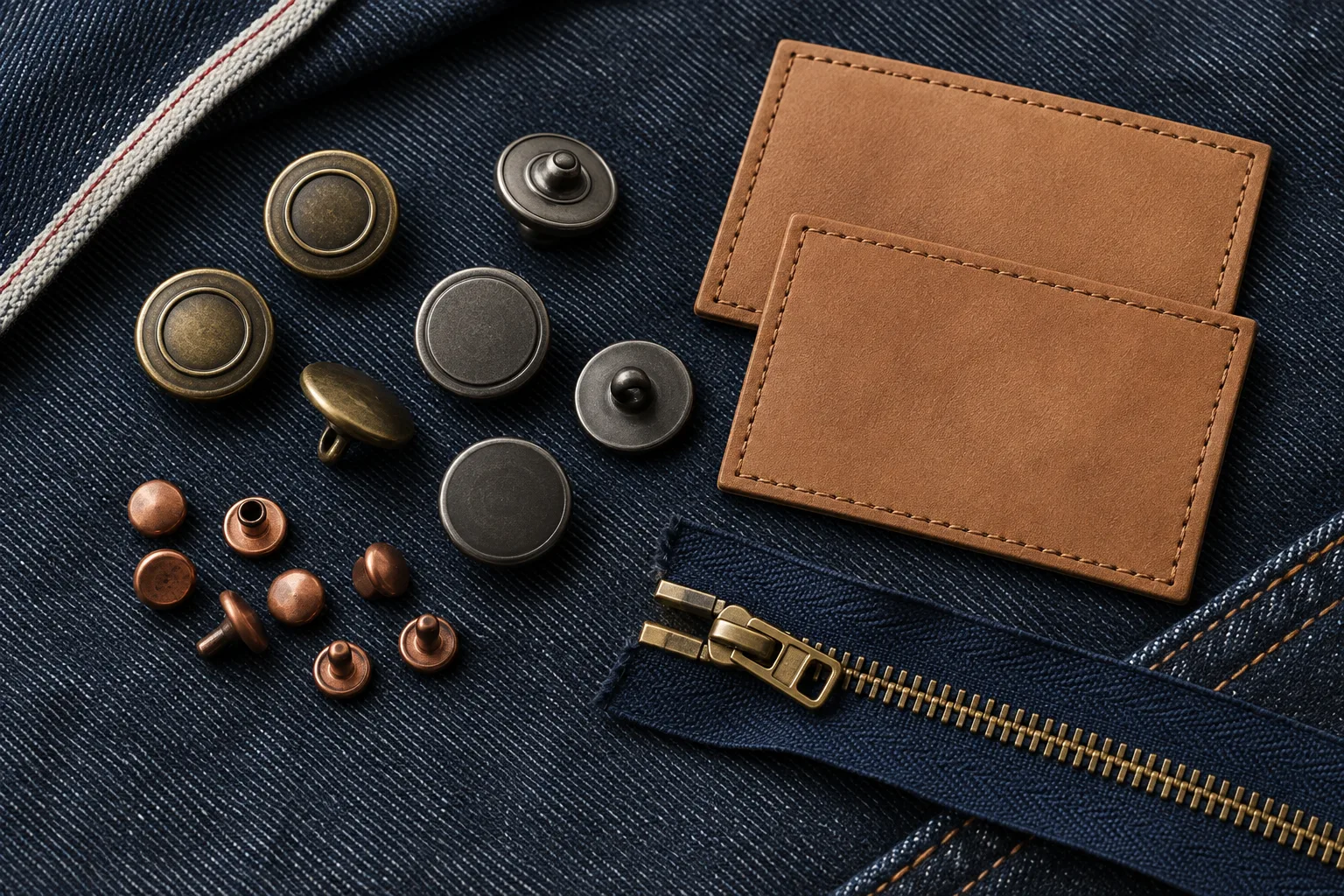
Custom Denim Trims: How Hardware Defines Brand Value
Key Touchpoints: Buttons, Rivets, Leather Patches, and Zipper Pulls
Think about how you actually handle a pair of jeans in a store. First, your thumb finds the waistband button. Then your fingers move to the zipper pull, the pocket rivets, maybe the patch on the back. It’s almost instinctive. And if any of those pieces feel cheap—light, hollow, rattly—you notice. The whole garment suddenly feels less impressive. That’s why custom-branded metal hardware matters so much. It’s the difference between a generic stock item and something that actually carries a label’s identity.
Perceived Quality: How Hardware Weight and Finish Justify a Premium Price Tag
Hardware weight and finish influence how a garment feels, but weight alone does not prove durability. Compare the construction, surface finish and attachment performance of actual samples. Antique brass, matte gunmetal and copper tones can support different brand aesthetics; approve the final appearance after the intended garment wash.
Customizing Shank Buttons & Rivets: Beyond Visual Aesthetics
Attachment check: Match the button or rivet cap, tack, fabric stack and setting die as one system. Confirm secure installation on a production sample.
Base Metals & Plating: Zinc Alloy, Brass and Finish Selection
What you make the hardware from determines how long it lasts and how good it looks:
- Die-Cast Zinc Alloy (ZAMAK): Great for intricate 3D logos, sharp debossing, complex shapes. It’s versatile.
- Stamped Solid Brass: A familiar option for heritage denim. Confirm the alloy, construction and finish against your durability requirements.
- Barrel & Rack Plating: Ask suppliers to specify the plating process, protective coating and supporting environmental documentation. Do not assume a decorative finish is suitable for every wash.
Fabric Weight & Prong Sizing: Preventing Hardware Pull-Out on Heavyweight Denim (12oz–16oz+)
Choose tack length from the compressed thickness of the complete waistband or pocket assembly, not fabric weight alone. Ask the trim supplier to match the cap, tack and setting dies, then test attachments on the actual fabric stack before bulk production.
| Assembly | What to specify | How to approve |
|---|---|---|
| Waistband button | Finished layer thickness, button diameter, compatible tack and die | Attachment trial and pull test before and after washing |
| Pocket rivet | Pocket construction, cap size, backing and skin-contact position | Check retention, sharp edges and fabric damage |
| Heavyweight or multilayer seam | Compressed stack thickness and supplier-recommended tack length | Approve a mounted sample using production equipment |
When the stem is too short, the internal expansion anchor can’t flare properly. It never locks in. And that means one thing: the button pops off during normal wear. Not a good look for any brand.
The Wash-House Torture Test: Preventing Tarnishing, Rust, and Stone-Wash Scratches
Stone washing, bleaching and enzyme treatments can change hardware color and damage unsuitable finishes. Approve buttons and rivets on a garment sample using the actual wash recipe, then check corrosion, staining, coating loss and attachment security. Review our denim wash options before finalizing the trim finish.
Wash approval: Compare the original trim sample with the washed garment and document acceptable changes in color and finish.
Sourcing Authentic YKK Zippers for Denim Production
Standard #4.5 vs. Heavy-Duty #5: Selecting the Right Gauge for Jean Flies and Jackets
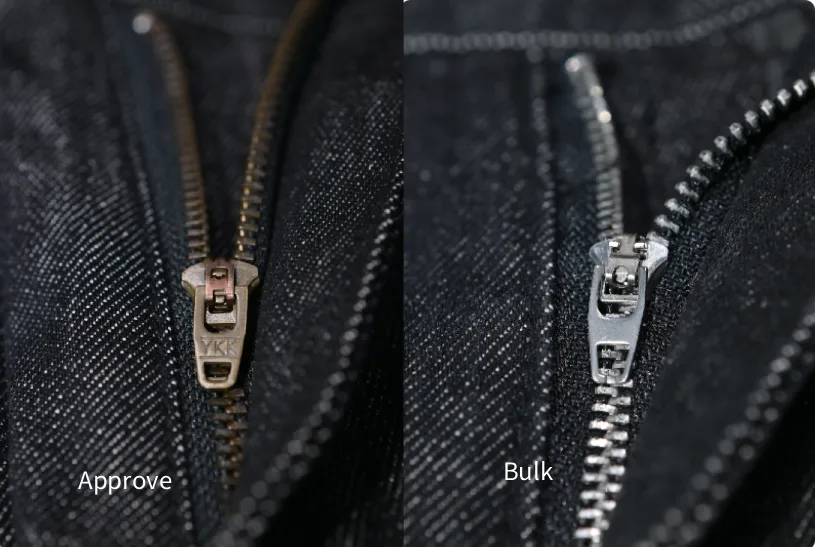
Specify the zipper model, chain size, length, tape color, metal finish and slider locking function together. A #4.5 or #5 option may be considered for a jeans fly, but final selection depends on the supplier’s product range and garment construction. Jackets may require a different opening configuration. Test the complete zipper in the intended garment and wash process.
Puller Customization Options vs. Production Lead Time Realities
Custom zipper pullers can require separate tooling, sample approval and minimum orders. Confirm which customization options are available for the selected YKK zipper and obtain a written schedule before committing to a launch date. Stock pullers may simplify development when timing or order volume is limited.
Anti-Counterfeit Verification: Avoiding “Grey Market” Zippers in Overseas Sourcing
Request the zipper supplier’s identity, exact product reference, purchase documentation and traceable order details. A logo on the puller alone does not establish authenticity. Match incoming bulk goods against the approved sample and retain sourcing records as part of your denim supply chain management.
Designing Custom Denim Back Patches: Materials & Performance
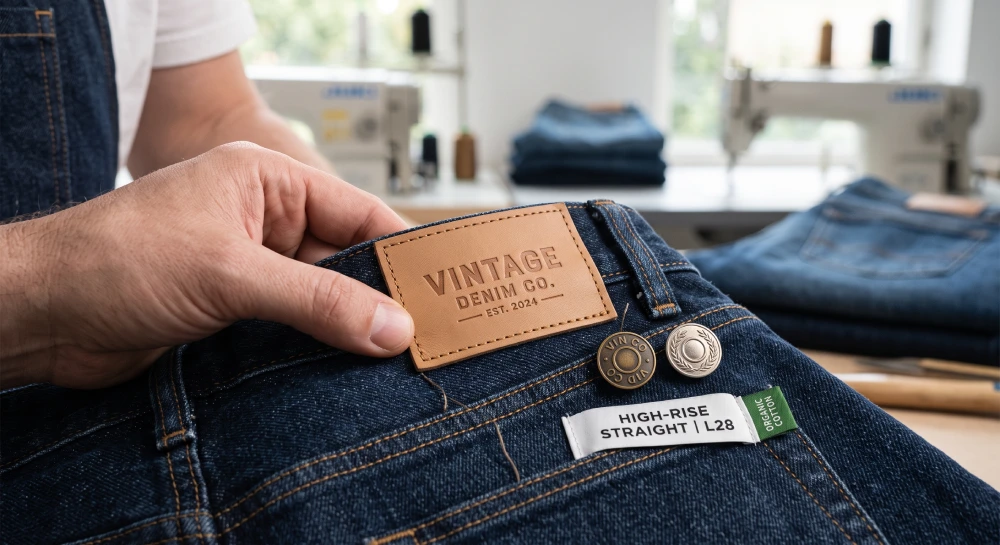
Genuine Leather vs. Jacron Paper vs. Vegan PU: Texture, Cost, and Aging
That back-right waistband patch is an external visual anchor. It’s one of the first things people notice. Here’s how the options stack up:
- Top-Grain Vegetable-Tanned Cowhide: Develops a rich, natural patina over time. The industry benchmark for heritage denim.
- Jacron Cellulose Paper: A paper-based patch option. Verify the specific grade, any certification claim and performance after the planned wash; do not assume every paper patch has the same properties.
- Vegan Polyurethane (PU): Clean uniform grain, sharp heat debossing, accessible entry price point.
Preshrinking and Colorfastness: Avoiding Leather Shrinkage and Dye Transfer in Industrial Laundry
Leather patches can shrink, stiffen or transfer color during garment washing and drying. Test the selected leather, finish and embossing on a mounted sample. Discuss suitable pretreatment or post-wash attachment with the supplier rather than applying one treatment to every material.
Attachment Methods: Single vs. Twin-Needle Stitching and Reinforcement Backings
Choose the stitch layout, needle, thread and any backing to suit patch thickness and waistband construction. Check for skipped stitches, puckering and tearing around needle holes. Approve the mounted patch after washing and flexing, including the areas exposed to belt friction.
Tech Pack Specifications & Quality Assurance for Trim Suppliers
Trim specification checklist: Include artwork, material, dimensions, finish, attachment method, wash requirements, test criteria, packaging and the approved sample reference.
Critical Tolerances: Technical CAD Drawings for Embossed & Debossed Molds
Provide clear vector artwork and dimensioned drawings for embossed or debossed logos. Specify logo size, relief depth, finish references and acceptable dimensional tolerances with the tooling supplier. Record these details in your denim tech pack so the garment factory and trim supplier work from the same approved specification.
Pull-Strength Testing: Agree on Methods and Acceptance Criteria
Test buttons and rivets as installed on the finished garment. Agree the test method, force, duration, sampling plan and pass criteria with the buyer and qualified laboratory. Requirements depend on the product and intended wearer; a single pull-force value is not a universal apparel standard.
- Record the applied force, test duration, fixture and condition of each tested assembly.
- Inspect for detachment, shank damage, fabric tearing and sharp edges, then assess results against the agreed criteria.
Chemical Testing: Define Requirements for the Destination Market
Separate material-content limits from surface-coating limits when preparing the test plan. For US children’s products, CPSC distinguishes the 100 ppm total-lead limit for accessible component parts from the 90 ppm limit for paint and similar surface coatings; see the CPSC lead requirements. For other markets and product types, ask a qualified laboratory to confirm applicable restrictions and tests for the exact trim materials and intended use.
Procurement Strategy: Managing MOQs, Tooling Costs, and Timelines
Approval sequence: Specification and quotation → artwork approval → tooling sample → mounted wash sample → bulk approval → incoming inspection.
Initial Mold & Die Fees vs. Unit Cost Amortization
Custom buttons, rivets and patch branding may involve separate tooling charges. Request a quotation that itemizes mold fees, unit prices, finish surcharges and minimum orders. Compare these with the broader custom denim production cost before deciding how many trim variants to launch.
Tooling cost per garment = total tooling cost ÷ number of garments using those trims.
For example, a $300 tooling fee spread over 500 pairs adds $0.60 per pair. Across 6,000 pairs, it adds $0.05. These figures illustrate cost allocation, not a supplier quotation; include any unused trim inventory in your budget.
Managing Batch Approvals: Golden Samples, Bulk Striking, and On-Site Attachment QA
To eliminate manufacturing variances, brands should enforce a multi-stage approval workflow:
- Digital 3D CAD Sign-off: Verifies dimensional relief, letter kerning, and prong length clearance.
- Physical Tooling Strike-Offs: Validates metal plating color, electroplating bath adhesion, and surface finish.
- Mounted Golden Samples: Confirms attachment integrity and wash stability directly on target production twill.
Set approval deadlines for artwork, tooling samples, mounted wash samples and bulk trim inspection. Keep a signed reference sample and record any agreed substitutions before production. Confirm delivery timing and the process for resolving defects in your purchase agreement.
Frequently Asked Questions (FAQ)
What is the minimum order quantity (MOQ) for custom-molded metal buttons and rivets?
MOQ varies by trim supplier, tooling, material and finish. Ask for a separate MOQ for each custom button, rivet, patch and zipper option; it may be higher than the garment MOQ. For smaller runs, consider stock hardware with fewer customized components and agree how any surplus trims will be stored.
Can custom trims withstand acid washing and high-heat drying?
Some trims can tolerate these processes, but performance must be verified on the exact material and finish. Test the full wash-and-dry cycle on a mounted sample, then check corrosion, discoloration, patch shrinkage, dye transfer and attachment strength.
What causes shank buttons to loosen or fall off after washing?
This failure happens when the tack prong length is improperly matched to fabric thickness. If the prong is too short, its expanding tip cannot flare and lock inside the button shank. Conversely, if an automated attachment press strikes with excessive pressure, it fractures the internal sleeve. Both scenarios cause buttons to detach under light tension.
Plan Your Custom Denim Trims with Lianwang Garment
Ready to develop buttons, rivets, leather patches and zipper details for your collection? Contact Lianwang Garment with your artwork, garment tech pack, target quantity and wash reference to discuss sampling, trim availability and a project-specific quotation.

Recent Comments