
Blue jeans. We all own them, we all live in them. But have you ever actually stopped to wonder why they’re blue? The answer is a weird cocktail of history, chemistry, and some pretty clever manufacturing. Most people never dig into it. So let’s dig. We’re going to look at the actual science behind indigo dye, plus some supply chain truths that rarely make it into the glossy write-ups. By the end, you’ll probably never look at your favorite pair the same way again. Let’s start at the beginning.
Origins: The Historical Inevitability of Why Jeans Are Blue
History doesn’t usually happen by accident. The blue of jeans was born out of pure necessity — not a design meeting. Early fashion choices were driven by practical needs, plain and simple. Blue was a functional tool before it was ever a style statement.
The 1873 Gold Rush and the Birth of Levi’s
The American Gold Rush was brutal on clothing. Miners needed pants that could take a beating. Enter Jacob Davis and Levi Strauss in 1873 — they used heavy canvas and copper rivets and changed history in the process. The result? Work pants that actually survived the mines.
And here’s the thing: early workwear was dyed blue for one very simple reason. Dark blue hides oil stains, dirt, and coal dust like nothing else. Laborers preferred it because the dark shade also masked wear and tear. The classic blue jean was born out of grime, not glamour.
The Hidden Properties of Indigo Dye
Indigo wasn’t just easy on the eyes. Natural indigo came with some hidden perks. People believed it had antibacterial properties, and it doubled as a natural insect repellent. For laborers, that was a massive advantage. After all, miners weren’t exactly doing laundry every day.
So indigo gave them a hygienic layer of protection, and the plant-based dye was relatively cheap to boot. No wonder it became the undisputed king of workwear fabrics.
Core Science: Unlocking the “Ring Dyeing” Magic of Indigo
The real magic of denim? It’s chemistry. Indigo behaves nothing like most other colorants, and understanding this process is the key to understanding denim itself.
The Unique Ring Dyeing Process
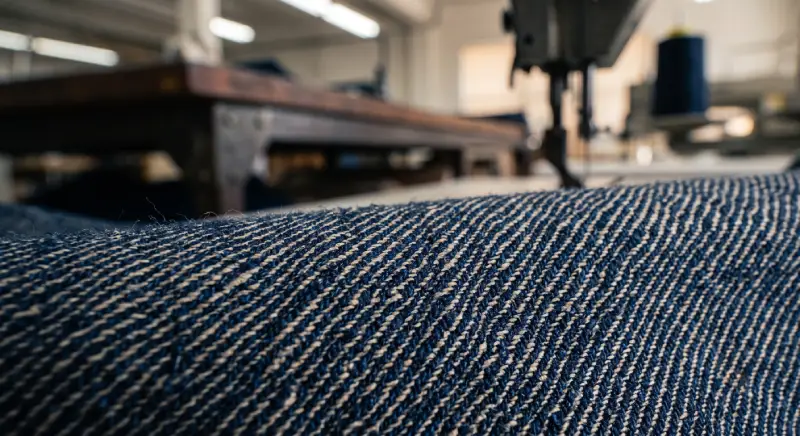
Indigo dyeing relies on a complex oxidation-reduction reaction. Cotton yarn gets dipped into dye vats, then exposed to oxygen. Repeat that multiple times. But here’s the twist — the dye never fully penetrates the yarn. It only clings to the surface. The core of the cotton yarn stays completely white. The industry calls this “ring dyeing.”
Picture a microscopic cross-section of the yarn — blue on the outside, pure white in the middle. That structure is what defines true denim. Without it, you’ve just got blue fabric.
Fading: From Laborer Marks to Personalized Totems
Ring dyeing gives jeans a unique aging process. Daily friction slowly strips away the surface dye, and the white core starts peeking through. Washing speeds this up. That’s how you get those high-contrast fades.
You’ll see “whiskers” around the pockets and “honeycombs” behind the knees. Originally, these marks just showed a laborer’s hard work. Today? They’re personalized totems. Every pair tells a unique story — and honestly, that’s half the charm.
💡 Exclusive Insights: 3 Real Truths Modern Users and Brands Care About Beyond Nostalgia
Most articles stop at the romantic history of denim. Fair enough. But modern B2B buyers and brands face real challenges, so let’s talk about the current industry pain points — and the advanced manufacturing solutions that actually address them.
Pain Point 1: The Frustrating “Crocking” and Colorfastness Battle
Top-ranking articles love to praise beautiful denim fading. They conveniently ignore a massive consumer complaint. Indigo jeans stain white shoes. Light-colored sofas? Ruined. Car seats? Frequently blue. This issue is called “crocking.”
Modern factories have to strike a delicate balance. Brands want great “washdown” capabilities. Consumers demand high colorfastness. You can’t always have both — unless you know what you’re doing.
Modern OEM and ODM factories solve this through specific finishing processes. Take Kaiping Lianwang Garment Co., LTD — they set development, production, sales, processing, and export trade as one of the professional garment enterprises. They use advanced soaping methods to remove floating colors, plus formaldehyde-free fixing agents to prevent excessive color transfer. They specialize in high quality denim jean clothing including women’s denim, men’s denim, and kids’ denim. The result: modern jeans fade beautifully without ruining your furniture.
Pain Point 2: Why Are Other Color Jeans So Rare? (Supply Chain & MOQ Economics)
Over 80% of jeans on the market stay blue. That’s not just cultural inertia — it’s the cost lock-in of industrialized production. Indigo dyeing processes, like rope dyeing or slasher dyeing, are massive operations designed for continuous, high-volume manufacturing.
For clothing brands, sourcing classic blue raw denim is extremely cost-effective. It offers the lowest Minimum Order Quantity (MOQ) and the best profit margins. Producing red or green jeans? Completely different methods. Factories usually have to use piece dyeing or sulfur dyes. The fabric texture changes significantly, and brands face higher sampling costs and strict supply chain barriers.
To overcome these hurdles, you need a strong manufacturing partner. This company, located in Jiangmen, Guangdong province in southern China, has a floor area of 7,000 square meters, more than 330 garment equipment units, and over 150 workers — including the manual department, sample department, and production line. There are also a range of qualifications to ensure high-standard operation. With many years of factory experience, they’ve developed a highly sensitive, creative team and strong sample development skills to meet different customer needs. Add 20+ years of manufacturing experience and a 15+ person professional R&D team, and navigating complex supply chain economics becomes a whole lot easier.
Pain Point 3: The Environmental Cost of Indigo and Modern “Green Washing” Breakthroughs
Traditional articles often romanticize old-school dye vats. They ignore the massive environmental cost. Traditional denim production requires immense water consumption and uses harsh chemical reducing agents like sodium hydrosulfite. The industry had to change — and it did.
Today, technology dictates modern jeans’ blue color, not pollution. Advanced garment factories now use ozone washing and laser fading. Foam dyeing is revolutionizing the industry. Today’s “vintage blue” can be achieved with zero water pollution, and 3D digitalization minimizes physical waste.
Sustainable practices are no longer optional. This company tries its best to reduce energy consumption in production. Projects like energy-saving lighting sources and boiler steam exhaust recovery systems embody the company’s environmental protection and low-carbon social responsibility. True innovation lies in eco-friendly technology — not just marketing spin.
Conclusion: Blue Jeans Are Vintage, But Manufacturing Is Heading Into the Future
So there you have it. The blue color of jeans isn’t a historical accident. It’s a brilliant miracle of chemistry and industry. Indigo protected gold miners. Ring dyeing created a global fashion phenomenon. And today, smart manufacturing drives the denim world. The future of denim is bright — and sustainable.
This company supports OEM and ODM services, with an annual output above 600,000 pieces. They’re committed to giving customers the best service experience — recommending fashionable fabrics regularly, using superb technology, supporting full quality control, and maintaining a fast delivery rate. That’s how their products get exported to Europe, the United States, Australia, and other markets.
Looking to elevate your denim brand? They attend clothing exhibitions every year to meet more customers. Overseas customers are welcome to visit the company — hopefully, a long-term partnership starts there. Contact the team today to download the professional guide on denim customization and wholesale.
Frequently Asked Questions (FAQ)
1. Why does indigo dye only coat the outside of the yarn?
Indigo dye requires an oxidation-reduction reaction to bind to cotton. The dye molecules are simply too large to fully penetrate the tight cotton fibers quickly. So only the outer ring absorbs the color, leaving a white core. That’s ring dyeing in a nutshell.
2. How can I stop my new blue jeans from staining my shoes?
This staining is known as crocking. First, wash your jeans inside out with cold water. You can also soak them briefly in a mild vinegar solution to help set the dye. Just always check the care label first — no one wants a shrinking disaster.
3. Why are black and colored jeans more expensive to produce than blue ones?
Blue denim relies on massive, continuous rope dyeing setups, so the scale creates immense cost efficiency. Colored jeans require batch piece dyeing. That leads to higher minimum order quantities and increased setup costs. Simple economics, really.
4. Is modern denim production bad for the environment?
Historically, yes. But modern facilities have revolutionized the process. Factories now use laser fading, ozone washing, and boiler steam exhaust recovery systems. The industry is rapidly shifting toward sustainable, low-carbon manufacturing — and that’s genuinely good news.

Recent Comments