

Learning how to audit a jeans factory starts with evidence, not a showroom tour. Verify the production site and subcontractors, trace fabric lots, inspect sewing and washing controls, and check finished jeans against an approved tech pack. Record each finding and close critical issues before authorizing production or shipment.
This B2B sourcing guide gives clothing brands a practical jeans factory audit checklist, from pre-audit documents to a corrective action plan. A factory audit evaluates the supplier’s systems and capability; a pre-shipment inspection evaluates a specific order. Use both when deciding whether a supplier can consistently deliver your denim collection.
Before arranging a visit, use our guide to choosing a jeans manufacturer to build your shortlist. Then agree the audit scope, product requirements and access to any outsourced processes.
Jeans Factory Audit Checklist at a Glance
| Audit area | Evidence to request | Decision to make |
|---|---|---|
| Documents and capacity | Site identity, relevant audit reports, production plan and subcontractor list | Can this site make your order within the agreed schedule? |
| Fabric and shrinkage | Roll inspection records, shade bands and lot-specific wash tests | Are material variation and pattern allowances controlled? |
| Sewing and trims | Approved sample, inline QC logs and hardware test records | Are workmanship and attachments consistent? |
| Washing and finishing | Approved wash standard, batch recipes and test reports | Can the laundry reproduce shade, hand feel and performance? |
| Final inspection and packing | Measurement report, agreed sampling plan and packing checks | Does the lot meet the purchase order requirements? |
| Corrective actions | Root cause, owner, due date and closure evidence | Have the risks been corrected and verified? |
Jump to: Preparation · Fabric · Sewing · Washing · Final inspection · Scoring · FAQs
1. Prepare for the Jeans Factory Audit
Send the supplier your product brief, order quantity, size range, target delivery date and audit checklist before the visit. Request the approved sample and latest denim tech pack, including measurement points, tolerances, fabric composition, construction details, trims and wash references. Without agreed specifications, an auditor cannot consistently distinguish a defect from an intentional design feature.
Verify documents and social audit scope
Check that the legal entity, factory address and production activities match the documents provided. Review relevant social audit reports or certifications requested by your sourcing policy, including their dates, scope and unresolved findings. Sedex membership is not a certification: SMETA is an audit methodology. A report from one site does not automatically cover another facility or an outsourced laundry.
- Request the current organization chart and named quality managers.
- Review worker safety procedures, training records and access to relevant evidence through the appropriate audit process.
- Check the status of previous corrective actions, rather than relying only on a cover-page rating.
- Use qualified auditors for specialist social, environmental or product safety assessments.
Map in-house work and subcontracted laundries
Trace the actual workflow: fabric receiving → cutting → sewing → washing → finishing → final inspection → packing. The jeans manufacturing process helps you identify where evidence should exist at each stage. Record which company performs each process and whether you can inspect that location.
Subcontracting is not automatically a failure. Undisclosed subcontracting or weak controls are the concern. Ask who approves wash recipes, retains samples and investigates defects. Check available capacity against current orders, staffing and bottlenecks; floor area or machine count alone does not prove an order can ship on time.
2. Audit Denim Fabric, Shade and Shrinkage Before Cutting
Start with a fabric lot and follow it through receiving, inspection, storage and cutting records. The objective is to prevent unapproved rolls or mixed shades from entering the same garment. For the broader sourcing context, review our denim supply chain guide.
| Check | What to verify | Acceptance basis |
|---|---|---|
| Fabric defects | Roll inspection reports using an agreed grading method, such as the four-point system | Buyer-approved points limit and inspection coverage |
| Weight and composition | Results linked to the approved material and lot | Tech pack specification and agreed test method |
| Shade consistency | Shade bands, roll grouping and comparison with the approved standard | Agreed visual standard; instrumental limits if specified |
| Skew and leg twist risk | Fabric preparation records and washed garment evaluation | Product-specific requirements |
| Shrinkage | Warp and weft dimensional change under the intended process | Approved pattern allowance and finished measurement tolerances |
Check the shrinkage-to-pattern workflow
Ask how each relevant fabric lot is tested using the intended production wash and drying conditions. Review marked specimen measurements before and after washing, the recorded dimensional change and the resulting pattern adjustment. Shrinkage depends on fabric construction, finishing and processing conditions; do not assign one universal percentage to all denim.
A swatch test supports development but does not replace a washed garment trial. Confirm the approved size set still meets the measurement chart after the planned wash. Separate production-wash shrinkage from subsequent consumer-care testing, and specify the method and acceptance limits for each.
3. Inspect Sewing Lines, Reinforcement and Hardware
Observe active production, not only prepared display samples. Select pieces from different operators and bundles, compare them with the approved sample, and review how inline inspectors report recurring defects. Look for evidence that corrections reach the line promptly.
- Seams: Check stitch formation, skipped stitches, tension, seam allowance and puckering. Specify stitch density by seam, fabric and thread rather than using one factory-wide number.
- Needles: Confirm the selected needle works with the fabric and seam thickness, and inspect for needle damage or cut yarns.
- Reinforcement: Check the approved bartacks or other reinforcements at pocket corners, belt loops and fly stress points.
- Traceability: Ensure rejected pieces are segregated and rework is re-inspected.
Verify button, rivet and zipper attachment
Compare hardware with the approved bill of materials and custom denim trims specifications. Review attachment test records, equipment calibration, test frequency and the method used. Pull force, holding time and pass criteria must follow the applicable product requirements and agreed test protocol; 90 N is not a universal rule for every garment.
Also inspect zipper operation, sharp edges and backing washers. Children’s products require a product-specific assessment of applicable safety requirements. A visual check alone cannot establish attachment safety.
Review broken-needle controls
Ask the supervisor to demonstrate the broken-needle procedure. It should include fragment reconciliation, quarantine of potentially affected work, investigation and documented release. Any detection method must be validated for the garment and its intentional metal trims; simply passing jeans through a detector does not prove contamination control.
4. Audit Denim Washing and Finishing Controls
The approved denim wash finish should be reproducible at bulk scale. Ask the laundry to connect a finished sample to its fabric lot, wash batch, machine and recipe record. The operation sequence will vary by finish, so assess the actual approved process.
Check recipe consistency and shade approval
Review chemical dosing, load size, time, temperature and drying controls, along with the records required by the chosen process. Compare production garments with approved wash standards under the buyer’s specified lighting conditions. Multiple light sources can reveal metamerism; they do not eliminate it. Agree acceptable shade bands and keep signed reference garments available to both teams.
Assess fabric strength after washing
Heavy washing can affect fabric and seam performance. Review post-wash test results for the actual material and finish, including pocket bags and reinforced areas. ASTM D5034 is a grab-test method for breaking strength and elongation, but its scope is not suitable for every fabric, particularly some high-stretch materials. Have the laboratory confirm the appropriate method and agree minimum performance requirements before testing.
Do not treat a fixed percentage of strength loss as a universal pass limit. Inspect tearing, abrasion damage and seam failures against the product’s intended use and approved specification.
Review chemical and wastewater evidence
Request the chemical inventory, safety data sheets and relevant conformance records. The ZDHC MRSL addresses restricted chemical inputs used in manufacturing; it does not replace finished-product testing. Review wastewater monitoring and treatment records against the requirements applicable to the site, using qualified environmental specialists where needed.
5. Verify Final Inspection, AQL and Packing
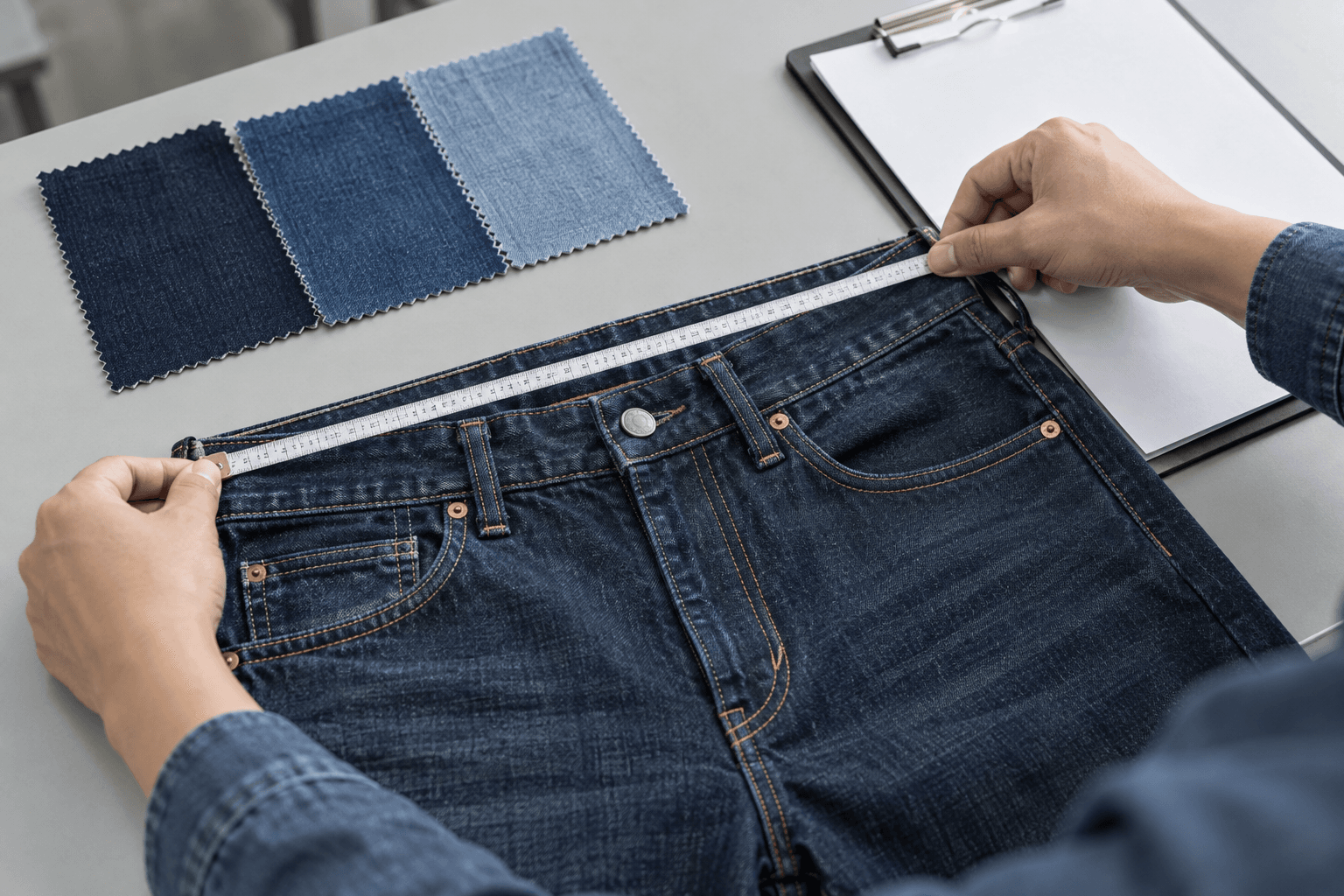
Measure finished jeans against the approved tech pack
Measure washed garments using the agreed method and size-specific chart. Check waistband, rise, hip, thigh, inseam and leg opening as relevant to the style. Record actual values, not only a pass mark. Evaluate leg twist with a defined measurement method and acceptance limit; one inch-based threshold will not suit every size and construction.
Agree the sampling plan and defect classes
Define the lot size, inspection level, sampling scheme and acceptance/rejection numbers before inspection. Intertek describes apparel inspection using statistical sampling and predetermined AQL criteria. AQL and general inspection level are different parts of a sampling plan.
For illustration, a buyer might specify General Inspection Level II with AQL 2.5 for major defects and 4.0 for minor defects, plus zero acceptance for critical defects found in the sample. These are buyer-selected criteria, not universal requirements or a guarantee that every unit is defect-free. Derive the actual sample size and acceptance numbers from the selected plan.
| Classification | Examples to define in your defect manual | Response |
|---|---|---|
| Critical | Broken needle fragments or other hazards identified by the applicable safety assessment | Hold affected goods and investigate under the agreed zero-acceptance policy |
| Major | Open seams, unacceptable shade differences, missing reinforcement or out-of-tolerance measurements | Apply agreed acceptance criteria and corrective action |
| Minor | Cosmetic issues such as loose threads or slight puckering within the agreed classification | Record and assess against the agreed minor-defect criteria |
Check packing and moisture controls
Verify size ratios, garment labels, barcodes, carton markings and packing quantities against the purchase order. Inspect storage conditions and packing dryness. Any moisture threshold must suit the material, instrument and agreed method; a generic meter reading is not sufficient evidence. Select desiccants for the packaging and transport conditions, and verify polybag requirements for the destination market.
6. Score the Audit and Close Corrective Actions
Use a documented scoring model for comparison, while treating critical findings as approval blockers regardless of the total score. The following weights are an example buyer framework, not an industry certification scheme.
| Audit pillar | Example weight |
|---|---|
| Compliance and management | 20% |
| Raw materials and traceability | 25% |
| Sewing and workmanship | 25% |
| Laundry and finishing | 20% |
| Packing and shipment controls | 10% |
Example calculation: Multiply each pillar’s score out of 100 by its weight, then add the results. A buyer might set 85 or above as eligible for approval, 70 to below 85 as conditional, and below 70 as requiring remediation and reassessment. Approval still depends on closing critical findings and meeting order-specific requirements.
- Record the finding and objective evidence, including affected process or lot.
- Ask for the root cause, immediate containment and a preventive action.
- Assign a responsible person and a deadline based on severity.
- Verify effectiveness through records, retesting or a follow-up visit before closing the action.
A factory audit does not replace sample approval, a trial order or shipment inspection. Connect those checkpoints using our B2B bulk jeans sourcing guide.
7. Plan a Supplier Review with Lianwang Garment
When evaluating Lianwang Garment, apply the same evidence-based checklist you would use for any shortlisted supplier. Request current site information, the proposed production route, applicable audit documents, sample milestones and an order-specific capacity plan. Confirm which processes are performed in-house and which involve approved partners.
Share your tech pack, wash reference, quantities, size breakdown and target delivery date to define the review scope. Contact Lianwang Garment to discuss your denim project and the supporting documents needed for your sourcing decision.
Frequently Asked Questions About Jeans Factory Audits
How do you audit a jeans factory before placing an order?
Review the supplier’s documents and process map, inspect fabric and sewing controls, verify washing capability, and check the system for final inspection. Compare evidence with your approved product specifications, then verify corrective actions before approving the supplier.
What is the difference between a factory audit and an AQL inspection?
A factory audit evaluates systems, capability and process control. An AQL inspection uses a defined sampling plan to assess a particular lot against agreed criteria. A supplier can have suitable systems and still produce a shipment that needs correction.
What documents should a denim factory provide?
Request site and subcontractor details, relevant audit reports, material traceability, fabric and wash test results, inline QC records, calibration records and corrective action logs. Before shipment, add the final inspection report and packing documentation required by your purchase order.
Can a remote audit replace an on-site factory visit?
A live video review and document check can help with initial screening or follow-up. They offer less visibility into production conditions and how samples are selected. Choose on-site verification where supplier risk, process complexity or unresolved findings require it.
Does a short lead time prove a factory is reliable?
No. Validate delivery commitments against material availability, line loading, laundry capacity and approval milestones. A realistic schedule with traceable quality checkpoints is more useful than an unsupported promise of fast production.

Recent Comments