
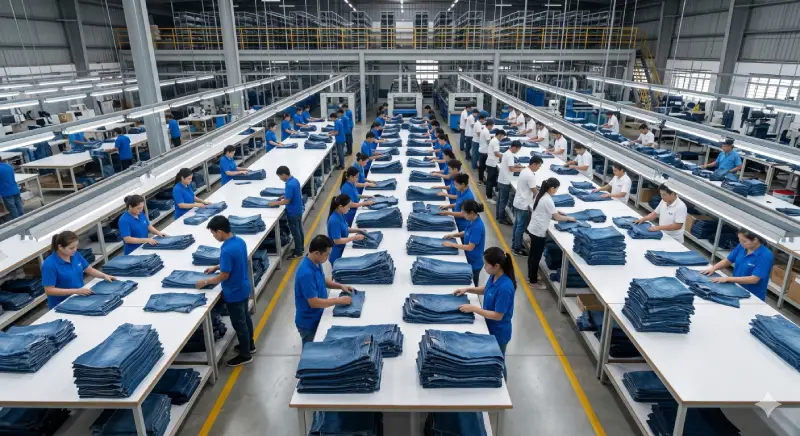
According to a study, the denim market worldwide will hit astronomical numbers by 2030, fueled by consumer demand for both evergreen and vintage looks as well as modern comfort. Yet the actual experience between the bales of cotton arriving at a manufacturer and a pair of jeans ready for retail is still a black hole, at least for B2B buyers, fashion entrepreneurs and independent brands.
If you want to build a tough apparel brand, you have to know what goes on behind the factory walls. This guide takes you behind the scenes to discover all the steps of denim production from start to finish. We will explore how premium manufacturers leverage cutting-edge engineering, sustainability and stringent quality controls to convert raw denim into the garments you see in stores today.
1. How a Modern Denim Factory Operates: A Step-by-Step Overview
From Raw Cotton to Premium Apparel: The Denim Production Line
The lifecycle of a pair of jeans is an intricate journey combining heavy machinery and artisanal craftsmanship. The production line moves through distinct phases: fiber preparation, indigo dyeing, weaving, precision cutting, heavy-duty stitching, industrial washing, and final hardware trim. Managing this complex flow requires a highly optimized infrastructure.
For instance, leading Chinese denim manufacturers like Kaiping Lianwang Garment Co., LTD operate expansive facilities covering over 7,000 square meters to house this extensive lifecycle under one roof. Their facilities integrate manual departments, sample departments, and specialized production lines to ensure a seamless workflow from raw textile to export-ready garments.
[Raw Cotton & Yarn] ➔ [Indigo Dyeing & Weaving] ➔ [Fabric Relaxing & CAD Cutting]
↓
[Eco-Washing & Laser] ⇦ [Chain Stitching & Assembly] ⇦ [Panel Sorting & Grouping]
↓
[Hardware Riveting] ➔ [35-lb Pull Testing] ➔ [Final QC & Eco-Packaging]
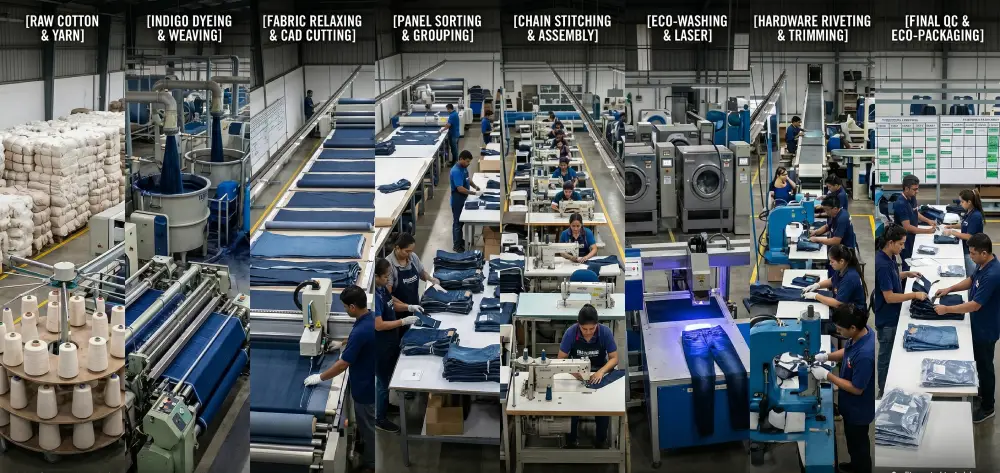
Jeans Making: A Walk Inside The Denim Factory
Key Departments Inside a Full-Vertical Clothing Manufacturer
A full-vertical denim factory functions as a solvent machine, using inter-departmental cooperation to bring sophisticated designs into action. Within an automotive manufacturing environment, work is divided among specialized centers of gravity:
- The Professional R&D Team: Specializes in fabric sourcing, pattern engineering and structural innovation.
- Sample Department — converts tech packs into actual samples, helps to check fit before a large run.
- The Mechanic: Involves industrial machine operators performing assembly work on a massive scale.
- Manual/Finishing Department: Artisan treatments such as hand-sanding, whiskering, and hardware installation
Running these departments requires a huge investment in hardware and labour. The top factories operate an ecosystem of 330+ garment equipment and a dedicated 150-strong production team to ensure multiple lines can run seamlessly at any given time.
How do factories manufacture denim jeans?
The same is true of the manufacturing process, which balances automated efficiency with human oversight. Factories receive the denim, which arrives in rolls as wide as a full-grown man from mills that only make fabric for clothes. These fabrics are then relaxed, cut by CNC machines and sent to the sewing room. Next, skilled operators using specialized heavy-duty machines sew panels together. The raw, stiff “greige” garments are processed and sent to the laundry, where they also go through semi-automated wet or dry chemical/or mechanical washing processes that result in their solid final texture and color and amount of distressing. Once finished, the jeans go to a manufacturing facility for hardware mounting, final quality checks and packaging.
2.Mill Stage: Indigo Dyeing and Weaving Inside the Denim Textile Factory
Rope Dyeing vs. Slasher Dyeing: Which Yields Better High-Low Contrast?
Prior to weaving this fabric using denim fabric, the warp yarns require indigo dyeing. Of these, two methods are the most common in the industry: rope dyeing and slasher (sheet) dyeing.
| Feature | Rope Dyeing | Slasher Dyeing |
|---|---|---|
| Process | Yarns are twisted into a “rope” and continuously dipped into indigo vats. | Yarns are spread flat as a parallel sheet and passed through vats. |
| Indigo Penetration | Low. Leaves a perfectly consistent white yarn core. | Higher. Indigo penetrates deeper into the yarn core. |
| Fading Potential | Excellent high-low contrast; highly prized for premium vintage fades. | Flatter, more uniform color distribution over time. |
| Production Efficiency | High volume, but requires massive machinery and setup times. | Highly flexible for smaller runs and faster color changes. |
Rope dyeing is the gold standard in premium denim for high-end retail outlets. Unlike synthetic dyes, indigo dye does not penetrate the yarn core fully; thus, subsequent washing processes at the factory can strip off this surface blue to reveal a brilliant white core, helping to create high contrast whiskers and fades.
Operating Modern Looms: Creating Right-Hand, Left-Hand, and Broken Twill
After dyeing, the warp yarns are shipped to an industrial loom to be woven along white weft yarns. The direction in which yarn traverses the fabric—a diagonal termed as “twill line”—radically changes the hand-feel, longevity, and fading behavior of the finished jeans.
- Right-Hand Twill (RHT): The most common denim weave ($Z$-twist), diagonal from bottom left to top right. It makes a thick, stiff material that leaves bright and crisp fade lines.
- Left-Hand Twill (LHT): a gentle ($S$-twist) from the bottom-right to top-left. It softens a lot after washing and offers a more relaxed, comfortable wear.
- Broken Twill: Developed for fighting “leg twist” (where the seams of the jeans swirl around your ankles after washing), it switches the weave direction in a zigzag manner, neutralising any tension within the fabric itself and resulting in an ultra-balanced drape.
Factory Sanforization: Controlling Fabric Shrinkage Before the Cutting Table
Denim is generally a raw, unhindered cotton fabric & this type of jeans weighs up to 40–50% per pair, and they have scope-to-move if we could modify this organic stitch from our side; otherwise, during its first wash itself it may shrink up to 10% to 12%, which will ruin a well-measured retail fit. So, modern textile factories run the denim through a device called sanforization to prevent that.
In this mechanical process, the cloth is subjected to steam and pressed on a thick rubber blanket that compels the cotton fibers to compress horizontally as well as vertically. It pre-shrinks the fabric, reducing residual shrinkage rates to an acceptable 1% to 3%. So this stage ensures that the dimension cut on the cutting table is equivalent to the size which user tested in a retail shop.
3.Pre-Sewing Logistics: Precision Fabric Relaxing and CAD Cutting
Why a Premium Denim Manufacturer Insists on a 24-Hour Fabric Rest Period
When denim rolls leave the textile mill and arrive at the garment factory, they are wound tight with an enormous amount of mechanical tension. If you are spreading and cutting the fabric immediately, once the panel is cut, it will automatically start to contract dynamically, leading to severe size discrepancies.
As a result, premium manufacturers require all fabrics to be dried for 24 hours. They unroll the denim and lay it flat on long tables in a temperature-controlled area. This enables the cotton yarns to revert to their original shape, which means stress from within is neutralized, and there will be no chance of distortion after being cut.
Maximizing Fabric Yield: Marker Making and Automated CNC Fabric Cutters
Fabric itself comprises upto 60% of the total manufacturing cost of a garment. The R&D team uses high-tech Computer-Aided Design (CAD) software to produce what are called “markers,” digital puzzles that place each pattern piece—legs, pockets, waistbands—as close together as possible across the width of fabric to minimize waste and maximize yield.
After optimizing the marker, relax denim is arranged into multiple layers (ply) on a cutting table. An automated Computer Numerical Control (CNC) fabric cutter electronically slices through a score of several layers of dense denim at once, using an oscillating vertical blade or laser. This automation, in fact, ensures at sub-millimetre-level precision that is not replicable by manual cutters powered by humans.
[CAD Design & Pattern Grading] ➔ [Digital Marker Optimisation] ➔ [CNC Automated Blade Cutting ]
Sorting Panels: Preventing Shading Issues Before Pieces Reach the Line
And even in a single dye batch, indigo hues show subtle variation between the head and tail of a yardage. So that if an operator inverts a left leg panel from Roll A with a right leg panel from Roll B, the jeans produced will be markedly mismatched in color, resulting in shading.
Every individual cut piece is marked with a label and number in the bundling and sorting step to mitigate this defect. The panels are bunched in shade lot and ply sequence, allowing all of the components that make up a pair of jeans to come from one area of fabric.
4.The Assembly Line: Heavy-Duty Stitching and Engineering Seams
Feed Dog Adjustments: Setting Up Your Sewing Machine for Rigid vs Stretch Denim
Heavy denim assembly requires special machines. One of the biggest engineering hurdles to overcome on the production floor is controlling how fabric is moved through a sewing machine. Feed dogs (those metal teeth underneath the needle plate) need to be perfectly tuned based on fabric weight and composition:
- Stiff 100% Cotton Denim (14oz+): Needs rugged, hardened steel feed dogs that push through with high pressure, or else they stall as they pull layers down.
- Stretch Denim (with Spandex / Elastane) – Must be stitched with lower feed dog pressure and differential feed synchronization. While sewing, high pressure will make the machine pull on the fabric, leading to wavy seams and distortion of the piece.
Chain Stitching vs. Lockstitching: Why Denim Factories Use Double-Needle Laps
If you take a close look at the inseam or yoke of a premium pair of jeans, you’ll see an obvious, thick seam. Chain stitching and lockstitching are the main stitches you will find in a denim factory that fulfil various functional areas:
- Lockstitch (Regular Seams): Combines both an upper thread and a lower bobbin thread, which interlock between the material. It’s flat, it doesn’t unravel easily, and it’s secure: perfect for those pockets and side seams.
- Chain Link (Waistband and hem): Uses a continuous looping thread system ($1$-needle or $2$-needle). Chains are more elastic, allowing them to give with the heavy nature of denim without breaking;
- Double Needle Lap Seams: The gold standard for inseams and yokes. In the photo, the unique folder machine interlocks two specialty fabric edges, sewing them down with two rows of parallel chain stitching. This is one of the structural designs that can provide high durability to friction.
Structural Reinforcement: Pocket Bar-Tacking and Multi-Layer Waistband Stitching
Jeans are also very high-stress wear. Places like the corners of the back pockets, the bottom of the fly, and when you pull up your belt loops, all get concentrated forces in day-to-day wear. To stop it from tearing, factories take the extra step of applying bar-tacks—many tightly spaced zigzag stitches that hold the layers together.
Additionally, the waistband itself contains between 4 and 6 layers of multiple dense denim fabrics being stitched through all at once. Multi-needle chain-stitch machines with heavy walking feet are used in factories to sew through these thick layers without missed stitches or broken needles.
5.The Washing Laundry: Transforming Raw Garments into Retail Trends
Dry Processes: Industrial Hand Sanding, Whiskering, and 3D Tacking
When jeans are off the assembly line, they are raw and dark and even. They get dyed in the laundry and transformed into a hot fashion item. Dry processes are handmade artisan-style Ethiopian processing methods in which each step is done by hand:
- Hand Sanding: Employees put jeans on inflatable rubber legs and literally sand indigo off areas such as thighs and seat with hand-held sandpaper in a simulation of wear over time.
- Whiskering: These are the horizontal fade lines that are made around the crotch region (where thighs meet) of particular hand-worked areas.
- 3D Tacking: Sections of the jeans are coated in resin, then folded before being pinned down and baked in an industrial oven to ensure realistic 3D creases are locked into the fabric permanently.
Sustainable Wet Processing: How Modern Laundries Deploy Enzyme and Ozone Wash
Traditionally, light blue wash was done by soaking thousands of gallons of water mixed with potassium permanganate (PP) – a skin-irritating chemical, or pumice stones (stone washing). Modern manufacturers are upgrading their infrastructure today to be more socially responsible and to use a low-carbon economy. Install cost-effective water and energy-saving systems such as boiler steam exhaust recovery systems, energy-efficient lighting, etc.
As for the wet-processing, modern laundries operate with sophisticated biological, alternative techniques:
- Enzyme Wash: It uses organic cellulase enzymes to gently eat surface cellulose fibers, releasing indigo dye without causing harm to the fabric or destroying washing machines with stone debris.
- Ozone Wash: Incorporates ozone gas ($O_3$) into a washing drum that is dry or slightly wet. The ozone is used to naturally bleach the indigo color out of the jeans without using any chemicals or water, and turns back into oxygen ($O_2$) before being discharged.
Laser Engraving: Calibrating Laser Wattage to Avoid Burning Cotton Weft Threads
The advent of laser technology, replacing manual hand-sanding and chemical bleaching for denim finishes, has also transformed the industry. An ultra-fast digital laser scans and projects a retro fade on untreated denim, burning the overlying indigo in seconds.
[Calibrate the Laser Wattage (CO2)] [Indigo Dye Vaporized (Leaves Weft Untouched) [Digital Textile Design from a Vintage Pattern
Wattage calibration is the crucial engineering element here. Your laser must be perfectly tuned to vaporize only the blue indigo on the surface warp threads. Conversely, if wattage is too high, it will burn through the white horizontal cotton weft threads that structurally hold everything together in tow, resulting in fabric degradation and premature tears.
6. Post-Processing: Hardware Riveting, Quality Control, and Trim
Installing Heavy Hardware: Secure Attachment of Shank Buttons and Zippers
The cleaned garments are then returned to the finishing floor for hardware installation. Where regular shirts use sewn-on buttons, jeans are outfitted with heavy-duty shank buttons (工字扣) and metal rivets. These are pressed into the fabric with pneumatic or hydraulic punching machines, which drive a button head into a sharp prong of metal underneath. The fly assembly is box-stitched with heavy-duty brass or nickel locking sliders.
The 35-Pound Pull Test: How Jeans Factories Ensure Hardware Safety Compliance
Loose metal rivets or buttons on garments, specifically children’s denim apparel, can create a choking hazard. Professional manufacturers conduct the same physical 35-pound pull test to meet stringent international safety standards (such as US CPSIA or EU REACH regulations).
With a calibrated mechanical tension gauge, quality control technicians grab an installed button, rivet and decorative snap and pull against the system with a continuous force of 35 pounds (approx. If any hardware falls off or a part of the fabric rips within that window, then it marks an inspection failure for the batch and immediately recalibrates the riveting machine.
Final Trimming, Commercial Pressing, and Eco-Retail Packaging
The last stage of production really is a process of aesthetic refinement:
- Thread Trimming: Specialized workers or suction cutters trim all the leftover thread tails from the high-speed assembly line
- Commercial Pressing: In this process, jeans are placed on tables with steam-injection pressing equipment to flatten waistbands, smooth out pockets and iron all those unwanted wrinkles that you don’t want to see in the store.
- Eco-Retail Packaging: Lastly, custom main labels, size tags, hangtags, and anti-mold stickers are applied. Thereafter, you fold the jeans in biodegradable polybags or eco-friendly bulk boxes in line with your OEM specification.
7. B2B Sourcing Guide: 3 Factory Secrets Successful Denim Brands Use
Secret #1: Controlling Shade Lots—What factories do to group variations in bulk runs
Indigo dyeing, being a fairly spontaneous process, cannot guarantee the same results for every single one of our bulk orders. Existing successful global brands do not expect a 10,000-piece production run to look one hundred percent the same. They instead send the factory a mandate to fulfill and ship by Shade Lots.
For instance, experienced factories will group final washed garments into these colors: Shade A, Shade B, Shade C. They bundle and ship these lots separately, ensuring that one retail store receives all of its inventory from the same shade lot, so that right next to each other on the display rack, you don’t have color discrepancies.
Secret 2: Know How to Avoid the Seam Puckering Trap Where Go-to Casings Fail on High- Spandex Blends.
Performance denim blended with lots of spandex is super popular among consumers, but a sewing nightmare. Excessive friction heating of the needle during a sewing operation can melt the internal elastane core, resulting in ‘spandex bleed’, or under seam puckering after washing.
To avoid falling into this trap, advanced manufacturers tune the technical parameters of their products as follows:
- Using ballpoint needles that glide along the side of the elastane fibers instead of cutting through them
- However, results on such machines are, to a degree, variable. My recent work relates to the exact application of specialized lubricant systems specifically designed for high-speed stitching needle cooling.
- Setting the tension to compensate for fabric retraction
Secret 3: The audit checklist- what you need to spot from a denim apparel manufacturer
When confirming a potential denim garment maker for your brand, do not get swayed by price tags alone; go deeper and dive into their operational transparency, shipping time and ability. Here is a Checklist you can use for your next remote or onsite audit:
- Equipment Capacities: Does the factory have top-of-the-line equipment (e.g., more than 300+ units of modern garment machinery & to efficiently scale up production)?
- R&D Capability: Do they have a well-trained, in-house R&D and sample development team that can quickly develop tech packs into physical prototypes within approximately two weeks or less?
- Lead Times and Responsiveness: Is their communication infrastructure conducive to P.R.E.P., with emails answered in under 30 minutes, quotes provided within 3 hours, and a consistent bulk production time of 25–35 days?
- Thorough QC protocols: Are you offered a 100% full inspection promise prior to shipping, along with quality assurance documents?
- Sustainability & Social Compliance: Do they reduce energy by making use of modern lighting or steam recovery systems? Do they have relevant industry certifications?
8.Frequently Asked Questions (FAQ)
A: However, IMOs can vary widely depending on whether a factory is a textile mill or a garment workshop. However, for completely custom OEM/ODM services requiring dyeing fabric from RAW materials (meaning your designs cannot be produced with yardage that has already been dyed), MOQs are usually capped at 500-1,200 per style/color. This is just because the manufacturer can use the in-stock fabrics they have, so manufacturers are generally able to accommodate lower initial development MOQs for brands looking to grow.
A:
You are using OEM (Original Equipment Manufacturer): The brand gives the identical tech packs, exact measurements, fabric options, and design patterns. The factory simply sources, executes, assembles and inspects the material.
ODM (Original Design Manufacturer): The factory uses its own R&D team to design, develop, and formulate fabrics and styles based on the current market trend. From there, the brand can choose these pre-created designs as well as make them their own by shielding their logo design or personalized washing result, or even customized product packaging.
A: A B2B denim factory that is completely optimized can build a bespoke sample in just 10–20 days from when the design details are completed. Usually, after the sample is approved and the fabric samples are dried, the mass production time could be 25–35 days, which leads agile retail brands by favourable go-to-market speed.

Recent Comments