
Inspiration is important, but launching or scaling a fashion brand takes more than just great sketches. It requires a supply chain that can manufacture the creative vision and deliver high-end products. Feeling the challenge, especially with denim brands. Denim is not a regular fabric; it is an ever-evolving one, a living textile. Therefore, a denim garment manufacturer can build or break your brand reputation.
This ultimate guide will take you through the organic ecosystem of denim manufacturing. We will also summarize the key metrics for factory evaluation, and shortly explain how you can gain insights from those in order to choose a reliable production partner.
1. Beyond Sewing: What Defines a True Denim Garment Manufacturer?
Most mass-market clothing — new emerging fashion brands, provided they are aware of the premise that any high-end denim clothes factory will automatically produce quality jeans. But denim in particular requires a very specialized skill set and manufacturing platform, which is different from what we generally produce.
1.1 The Complex Ecosystem of Denim Sourcing and Wet Processing
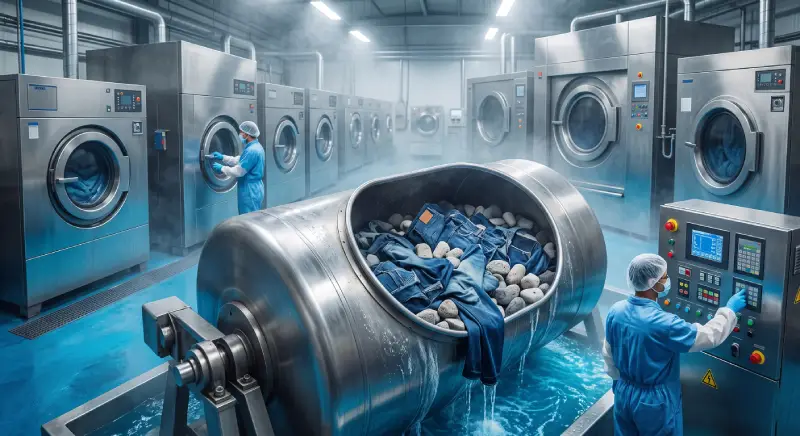
A pair of jeans is never finished when the last seam has been stitched, unlike traditional cut-and-sew garments. Actually, even sewing is half the battle. Wet processing, as they say, reveals most of the character and colour hue, etc., as well as the feel of denim. Complex chem-mechanical washes, hand-scraping, and stone washing are required in this phase. A genuine denim garment maker needs to effortlessly govern a sophisticated ecosystem. It means pairing raw fabric sourcing with high-tech washhouses to deliver exacting, repeatable aesthetics. Integration of this knowledge is critical for ensuring consistency throughout mass production.
1.2 OEM vs. ODM: Tailoring Production to Your Fashion Brand’s DNA
You need to make a decision on whether you follow Original Equipment Manufacturer (OEM) or Original Design Manufacturer (ODM) production models, depending on the internal capabilities of the brand.
· OEM Services: Best for brands with an in-house design team that supplies complete tech packs. Every detail, which consists of Certain washes, fabrics, Custom LOGO printing and packing, has been customized by the manufacturer.
· ODM Projects- Best for Brands That Sourcing the Manufacturer with Technical Expertise. Elite manufacturers employ dedicated research and development (R&D) teams that deal with end-to-end ODM projects, translating theoretical concepts into ready-to-market designs.
Take, for example, Jiangmen, Guangdong province-based Kaiping Lianwang Garment Co., LTD, one of the leading professional garment enterprises that supports both OEM and ODM services. Underpinned by two decades’ worth of manufacturing experience, coupled with a competent 15+ person professional R&D team, they offer brands flexible production solutions matched exactly to their strategic DNA.
1.3 Why Traditional Clothing Factories Fail at Complex Denim Construction
Uniform, lightweight fabrics (think cotton jerseys or polyester blends) have been the forte of traditional clothing factories. But they often struggle with hot-water denim. To work with denim, you need heavy-duty industrial-grade machinery that has the ability to sew through thick seams without breaking needles or skipping stitches. Moreover, denim reacts entirely differently to moisture and heat. Technical skills to calculate fabric shrinkage or accommodate the aggressive structural stress of a heavy wash cycle are rarely found in standard garment factories. This common shortcoming frequently results in puckered seams, misshapen fits and fragile construction.
2. Crucial Sourcing Metrics: How to Evaluate a Jeans Manufacturing Factory
You can only preserve a good profit margin while safeguarding the value of your brand if you screen prospective manufacturing partners with easily quantifiable KPIs.
| etric | Benchmark Standards |
| Production Lead Time | 25–35 Days (Optimized Bulk Production) |
| Sample Development Turnaround | 10–20 Days |
| Technical Communication Response | Inquiry response < 30 mins; Quotation < 3 hrs |
2.1 Decoding Fabric Specifications: Rigid 100% Cotton vs. Performance Stretch Denim
Your manufacturer needs to have a very complex approach toward the field of textile engineering. If they are forced to, they need to run you through the structure; the difference between rigid 100% cotton denim (coveted in the streetwear space for its true drape) and technical stretch denim blends (which can contain spandex or elastane). If you sew with tension and chemical washing, each fabric reacts differently. Tops manufacturers continually suggest on-trend and fashionable fabric options, making sure your collection is relevant with regard to the market.
2.2 Navigating Minimum Order Quantity (MOQ) and Transparent FOB Pricing Structures
Growing brands are hosted here, too, but high MOQs often prevent selling their products. You should be able to see the pricing structure of your factory listing fabric costs, labor, hardware and wash fees when it comes to Free On Board (FOB) pricing. Moreover, inquire about sample charge refund policies. Well-established manufacturers usually provide free samples or refund the sample expense once a full-price order reaches the quantity required for production. This reduces the upfront development risk on your brand.
2.3 Managing Production Lead Times and Technical Pack (Tech Pack) Alignment
Time to market is one of the key factors in the fast fashion business. You need a partner that promises the highest possible efficiency, consistent & reliable production timelines. Take Kaiping Lianwang Garment as an example: the advanced manufacturer promises that the turnaround time of all products is 25–35 days. Additionally, they can carry out complicated sample developments in 10–20 days through their sample department.
For this to happen, your tech packs will have to perfectly match the factory’s capabilities. Quick response to queries, like responding within 30 minutes and quotations being detailed, including technical product specs within 3 hours, allows for this alignment.
3. The Hidden Pitfall: Controlling Wash Batch Variance & Shrinkage
The largest blind spot most clothing brands have is thinking that mass-production jeans will look exactly as the pre-production samples appear. Controlling batch variation is an industrial process challenge that denim manufacturing has to confront on a continuous basis.
3.1 Why Samples Look Perfect But Bulk Orders Suffer from Color Shading
A single pair of jeans sample will look perfect, and the next bulk order might come in batches of 2,000 pieces with serious shading. The problem is that denim fades its color with indigo, and the substance itself oxidizes in open air. If you change the washhouse, water pH level, or drying time, you will get a different finish color. A top-tier manufacturer avoids this by using rigid lot segregation & standardized chemical-a dosing systems.
3.2 The Physics of Denim Shrinkage: How Top Factories Stabilize Fit Pre-Sourcing
Denim fabric goes through significant shrinkage—at times 10%–12%—when subjected to wet processing. If a factory cuts fabric to standard patterns, the jeans will be unmarketable and totally out of size specifications. The best factories have realised this and test all new fabric rolls for shrinkage before deciding to use them. They wash a test strip, measure shrinkage vectors and then adjust the cutting patterns as per CAD software before production.
3.3 Advanced Finish Methods: Stabilizing Enzyme, Stone, and Acid Washes Across Thousands of Pieces
The key here is incredible technical precision: because enzyme, stone or acid washes can change from one garment to the next, maintaining consistency across thousands of garments through fabric tries can be tough. If the pumice stones or enzymes break down somewhere in the middle of a production run, the final garments are going to look completely different than the first batch. Premium denim makers use automated, programmable washer units that track cycle times, mechanical friction and water temperatures to deliver a consistent finish on every individual pair.
4. Eco-Compliance in 2026: Sustainable Blue Jeans Production
Firstly, sustainability has transitioned from a marketing buzzword to a tight regulatory corridor and foundational consumer demand.
4.1 Meeting EU Regulations: GRS, OEKO-TEX, and Digital Product Passports (DPP)
International fashion markets call for supply chain transparency that can be proven. Stylists, if you’re packing for your next vacation, consider embedding technology in suppliers’ goods that align with various mandates for brands entering the European market (like GRS, OEKO-TEX certifications and coming DPP). These legislations mandate factories to track, in detail, each step an article of clothing takes from raw organic cotton sourcing through natural dye processes.
4.2 Modernizing the Washhouse: Laser Distressing and Waterless Ozone Technology
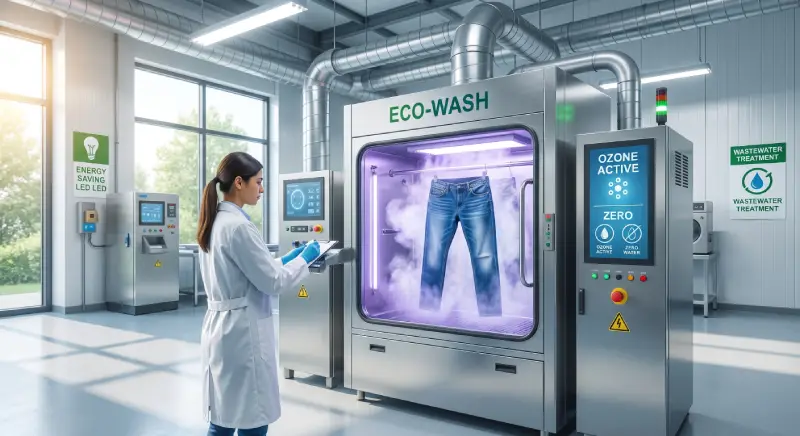
The old-style denim washhouse, formerly synonymous with environmental pollution, has had a green shakeup. Advanced laser distressing that is often performed in factories has replaced hazardous hand-scraping and potassium permanganate spraying for progressive manufacturers. They also use air instead of thousands of gallons of water to bleach denim with ozone technology that is devoid of H2O and uses less energy.
4.3 Auditing Factory Ethics: Waste Water Treatment (WWT) and Social Responsibility
If your potential partner has a wastewater treatment (WWT) facility, take a closer look at what their low-carbon initiatives are. Ethical manufacturers strive to reduce energy usage in every step of the manufacturing process. Take, for instance, the green infrastructure projects carried out by Kaiping Lianwang Garment, including energy-saving lighting sources and boiler steam exhaust recovery systems. These actions show compounding evidence of both environmental integrity and low-carbon socio-responsibility.
5. Streetwear Trends: Heavy Customization and Secondary Craftsmanship
Strong demand for heavily customized, complex denim aesthetics continues to be driven by the global streetwear market.
5.1 Integrating Multi-Process Designs: All-Over Prints, Rhinestones, and Heavy Distressing
Modern denim fashions now rely on several intermediate production phases, all performed on one individual garment. One pair can include all-over laser prints, rhinestone adornments, destroyed hems and nitty-gritty weaving. This process also needs a very carefully arranged factory layout to manage. It requires smooth arrangements from the manual department, sample division and specialized lines of output to take care not to harm the structure of the denim material.
5.2 Sourcing Premium Custom Branded Hardware: Custom Rivets, YKK Zippers, and Leather Patches
A brand is often proven by hardware quality. A world-class manufacturing partner will give your brand access to top trim suppliers with hard-nosed branded metal rivets, hot-pressed leather patches, and durable, authentic YKK zipper teeth constructed for aggressive stone-washing cycles without melting away or sticking.
5.3 On-Trend Silhouettes: Mastering the Pattern Architecture of Baggy, Cargo, and Y2K Flared Jeans
The fashion cycle has gone beyond the classic skinny jean to include elaborate shapes such as loose-fitting baggy jeans, multi-pocket utility cargo pants, and early-2000s-inspired flared styles. These are styles that need the best pattern-making. Pattern makers in the factory need to know how to make heavy denim drape around deep cargo pockets and dramatic flares appealingly, to make sure that garments are aesthetic and comfortable.
6. Step-by-Step Inspection Checklist Before Releasing Your Bulk Payment
Always pay your final bulk payment only when your production run passes a strenuous quality control check.
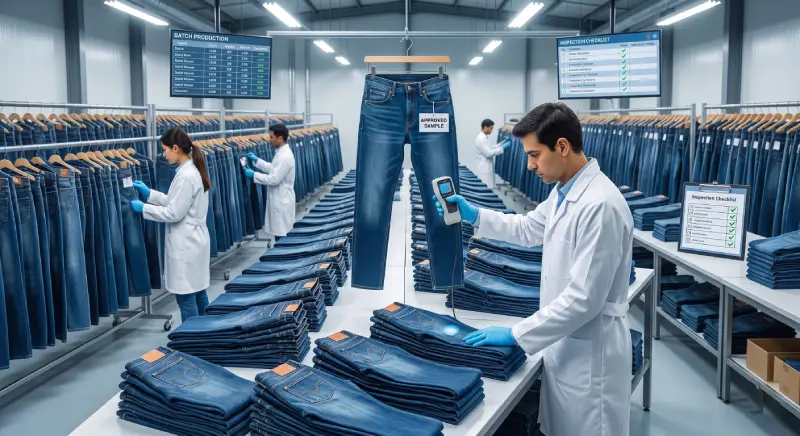
6.1 Conducting Pre-Production Sample Audits for Stitching Density & Seam Strength
Audit the PP with a lot of scrutiny before approving for full-scale production. Ensure that the number of stitches per inch is between 8 and 10. Bartack at critical stress points (crotch seam, belt loops, back pockets) to help prevent ripping under heavy pressure.
6.2 Setting Up Independent Third-Party Quality Control (QC) Inspections
Never take a factory’s word for it. Outsource an independent quality inspection agency to carry out a physical check with traditional AQL 2.5 standards. A well-known manufacturer will totally embrace this transparency, backing full quality control and even supplying any national quality certifications and reports when being shipped.
Pre-Payment Quality Assurance Checklist
| No. | Verification Item | Operational Focus / Standards |
| 1 | Stitch Density & Reinforcements | Verify stitch density (SPI) and ensure all bartack reinforcements are correctly placed at stress points. |
| 2 | Color Consistency Audit | Audit color variance across separate wash batches to ensure it falls within acceptable shade-band tolerances. |
| 3 | Dimensional Inspection | Measure physical dimensions of the finished garments against the approved tech pack spec sheets. |
| 4 | Hardware Integrity Testing | Test functional and physical integrity of all hardware items (including zippers, rivets, and buttons). |
| 5 | Documentation Review | Conduct a final review of all third-party inspection certificates and internal quality assurance reports. |
6.3 Conclusion: Partnering with a Long-Term Denim Garment Manufacturer
It is an investment in the future of your brand to choose the right manufacturing partner. Search for companies that have combined with purpose-built infrastructure and other mainstay technical solutions. Think of manufacturers such as Kaiping Lianwang Garment Co., LTD, which run factories 7,000+ square meters with more than 330 kinds of garment machines (10 production lines) and over 150 skillful workers. Backed with an outgoing production of over 600,000 units per year and experience in the global export market within Europe, the US and Australia, giving you the reliability to scale out your business.
When working with a transparent, sustainable manufacturer who knows their stuff, you reduce those production challenges — meaning minimal variation batch-to-batch and denim that makes your customers come back for more!
Frequently Asked Questions (FAQ)
Q1: How long does it take to create denim samples and bulk orders?
Custom sample creation by top-level manufacturers is usually accomplished within 10–20 days. Bulk production lead time is normally between 25 and 35 days, which may be longer or shorter depending on the complexity of the design, after samples are approved and tech packs are aligned.
Q2:What to Do About Sizing Issues due to Shrinkage with a Bulk Denim Order?
For instance, make sure your manufacturer tests the fabric lots for shrinkage before they cut them. The better factories will wash test swatches, measure the shrinkage rate and use that to adjust their production pattern dimensions so that when finished, those jeans come out according to your tech pack spec.
Question 3: What if I get defective garments or damaged garments in my shipment?
Cooperate with manufacturers who guarantee you a clear quality. Trustworthy providers will perform an extensive check on every consumer good before dispatch. Also, look out for an explicit after-sales agreement that states that in the case of the sale of defective goods, the broken pieces will be replaced.

Recent Comments