
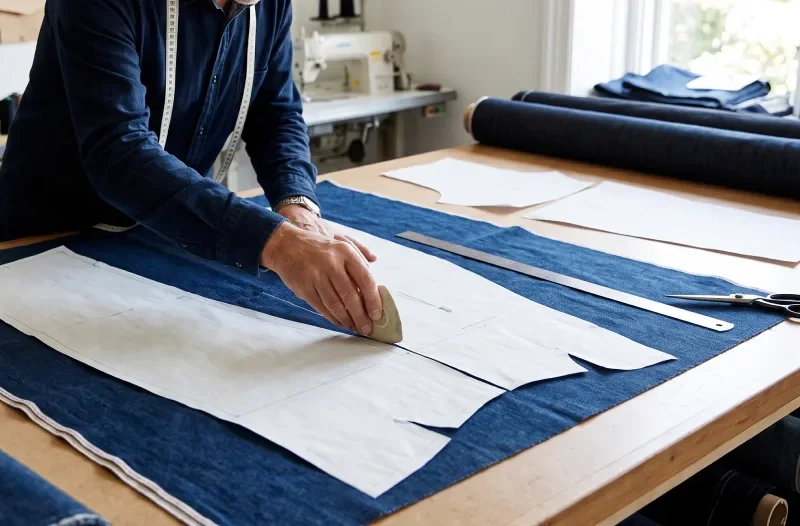
That proverbial pair of jeans that fits just right is something you might only dream of. Millions of men are left making do with a pair of starchy, stiff denim that pinches at the waist, or bulges at the thigh — standard mass-production sizes. Custom-made men’s jeans offer a clearer outline as it is tailored according to the curves of your body.
Everything you want to know about custom fit denim is in this guide. We analyze the details of patterns, fabrics, how you measure and manufacturing standards. Plus, we deliver 40 years’ worth of denim production expertise on how to buy it right.
1.The Real Reason Standard Off-the-Rack Jeans Suck For Most Modern Men
Off-the-rack (OTR) denim is based on averages, not real human biology. As a result, off-the-rack jeans often present fit problems for athletic physiques, taller individuals, or anyone not in line with regular size charts.
1.1 The Shared Issues of Poor Fit: A Tight Thigh Here — A Gap at the Waist There, Friction at the Inseam
Mass-produced jeans are plagued by three major pain points that most men encounter:
· Narrow Hips with Bogus Biceps: Athletic men, to fill out larger thighs and eliminate gaps in the waistband, typically pinch an inch or two off their waists. Also, as a result, the back is sadly gaping at the waistband.
· Inseam Friction and Bunching: The inseams you can find second-hand in mass-manufactured clothing for men are not typically a great fit for your actual leg length. As a result, extra fabric folds over the ankles or creates unnecessary friction between the inner thighs.
· Seat Compression: Normal designer jeans compress the buttocks in a flattening way. As a result, no matter how thin you are, when you walk, the cloth tugs against your hips to an uncomfortable extent.
1.2 MTO vs off-the-rack; reason that off-the-rack is hidden different structure
Automated batch-cutting of stacked fabric layers forms the basis for mass production. This is why thousands of identical pattern panels are cut at once on factory machines. This generates savings in production costs through the neglect of asymmetries that are specific to the subject.
Note that true made-to-measure denim is different, in that there is individualization on the pattern. Since then, many garments are manufactured using specialized R&D teams and accurate machinery to develop patterns (on low-energy 3D printers) suitable for mass production. For example, high-end denim factories will send a team of dedicated researchers—more than 15 individuals working across more than 330 unique types of machines—to create unique specs for each line of custom denim. These structural differences guarantee that each seam can fall in absolute harmony with your natural posture.
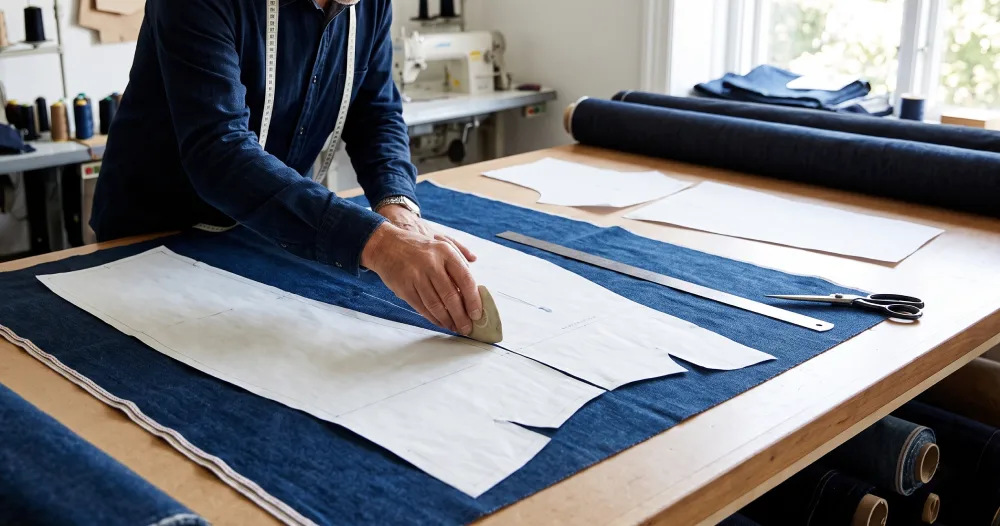
For brands developing a fit block, a detailed denim tech pack helps record rise, waist, seat and leg measurements consistently.
2.Rise, seat and seated easy — the missing link to fit into a pair of denim
Those numbers are blurred entirely in favour of waist and inseam. Yet, two dimensions cannot tell when it’s right.
2.1 Why Waist and Inseam Build Your True Custom Charmer
Two men with a 34-inch waist and 32-inch inseam can have entirely different body shapes. For example, a pelvic tilt – or a fuller seat in one man but not with another. The third male is often flat in the back and longer in the form.
Standard sizing pays no attention to pelvic shape whatsoever. Thus, waist and inseam specs do not give an accurate representation of how something will hang on the lower half.
By adjusting the front and back rise ratios, you circumvent “Crotch Dig.”
When the rise ratio is well out of balance, you get what we refer to as a dreaded “crotch dig” or “cardboard wedgie”. Front rise determines where the waistband hits your belly. Back rise gives the extra space you need throughout posterior curves.
Expert Insight:
As you sit down, your hips rotate backwards and your bottom swells mega. To narrow the front and keep the back rise, THE WAISTBAND WILL BE PULLED DOWN AS YOU SIT WHILE THE GREETING CARD SEAM AT CROTCH LEVEL KEEPS DIGGING AGGRESSIVELY UPWARD! The standard solution to this is by altering the Back Rise angle individually, which is what professional custom tailors do. Custom denim allows you to eliminate seated tension at the back rise panel by adding vertical depth and some curve without creating front bulges.
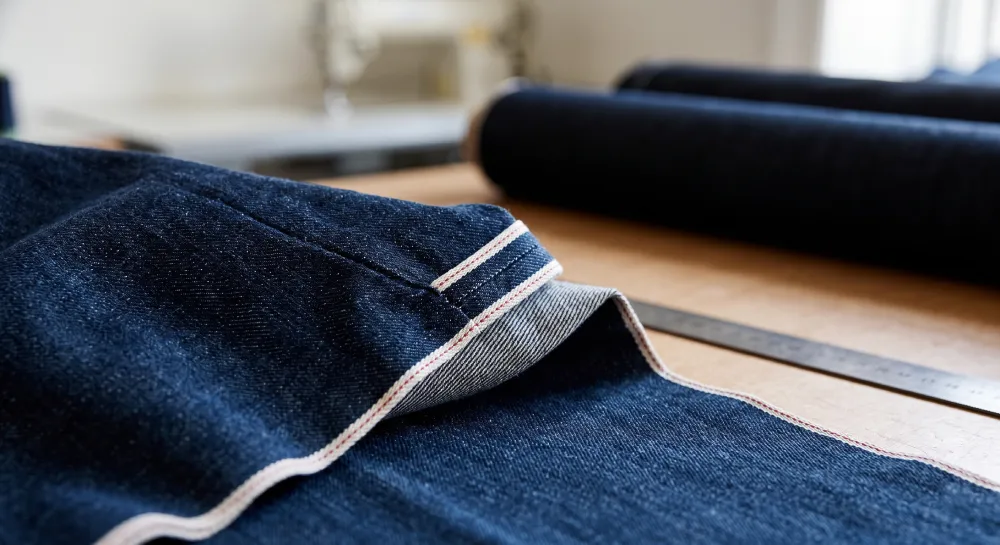
Choosing raw or selvedge fabric also affects the break-in period; see our guide to what selvedge denim is for more detail.
3.Custom Denim Fabric Selection – The Right Material Matters
Fabric construction is what makes custom jeans look, touch, and wear like a dream.
3.1 Raw Selvedge Denim -vs- Micro-Stretch Blends
· Raw Selvedge Denim – This is made in the traditional way on shuttle looms that cause tight self-finished edges. Moreover, 100 % cotton raw denim conforms and adapts to whatever your body is like after months of usage.
· Micro-Stretch Blends: Adding 1% to 2% elastane (spandex) allows the pants to feel comfortable right away. Hence, these stretch blends are particularly adept at lending a dynamic from the active-lifestyle realm and—especially in lean silhouettes.
3.2 Real World Shrinkage Data: The First Wash What Happens
Water and heat cause fiber contraction in all cotton denim. As a result, when it comes time for custom pattern makers to cut fabric, they should determine precise shrinkage allowances.
The table below shows real-world data on shrinkage testing across different denim fabrics.
When buying bespoke denim online, give your maker clear guidance about wash qualifications. Before full production runs, professional plants test fabric samples in-house to calculate the accurate variables for shrinkage.
| Fabric Composition | Pre-Wash State | Post-Wash Shrinkage (Waist) | Post-Wash Shrinkage (Inseam) | Recommended Customization Strategy |
| 100% Cotton Raw Selvedge | Unsanforized / Rigid | 3.0% – 5.0% | 4.0% – 6.0% | Request +1.5″ inseam compensation and +0.75″ waist allowance. |
| 100% Cotton Sanforized Denim | Pre-treated / Pre-shrunk | 1.0% – 2.0% | 1.5% – 2.0% | Order true to size; fabric stabilizes after first gentle wash. |
| Cotton / Poly / Elastane Blend | Micro-Stretch (2% Stretch) | 0.5% – 1.5% | 1.0% – 1.5% | Cut snug; elastane rebounds quickly after washing. |
3.3 Denim Weight Chart: Lightweight 11oz to Heavyweight 16oz
· Shades in the 9-11 ounce range: Best for summer months and warmer climates. That said, thinner fabrics wear out more quickly under continuous abrasion.
· Midweight (12oz – 14oz): The golden standard of all-year usage. Also provides structure durability with everyday comfort.
· Heavyweight (15oz — 18oz+): Really tough and stiff. Heavy Denim does give you nice fade lines but takes a long time to break in.
Details such as rivets, buttons and leather patches can complete a custom pair; explore our guide to custom denim trims.
4.Beyond Fit: Personalizing the Details
With custom tailoring, you can dictate functional hardware and aesthetic embellishments to the millimeter.
4.1 (Functional Customizations — Zipper Fly v/s Button Fly, Pocket Depth
· Traditional button flies, to avoid horrible fabric bulging when sitting down. In contrast to more upscale leather zipper flies, which are very quick and contemporary.
· Pocket Depth: She just finished raving about mass-produced shallow front pockets. Deepen Pocket Bags: Your custom jeans support the more rigid insertion of large smartphones.
4.2 Aesthetic elements: thread color, hardware rivets and leather patches
The art of personalization takes basic garments into signature territory. Custom tobacco contrast stitching, solid copper rivets or leather waist patches of your own design. You are offered not only one-stop OEM and ODM services, but also full customization of wash techniques, logos that match your brand, additional hardware according to design start-up, as well as specialized packaging.
5.Measuring Custom Men’s Jeans (Online vs. In-Person)
The right measurement input is paramount to creating the perfect fit.
5.1 3D Body Scanning Apps vs. AI Fit Quizzes; 3 Send Your Favourite Pair
· 3D body scanning apps — Create thousands of points of data about the body in a matter of minutes using mobile cameras.
· Predict Sizes Through Algorithm Averaging Based on Height, Weight and Brands But AI estimates still may not capture idiosyncratic limits of posture.
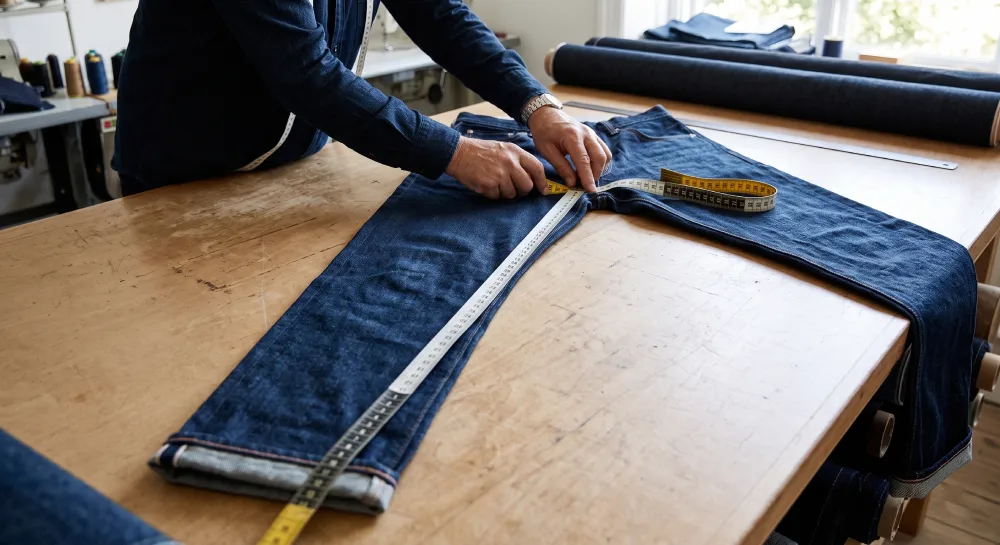
· Measuring your favourite pair: This is still the most accurate DIY method. A garment specification based on a good-fitting pant.
5.2 In-Home Ordering: A Step-by-Step DIY Measurement Protocol
Follow this specific protocol, using a soft, flexible cloth measuring tape:
Waistband: Lay the jeans flat. Measure end to end while pulling the front and back waistbands flush, and multiply by 2.
Front rise: Measure vertically from the intersection seam of the crotch up to where it meets the top of the front waistband
Thigh Width: Measure flat across the leg panel beginning 1 inch down from where the crotch seam and side seam meet.
Inseam – Measure from the top between your legs where the crotch meets straight down to the bottom leg opening hem.
6.Size, Height, and Weight Changes: Is It Real?
The long-term value of custom clothing raises some valid questions in terms of investment.
6.1Value Comparison over 3 Years
Fast-fashion denim that starts at $50 often breaks down after 30 wears. That yields a $1.67 cost per wear.
On the other hand, a $300 custom denim in high-quality cotton is comfortable up to 300+ washes. That means the price-per-wear then comes down to $1.00, offering better long-term savings.
6.2 The Weight Fluctuation Cushion: How to Design Jeans That Fit in the Face of ±10 lbs
Expert Insight:
There you have it; men are continually ‘afraid’ that slight weight variations will spoil their costly bespoke jeans. This is why it would be best if seasoned custom pattern designers include a ±10 lbs weight cushion. Custom jeans also fit into those naturally changing body proportions via hidden stretchable waistline structures or internal seam allowances. Additionally, select direct-to-consumer custom brands have warranty benefits for alterations over time, including complimentary options to adjust waist settings.
7.Best Custom Jeans for Guys
7.1 Blue Delta Jeans: Best for High-End Made-to-Measure
Full bespoke is the name of the game at Blue Delta. Additionally, they provide premium fabric customization and consultation services to elite clientele.
7.2 Best for Tech-Driven Fit: Unspun →→Expert Evaluation 4.6/5. As of October 2023, we have both widespread and custom denim brands.
Unspun shapes custom patterns from zero-waste 3D mobile scans via smartphone. Sene also uses algorithms, but to provide customized stretch denim quickly.
7.3 Easy to Home Try-On: Todd Shelton
Todd Shelton: Todd Shelton ships physical try-ons to your residence. That means you can physically test the fit before committing to final production.
Textile Standards: Industrial Denim Manufacturing
An expert manufacturing partner sits behind every custom denim brand. High-quality true custom requires strong internal factory capabilities, quality management and advanced technology.
To illustrate, some garment firms would have a facility of more than 7,000 m2 with over 150 experienced workers. In the latter group, you have manufacturing plants with 10+ automated production lines yielding an annual capacity of over 600,000 denim pieces.
Manufacturing standards today also require more sustainable practices. Premium facilities are equipped with energy-saving LED lighting and boiler steam exhaust recovery systems that help reduce their environmental footprints.
Logistics & supply chain: Quick turnaround times are a must-have for online custom brands. Fast-response factories offer inquiry response in 30 minutes, accurate Quotes in 3 hours, custom sample development within 10–20 days and order fulfillment done by using the production capacity for orders of 25–35 days, with just a few top manufacturers guaranteeing full inspection quality.
For care tips after choosing rigid fabric, read our guide to softening stiff denim.
Frequently Asked Questions (FAQ)
Q1: How much time does it take for a custom pair of jeans to reach the customer?
Online custom denim brands typically take about 2 to 4 weeks to deliver. This timeline includes the creation of patterns tailored to you, precise cutting, crafting and quality inspection.
Q2: Custom jeans fit perfectly when they arrive; if not, what should I do?
Many respectable custom denim makers even offer guarantees on the fit, or credits towards alterations. Visibly, smaller tweaks like the waist or hem can be sewn locally by tailors or sent back to the brand to be re-stitched.
Q3: How many times do I wash raw custom denim?
Wear raw denim for 3 to 6 months before its first wash to preserve color density and fabric structure. To prevent shrunken fabrics and unexpected cold washes.
Q4: Could my custom jeans blow out in the crotch later on?
Yes. Good quality denim will have additional seam margins to permit professional tailors of the profession to do darning and/or gussets that can drastically lengthen these garments.

Recent Comments