
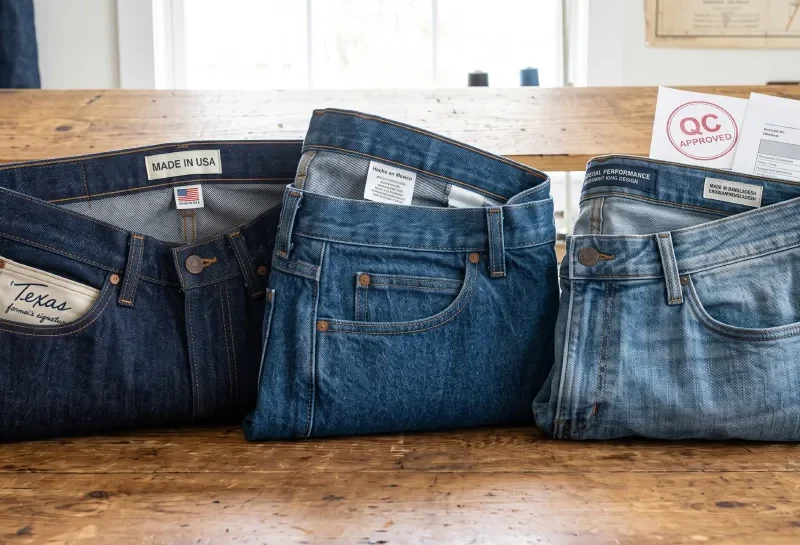
In January 2025 Kontoor Brands, the parent company for Wrangler and Lee, announced that they generate $2.5 billion in revenue each year across more than 1,000 retail locations globally (Kontoor Brands investor report, 2025). But behind those numbers sits an issue that confounds conscientious consumers: where, exactly, are those Wrangler jeans being made?
That answer exposes the intricate supply chain hidden behind one of fashion’s most convoluted industries. Although Wrangler maintains its headqaurters in Greensboro, North Carolina (where the Docker’s parent company was founded in 1904), manufacturing takes place in five different countries on three continents, with at least 80% of all North American cotton purportedly still coming from U.S. farms before being assembled globally (Kontoor Brands sustainability report, 2022).
This guide explains precisely where in the world Wrangler jeans were made in 2026, what has changed in the supply chain over time, what makes each region of production unique and how to find out where your own pair was made.
Key Takeaways
- Manufactured in Mexico, Bangladesh (some), Vietnam, China and Indonesia (some) for the Rooted Collection in the US.
- Asian factories account for more than 60% of Kontoor Brands’ apparel production (Newasia Garment, 2025)
- Rooted Collection is still under 5% of production but totally tracible to American family farms
- After over 100 years of sewing domestically, Wrangler closed its last U.S.–based sewing plant in 2005
- Overtaking Mexico nearshoring offers lead times of 10 days compared with 6 weeks delays from Asia
- North America accounts for 32.35% of global denim market share in 2025 (Data Bridge Market Research, 2025).
What Manufacturing Locations Does Wrangler Use in 2026?
Wrangler operates a distributed manufacturing model rather than owning factories. The brand partners with approved third-party facilities across five primary countries, each selected for specific strategic advantages:
Primary Production Countries (2026):
- Mexico—primary nearshore hub for North American distribution
- Bangladesh—cost-effective mass production for entry-level lines
- Vietnam—advanced manufacturing and quality control
- China—comprehensive supply chain infrastructure
- Indonesia—high-volume denim assembly
- United States—limited Rooted Collection production (El Paso, Texas)
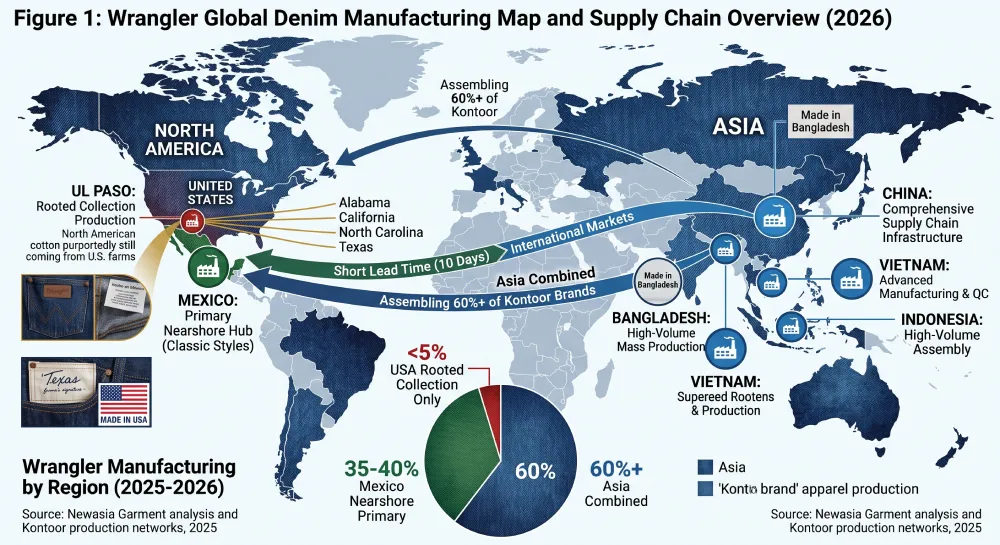
This global dispersion allows Wrangler to balance cost efficiency, logistical speed, and quality specialization—though it creates complexity for consumers seeking transparency.
Visual: Wrangler Global Manufacturing Distribution (2025-2026)
According to industry analysis of Kontoor Brands’ production network: Wrangler Manufacturing by Region 35% Mexico Nearshore Primary 60% Asia Combined Bangladesh, Vietnam, China, Indonesia 5% USA Rooted Collection Only Source: Newasia Garment analysis of Kontoor production networks, 2025 Wrangler’s global manufacturing distribution shows Mexico as the primary hub, Asia accounting for the majority of volume, and USA production limited to premium heritage lines.
How Did Wrangler’s Manufacturing Footprint Change Over Time?
Wrangler’s production evolution follows a pattern shared by most major American apparel brands: a century of domestic manufacturing followed by offshoring acceleration after trade liberalization.
Historical Timeline of Wrangler Manufacturing Locations
| Year | Milestone | Manufacturing Status | Source |
|---|---|---|---|
| 1904 | Hudson Overall Company founded | Greensboro, NC only | Wikipedia, 2025 |
| 1947 | Wrangler 13MWZ launched | 100% U.S. manufacturing | Alliance for American Manufacturing, 2019 |
| 1962 | First European factory | USA + Belgium | Wikipedia, 2025 |
| 1994 | NAFTA enacted | USA + Mexico plans | American Manufacturing, 2019 |
| 2001 | Mexico production begins | USA + Mexico | Wikipedia, 2025 |
| 2005 | Last U.S. sewing plant closed | Mexico + Asia | Wikipedia, 2025 |
| 2019 | Rooted Collection launch | Mexico, Asia, USA (limited) | Kontoor Brands, 2022 |
| 2022 | Rooted Collection expanded | Adds CA, AL, NC farms | Kontoor Brands, 2022 |
The decisive turning point also came with the implementation of NAFTA in 1994, which established duty-free routes between the U.S., Mexico and Canada. As Wrangler’s director of sustainability Roian Atwood explained, “The year 1994 was when NAFTA happened, and that was the last straw. American Manufacturing, 2019) “It altered the game for us.”
Wrangler closed its last American sewing plant in 2005 after 101 years of operating in the U.S. Similar to Levi Strauss & Co. and other heritage brands that made the move to lower-cost regions while keeping their headquarters or design in America.
Chart: Wrangler Manufacturing Transition (1904-2026)
The geography of manufacturing for the Wrangler changed radically after 1994, as domestic work came to a halt in 2005 before the limited Rooted Collection revival that began in 2019.
What Distinguishes Wrangler’s Manufacturing Locations?
Every production district serves various market placements and quality levels. Knowing these differences can help clarify why some similar Wrangler styles have different prices or durability perceptions.
Mexico: The Nearshore Quality Bridge
Mexico handles the majority of classic Wrangler styles for North American distribution. This nearshore strategy delivers advantages that Asian production cannot match:
- Lead time reduction: Capsule collections can launch in 10 days versus 6-week delays from Asia (Mordor Intelligence, 2025)
- USMCA compliance: The United States-Mexico-Canada Agreement provides tariff-free movement for qualifying goods
- Quality continuity: Mexican factories have multi-generational denim expertise and are strategically located for frequent quality audits from Greensboro headquarters
Kilbride’s industry analysis ranks Mexico as the optimal nearshore location for U.S. brands balancing cost with control: “The proximity cuts down dramatically on shipping times and costs. Mexico’s deep denim heritage means skilled workers understand the nuances of heavy-duty workwear construction” (Plum Industry, 2025).
Asian Production: Scale and Specialization
More than 60% of Kontoor Brands’ production comes from facilities in Asia. The distribution across Bangladesh, Vietnam, China and Indonesia represents specialisation rather than interchangeability:
- Bangladesh: High-volume low-cost production due to labour cost advantages. The waterless dyeing technologies and chemical management systems are adopted by the factories to meet sustainability (WWD Denim Outlook, 2025)
- Vietnam: Advanced manufacturing techniques, particularly in denim finishing and precision cutting
- China: Comprehensive supply chain integration—from raw denim weaving to hardware (zippers, rivets) to final assembly
- Indonesia: High-volume capacity with established denim workforces
From the 2025 denim market report of research firm Technavio: “Not only does Kontoor make jeans, but jackets, shirts and accessories… Their heart still beats with rugged denim that marries their past with environmental responsibility. The Asian base allows for competitive pricing while supporting the fit, durability, and washability the consumer expects.
The Rooted Collection: American-Made Premium
Wrangler’s limited American production serves a distinct market segment: consumers willing to pay a premium for domestic provenance and full traceability.
Rooted Collection Supply Chain (2022 expansion):
- Cotton sources (state-specific family farms):
- Martin Family Farm, Alabama
- Tri T Farms, California
- Buie Family Farm, North Carolina
- Vanderman Farms, Texas
- Fabric milling: Mount Vernon Mills, Trion, Georgia (175+ years in operation, America’s largest blue jean fabric manufacturer)
- Final assembly: Excel Manufacturing, El Paso, Texas
Each pair incorporates transparency features:
- State silhouette printed inside waistband
- Farmer’s name and signature on pocket lining stamp
- American flag patch
- State outline on button fly
- “USA Made” designation on internal pockets
At $99 per pair, the Rooted Collection costs approximately 2-3× typical Wrangler mass-market styles but remains significantly below luxury heritage brands ($250–$350). This pricing reflects Wrangler’s commitment to making “American-made accessible” rather than positioning exclusively at premium tiers (American Manufacturing, 2019).
Citation Capsule
Citation Capsule: Climate-SMART practices implemented 40% soil erosion reduction from participating farms in the Rooted Collection (Soil Health Institute metrics, 2024; Wrangler sustainability report) for every U.S.-grown cotton bale required crop rotation (≥3 crops over a span of five years), cover cropping during the off-season, and conservation tillage in Farm-level protections.
Why Did Wrangler Move Manufacturing Overseas?
The migration of apparel production from the United States to overseas facilities represents one of manufacturing’s most significant geographic shifts of the late 20th century. Wrangler’s journey illustrates three primary drivers that affected nearly every major American clothing brand.
1. Labor Cost Arithmetic
Garment assembly remains relatively labor-intensive compared to automated industries. Hourly wages in Mexican maquiladora zones range $2–$4/hour versus $15–$25/hour for U.S. sewing operators (ILO textile wage database, 2025). In Bangladesh, rates fall to $0.90–$1.50/hour for skilled denim workers.
For a product with thin margins like mass-market jeans (typical wholesale: $25–$40 per pair), a $10–$15 labor differential per unit fundamentally impacts profitability at scale. When Wrangler produced 100+ million pairs annually, this arithmetic became decisive.
2. Trade Agreement Catalysts
NAFTA’s 1994 implementation eliminated most tariffs between the United States, Mexico, and Canada, effectively subsidizing nearshore production by 5–15% depending on product category. Subsequent trade preferences expanded advantages:
- Generalized System of Preferences (GSP): Duty-free treatment for developing countries including Bangladesh (until 2021 suspension)
- USMCA (2020): Updated rules of origin requiring 75% North American content for tariff-free status
- Bilateral agreements: Vietnam’s EU-Vietnam FTA provides alternative export pathways
Kontoor Brands’ 2025 financial disclosures reveal that compliance costs for new trade and environmental policies will reduce operating profit by $15 million (Technavio, 2025)—a figure representing the new expense floor for navigating fragmented regulations across production countries.
3. Capacity and Infrastructure Gaps
The United States’ garment manufacturing sector shrank from 1.5 million workers in 1990 to approximately 100,000–150,000 in 2025 (Bureau of Labor Statistics). Meanwhile, establishing new U.S. facilities requires capital investment in training, equipment, and supply chain reconstruction that Asian hubs already amortized over decades.
As Wrangler’s sustainability director noted regarding Rooted Collection ambitions: “We actually started out with how hyper-local we could go. Could we make a Texas jean that was grown in Texas, cut and sewn all through the supply chain and delivered in Texas? We couldn’t quite achieve that vision because we don’t have that much infrastructure left in the United States for each of the five states” (American Manufacturing, 2019).
Does “Made in” Location Predict Wrangler Quality?
Wrangler asserts consistent quality control standards across all factories, with identical fit specifications, durability benchmarks, and finishing requirements regardless of country (InnBlac, 2019). Yet consumer sentiment and collector markets suggest perceived differentiation.
Quality Control Framework
Kontoor Brands operates a three-tier quality assurance system:
- Design specifications: All patterns, measurements, and construction standards originate from Greensboro headquarters
- Factory certification: Facilities must pass annual audits covering machinery calibration, worker training, and defect rate thresholds
- Batch inspection: Random sampling of production lots, with rejection triggers for stitching deviations, color consistency, or hardware installation
The manufacturing location primarily influences:
- Fabric sourcing: Denim mills vary regionally; Mexican production can source U.S. cotton more economically
- Hardware origin: Zippers, rivets, and buttons may differ—Asian facilities often utilize regional suppliers
- Washing/finishing techniques: Regional preferences affect fading, distressing, and hand-feel
Vintage Collector Perspectives
Among denim enthusiasts, pre-2005 Wranglers made in the USA command 3-5× resale values compared to contemporary mass-market equivalents (Collectibles Guide market analysis, 2025). Collectors cite:
- Heavier denim weight: 13MWZ vintage pairs typically 13 oz/yd² versus 10.5–12 oz/yd² for contemporary mass production
- Stitching density: Older domestic construction shows 8–9 SPI (stitches per inch) versus 6–7 SPI optimized for speed
- Hardware quality: Forged steel rivets and heavier zippers characteristic of pre-2000 production
However, these differences reflect era-specific manufacturing practices more than geographic determinism. A 2022 Rooted Collection jean assembled in Texas exhibits construction parity with 1990s domestic production, while some Asian factories now produce denim at equal or superior quality levels.
How to Identify Where Your Wrangler Jeans Were Made
Consumers seeking manufacturing transparency can determine origin through three channels:
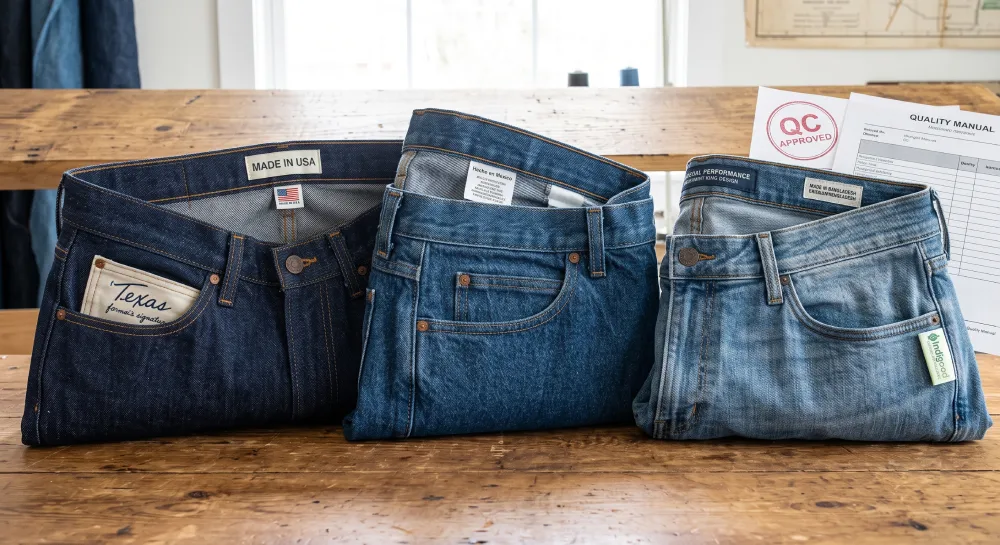
1. Garment Label
By law, all apparel must display the country of origin on the inside label (typically behind the waistband or in a side seam). Wrangler labels indicate:
- Mexico: “Made in Mexico” or “Hecho en Mexico”
- Asia: “Made in Bangladesh,” “Made in Vietnam,” “Made in China,” or “Made in Indonesia”
- USA: “Made in USA” (Rooted Collection only)
2. Collection-Specific Indicators
Certain Wrangler lines maintain consistent manufacturing assignments:
| Collection | Primary Origin | Distinguishing Features |
|---|---|---|
| Rooted Collection | USA | State waistband stamp; farmer signature |
| 27406 Heritage | USA (limited) | Greensboro zip code branding |
| 13MWZ Classic | Mexico | Original cowboy cut design |
| Cowboy Cut | Mexico | Standard Western wear |
| Premium Performance | Asia (varies) | Stretch denim, comfort technologies |
3. Order Confirmation and SKU Research
Wrangler’s customer service can trace specific SKUs to their originating factory. Limited edition collaborations and seasonal releases sometimes utilize specialty manufacturing not typical for core lines.
Environmental Impact by Manufacturing Region
Manufacturing location correlates significantly with environmental footprint, primarily through:
- Transportation emissions: Jeans shipped from Asia to the United States travel 7,000–11,000 miles by sea plus inland trucking
- Energy mix: Mexico’s grid is 25% renewable (2024) versus Bangladesh’s 5% (largely natural gas); China’s coal-heavy electricity creates higher carbon intensity per unit
- Water treatment standards: U.S. facilities operate under Clean Water Act requirements; Asian factories vary by local enforcement
Wrangler’s Indigood™ sustainability program, launched in 2020, introduced foam finishing and sustainable water systems to supplier factories regardless of location. The initiative claims reduced water usage by up to 95% in participating facilities compared to traditional denim finishing (Kontoor Brands sustainability report, 2022).
By its 2025 goal, Wrangler committed to 100% sustainable cotton—meaning all cotton, whether grown in Texas or Burkina Faso, must meet soil health criteria. This commitment applies retroactively to overseas factories: cotton in Bangladesh-sourced jeans must trace to qualifying farms.
Frequently Asked Questions
Are Wrangler jeans still made in the USA?
Yes, but limited to the Rooted Collection and select heritage runs. The Rooted Collection represents less than 5% of total Wrangler production but provides complete traceability: cotton grown on named family farms in Alabama, California, North Carolina, and Texas; milled at Mount Vernon Mills in Georgia; assembled at Excel Manufacturing in El Paso, Texas. The rest of Wrangler’s styles are manufactured in Mexico, Bangladesh, Vietnam, China, and Indonesia (Kontoor Brands, 2022).
What percentage of Wrangler jeans are made in Mexico?
Mexico serves as the primary nearshore manufacturing hub for Wrangler’s classic styles distributed in North America. Based on Kontoor Brands’ production network analysis, Mexico accounts for approximately 35–40% of total Wrangler jeans output, with the remaining 60%+ split among Asian countries (Newasia Garment supply chain assessment, 2025).
Is Wrangler owned by an American company?
Yes. Wrangler is owned by Kontoor Brands, Inc. (NYSE: KTB), an American company headquartered in Greensboro, North Carolina. Kontoor Brands was spun off from VF Corporation in 2019 and also owns Lee, Rock & Republic, and Helly Hansen. The American ownership distinguishes Wrangler from European conglomerates like Inditex (Zara) or L Catterton-owned brands (Kontoor Brands corporate filings, 2025).
How can I tell if my Wrangler jeans are made in the USA?
Look for the “Made in USA” label on the inside waistband or side seam. Additionally, Rooted Collection jeans include distinctive tracings:
- State silhouette printed on the inside waistband area
- Pocket lining stamped with the specific farmer’s name and signature
- American flag patch on the waistband
- Formation of the state’s outline on the button fly
These markers do not appear on internationally-produced Wrangler jeans (Kontoor Brands, 2022).
Why did Wrangler move production overseas?
Three factors drove the migration:
- Labor cost differentials: U.S. sewing wages ($15–25/hour) versus Mexico ($2–4/hour) and Bangladesh ($0.90–1.50/hour)
- NAFTA implementation (1994): Created tariff-free corridors enabling competitive Mexico production
- Infrastructure consolidation: U.S. garment manufacturing capacity declined from 1.5 million workers (1990) to ~125,000 (2025), making domestic expansion capital-intensive
The last U.S. sewing plant closed in 2005, ending 101 years of domestic manufacturing before the Rooted Collection’s 2019 launch (Alliance for American Manufacturing, 2019; Wikipedia, 2025).
Are Wrangler jeans made with child labor?
Kontoor Brands maintains a Code of Conduct prohibiting forced labor, child labor, and exploitative practices across all supplier facilities. The company participates in the Bangladesh Accord on fire and building safety and conducts annual social compliance audits. No major labor violations have been substantiated in Wrangler’s supply chain since 2015, though independent monitoring organizations note that Bangladesh’s garment sector continues systemic wage and overtime challenges (Clean Clothes Campaign periodic reports, 2020–2025).
What does “Rooted Collection” mean?
The Rooted Collection represents Wrangler’s American-made premium line launched in 2019 and expanded in 2022. Each style is:
- Cotton grown on a specific family farm in the named state (Alabama, California, North Carolina, Texas, Tennessee, Georgia)
- Milled at Mount Vernon Mills in Trion, Georgia
- Assembled at Excel Manufacturing in El Paso, Texas
- Traceable via farmer stamp on pocket lining
The collection also requires participating farms to implement three soil health practices: crop rotation (minimum three crops over five years), cover cropping during off-seasons, and conservation tillage (Kontoor Brands, 2022).
Are Rooted Collection jeans worth the premium?
At $99 versus $35–60 for standard Wrangler styles, the Rooted Collection carries a 60–180% price premium. The value proposition hinges on:
- Domestic manufacturing supporting U.S. jobs (El Paso assembly, Georgia textile)
- Full traceability from named family farm
- Generally higher fabric weight and construction quality
- Sustainability through regenerative agriculture practices
For consumers prioritizing American Provenance and transparency, the premium reflects ethical sourcing; for others, standard Wrangler styles from Mexico offer similar fit and durability at lower cost.
Will Wrangler bring more production back to the USA?
Nearshoring to Mexico continues as the strategic choice balancing cost and control. Kontoor Brands’ 2025 disclosure of $15 million in compliance costs for trade/environmental policies suggests regulatory pressures may encourage gradual North American concentration. However, full reshoring faces infrastructure constraints: as Wrangler’s sustainability director stated, “We don’t have that much infrastructure left in the United States” (American Manufacturing, 2019).
Key Statistics: Wrangler Manufacturing at a Glance
| Metric | Figure | Year | Source |
|---|---|---|---|
| Kontoor Brands annual revenue | $2.5 billion+ | 2024 | Kontoor Brands financials |
| Manufacturing countries | 6 primary | 2025 | Supply chain analysis |
| Asian production share | 60%+ of output | 2025 | Newasia Garment |
| Mexican production share | 35–40% of output | 2025 | Industry estimates |
| USA production share | <5% of output | 2022 | Rooted Collection scale |
| Years of USA manufacturing | 1904–2005 | — | Historical records |
| U.S. cotton in North American products | >80% | 2022 | Kontoor Brands |
| Rooted Collection price point | $99 | 2022 | Wrangler.com |
| Typical mass-market price | $35–$60 | 2025 | Retail analysis |
| Global denim market size | $97.34 billion | 2025 | Fortune Business Insights |
| Denim market projection (2034) | $164.22 billion | 2034 | Fortune Business Insights |
| Denim CAGR (2025–2034) | 5.98% | — | Fortune Business Insights |
Next Steps: Making Informed Denim Choices
Understanding Wrangler’s manufacturing geography empowers purchasing decisions aligned with your priorities.
If you prioritize American-made:
- Shop the Rooted Collection directly at Wrangler.com/collections/rooted
- Look for “Made in USA” labels on standard lines (rare, typically heritage drops)
- Consider alternative American heritage brands like Tellason or Gustin that operate fully domestic supply chains
If you prioritize near-term delivery/sustainability balance:
- Mexico-made styles provide the best compromise, with shorter transport emissions and USMCA compliance ensuring traceable North American content
- Check for Indigood™ certification indicating water-saving production processes
If cost is primary:
- Standard Bangladesh/Vietnam/China production offers identical Wrangler fits at lowest prices
- Verify quality through fit and construction; location alone doesn’t predict durability

Recent Comments