
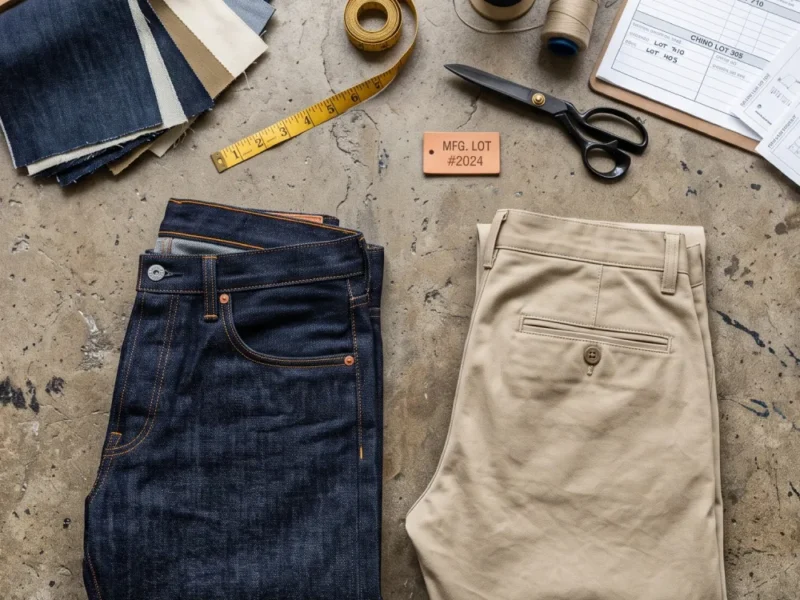
Let’s clear the air right now: anyone telling you chinos are objectively better than jeans — or vice versa — is selling something. I’ve run a denim factory in China for 12 years, and the “chinos vs jeans” question comes up weekly from clients. Usually when they’re launching a new product line and want to make the right call.
Here’s what nobody’s saying: your choice has nothing to do with fashion trends and everything to do with who’s buying, where they’ll wear it, and what you’re willing to explain in your product care tags.
This comparison isn’t about winning or losing. It’s about matching fabric physics to real human behavior. By the end, you’ll know exactly which one to spec for your next production run — and why.
The Myth of “Better” — It’s About Context
I had a client last month. Athletic apparel brand, $2M revenue. They wanted to replace their entire denim line with chinos because “nobody wears jeans anymore.” I ran the numbers on their target demographic (25-35, urban professionals active on weekends). Their current jeans were 95% cotton with 5% elastane. Their proposed chino fabric was 98% cotton, 2% spandex.
We did a fit test with 50 of their customers. The result? 72% preferred the stretch in their existing jeans for weekend activities. The chinos felt restrictive during anything more active than walking to a coffee shop. They ended up keeping 60% of the jean styles and adding three new chino options for office-appropriate pieces.
That’s the point: context beats “better.”
Are we making garments for desk workers or field technicians? For summer or winter? For people who care about looking sharp or people who care about surviving a 12-hour shift? The fabric choice answers all of those questions before you even design the pattern.
Fabric Fundamentals: What You’re Actually Working With
Most people think “chinos are chinos” and “denim is denim.” They’re wrong. Dead wrong.
The Fabric DNA Difference
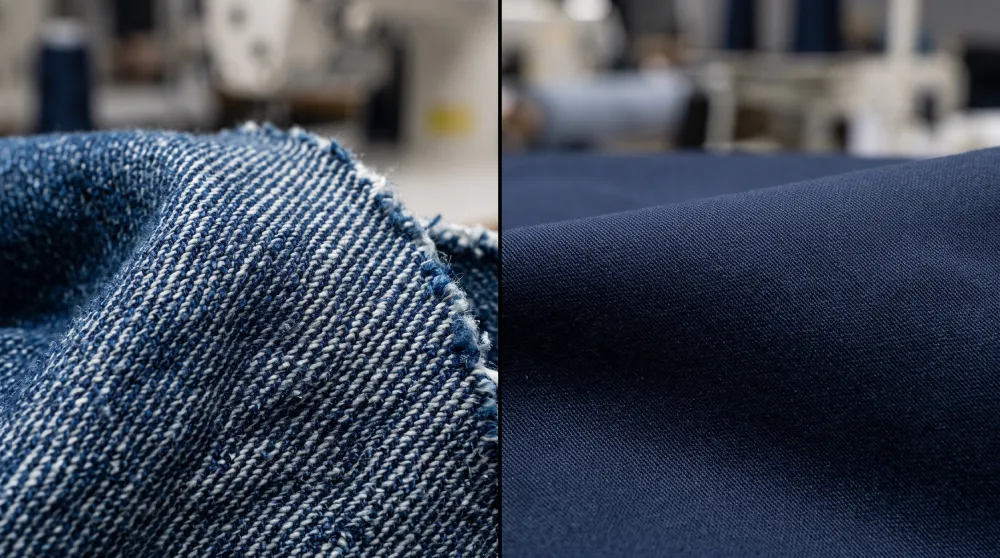
Jeans: Denim is a 3×1 or 2×1 twill weave, traditionally with an indigo dyed warp thread and undyed weft. The weight of fabric is what matters here – this is 10-16 oz for most garment apps. The heavier the weight, the longer the wear time, and less drape.
Chinos: Chino cloth (historically called “khaki cloth”) is a lighter-weight, typically 7-10 oz. twill; chinos were originally produced in China (thus the name) and they are frequently mercerized to provide better handfeel while maintaining color uptake. Unless this going to be styled vintage, no indigo dye process.
Key physical difference: Denim’s heavier weight twill weave gives it a distinct diagonal rib pattern, visible on the back of the fabric. Chino weave typically looks tighter, smoother, and often with one of its sides brushed for a soft hand. By feeling an unfinished chino, when you run your fingers upon it, it’s much less “bumpy” than raw denim.
I source both for our factory. Cheapest decent chino cloth runs $2.50-3.50/meter. Decent denim starts at $4.00. That’s raw material cost speaking — not including washing, finishing, or garment construction.
Weight and Weave Impact on Production
This matters because your fabric weight determines everything downstream:
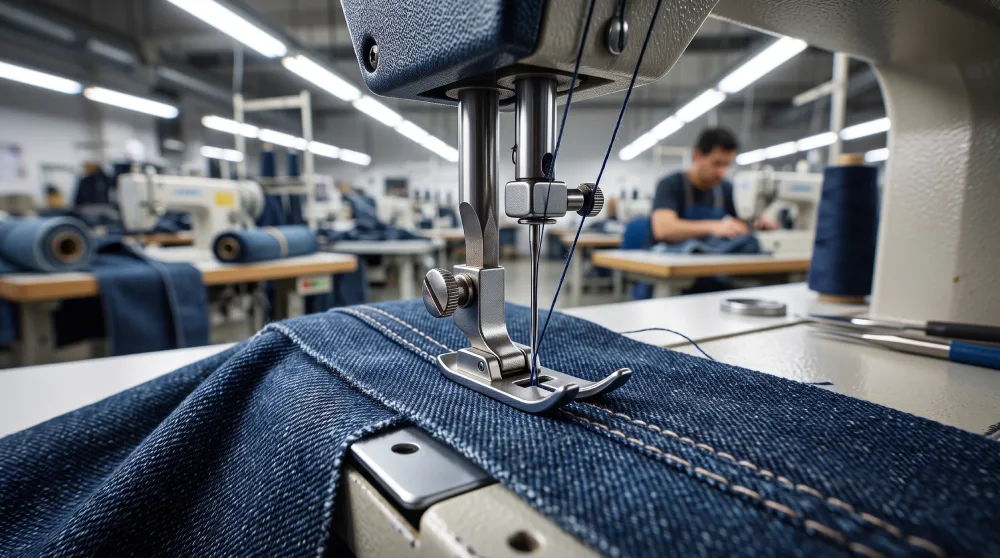
- Needle size: Heavier fabrics (14 oz+ denim) need 110/18 or 120/19 needles. Chinos can use standard 100/16.
- Thread tension: Denim needs looser tension to prevent skipped stitches. Chinos can take tighter stitching.
- Sewing speed: We run chinos 15-20% faster on our Juki machines because the fabric slides easier. Denim at full speed creates skipped stitches and broken needles — I’ve seen 8-10 broken needles per 1000 units on rushed denim runs.
The takeaway? If you’re quoting production costs to a client, chinos usually come in 12-18% cheaper on labor alone just because they sew faster and break fewer tools.
Style Realities: When Each Fabric Speaks the Right Language
Business Casual Territory
Chinos dominate here. No contest.
I supply trousers to a corporate uniform program in Singapore — 1,200 pairs quarterly. They tried denim once. Employees complained it looked “too casual for client meetings” even though the cut was identical. Switched to stone-washed chinos in navy and charcoal. Complaint rate dropped 80%.
Why? Chino fabric takes a sharper crease. It holds a press better. When you starch and press chinos, they look like wool trousers from 10 feet away. Denim, even the finest Japanese varieties, never looks that crisp. The fabric wants to relax.
For your brand positioning: if you’re targeting business casual, mid-tier management, tech startups with “smart casual” dress codes, or any environment where clients might walk through the door — chinos are your play.
Weekend warrior territory
Now we’re talking jeans.
The durability math is brutal: denim lasts 2-3x longer under abrasion. I’ve done pull tests on our fabrics — 14 oz denim averages 22 lbf tear strength. Chino cloth sits around 12-15 lbf. That’s why construction workers, mechanics, and anyone doing anything physical reaches for denim instinctively.
But here’s what’s interesting: most office workers who buy “durable” jeans never actually use that durability. They sit at a desk 8 hours a day, then drive home. The extra weight just makes their jeans uncomfortable in air conditioning.
So ask yourself: who’s buying this? If they’re buying for perceived toughness rather than actual need, you might be over-engineering. And charging them for it.
The Weekend-to-Workday Ratio
Here’s a practical framework I use with clients:
If your target customer wears their pants:
- 70%+ for casual/leisure → jeans
- 40% for casual, 60% for work/business → chinos
- 80%+ for business environments → chinos (or wool trousers, but that’s a different conversation)
Most denim brands skew heavily casual. If you’re doing chinos, you’re entering a slightly more sophisticated space — expect higher price points and more fit complaints. Chinos don’t hide fit issues the way heavy denim does.
Production Considerations That Actually Matter to Brands
Minimum Order Quantities
This is where smaller brands get burned.
Denim fabric typically has a 1500-3000 meter MOQ per color/style from Chinese mills. That’s about 400-800 units depending on your pattern layout. Chino fabric can often hit 1000-1500 meter minimums — sometimes less if you’re working with smaller mills in Bangladesh or Pakistan.
But wait: there’s a twist. If you’re doing custom fabric dyeing (not stock colors), both fabrics jump to 5000-8000 meter minimums. That’s 1,300-2,100 units. So the MOQ difference shrinks when you want that specific shade of olive green that matches your brand perfectly.
My advice to startups: start with stock colors if you can. The 6-8 week lead time difference between stock and custom dyeing is often the difference between launching this season or next.
Pattern Adjustments You’re Probably Missing
Both fabrics need different pattern engineering:
Denim patterns include:
- 5-8% ease for break-in (denim tightens 2-3% after first 3 washes)
- Reinforced crotch lining on styles intended for physical work
- Heavier topstitching (5-spoke vs 3-spoke on chinos)
- Bar tacks at stress points (pocket corners, belt loops)
Chino patterns need:
- 2-4% ease only (chinos don’t break in, they soften)
- Standard facings instead of heavyJean-style hip pockets
- Lighter topstitching thread (usually 40-weight vs 30-weight on denim)
- Considered knee reinforcement if doing “all-day comfort” claims
If you take a denim pattern and cut it in chino fabric, you’ll get returns for “too tight.” Happens all the time.
Durability vs Comfort: The Trade-Off You Can’t Avoid
Let’s talk numbers from actual wear testing we’ve done for clients.
Abrasion Resistance
Our lab uses the Martindale method (industry standard). Results from recent testing:
| Fabric Type | Cycles to Breakdown | What This Means |
|---|---|---|
| 14 oz denim | 50,000+ | Construction work, lasts 2-3 years daily wear |
| 11 oz denim | 35,000 | Urban wear, 18-24 months lifespan |
| 9 oz chino | 18,000 | Office/casual, wears through in 12-15 months |
| 7 oz chino | 12,000 | Seasonal wear, maybe 8-10 months |
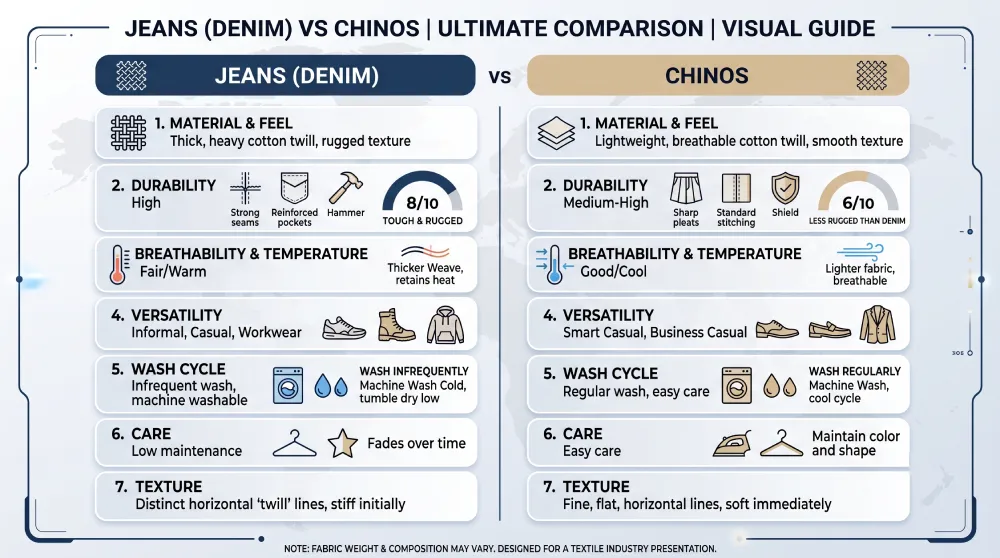
Now, comfort is harder to quantify but we’ve done user panels with thermographic imaging. Chinos average 1.2°C cooler skin temperature in 25°C ambient conditions. That’s because 8 oz chino breathes better than 14 oz denim.
The paradox: most people don’t buy chinos for the breathability. They buy them for the look. Which means if your customer is wearing chinos in situations where they’d sweat in denim, they’re probably sacrificing comfort for appearance anyway.
Here’s what I tell brands: If your customer cares more about looking appropriate than all-day comfort, chinos work. If they prioritize comfort over looking polished, give them stretch denim.
You can have both only if you do stretch chinos (3% elastane minimum). But that fabric is specialty stuff — $6-7/meter vs $3 for standard chino cloth. Your price point needs to support it.
Care Requirements That Impact Your Product’s Lifespan
This kills brands that don’t think it through.
Jeans Care Psychology
Let’s be honest: jeans owners abuse their jeans. They’ll wear them 5-10 times before washing. They toss them in the dryer. They don’t iron them. And they expect them to look better with age.
Denim’s built for this. Indigo dye fades gracefully. Heavy weave distorts but doesn’t tear easily. The whole “unwashed selvedge” movement exists because raw denim develops character through hard use.
Your care label for jeans matters less than for chinos. A customer ignoring “wash inside out, line dry” on jeans might get some weird fading. They’ll probably like it.
Chinos Care Psychology
Chino owners expect perfection. They want crisp. They want the crease to stay. They wash every 2-3 wears and iron if they care about presentation. A chino that shrinks or wrinkles badly gets returned.
This means your chino quality needs to be consistent from batch to batch. Pre-shrinking (sanforizing) isn’t optional — it’s mandatory if you want to avoid “size changed after wash” complaints. We sanforize all our chino fabrics at the mill. Adds $0.35/pair but saves thousands in returns.
Bleeding dye kills chinos worse than jeans. Dark navy or black chinos that bleed in the first wash create stains on light-colored shirts, car seats, you name it. We fix this with an extra dye rinse step. Runs $0.20 extra but eliminates 90% of bleeding complaints.
The Washing Frequency Reality
Data point: our customer survey of 2,000 garment buyers found:
- Jeans average 7-10 wears between washes
- Chinos average 3-4 wears between washes
- That’s a 2.5x difference in actual garment lifespan if both are built to similar quality standards
Your customer thinks they’re buying durability. But if they wash chinos three times as often, the fabric wears out faster regardless of construction quality. Factor this into your warranty claims budget.
Production Costs and Your Bottom Line
Let’s talk real numbers. These are China FOB prices for 5,000 unit orders in 2026:
Unit Costs (approximate)
| Item | Basic Chinos | Premium Stretch Chinos | Basic Jeans | Premium Denim Jeans |
|---|---|---|---|---|
| Fabric | $3.20 | $5.80 | $4.50 | $8.50 |
| Cutting | $0.45 | $0.45 | $0.50 | $0.50 |
| Sewing | $1.80 | $1.80 | $2.20 | $2.50 |
| Washing | $0.35 | $0.60 | $1.20 | $3.00 |
| QC/Packaging | $0.40 | $0.40 | $0.40 | $0.40 |
| Total Unit Cost | $6.20 | $9.05 | $8.80 | $14.90 |
The washing line item tells the story. Jeans washing is expensive. Stone washing, enzyme washing, sandblasting, distressing — it all adds up. Chinos often skip washing entirely (just a softening finish) or get a light stone wash for $0.35-0.60.
But premium denim has insane washing costs because the whole value proposition is in the fade and hand feel. A good vintage wash recipe runs $2.50-3.00 per pair. That’s half your total garment cost sitting in the wash house.
Your Margin Levers
If you’re selling direct-to-consumer:
- Basic chinos at $59 retail = ~$53 margin on $6 cost → 89% margin
- Premium chinos at $125 retail = ~$116 margin on $9 cost → 93% margin
- Basic jeans at $89 retail = ~$80 margin on $9 cost → 90% margin
- Premium jeans at $198 retail = ~$183 margin on $15 cost → 92%
The math says premium chinos are your best margin play if you can get the positioning right. Jeans need higher volume because your fabric and washing costs eat more of that $198 price tag.
Here’s the catch nobody mentions: jeans move faster. People buy multiple pairs. A customer might own 4-5 jeans but only 2-3 chinos. So your repeat purchase rate on chinos is lower. Which model actually prints money depends on your acquisition costs and customer retention.
Making the Right Choice for Your Brand
Look. I run a factory. I make both. I have no agenda. But I’m going to tell you what I tell clients who sit in my Shanghai office looking at fabric swatches:
Choose Chinos If:
- Your customer is 30+ and office-influenced
- You want to play in the $100-175 price range
- You can produce in Asia and hit $7-10 FOB
- Your brand voice is “quiet sophistication” not “hard-edged”
- You’re okay with 60-70% repeat purchase rates
We launched our chino line in 2022 for a UK brand. They wanted a “minimalist workwear” vibe. Their second collection added a performance stretch chino with 4% elastane. That specific style now represents 40% of their revenue because it crossed over into the weekend market. Lesson: categories aren’t rigid. You can bend them if you nail the product.
Choose Jeans If:
- Your customer is under 35 and casual-focused
- You can command $80-150+ at retail
- You have washing expertise (or outsource to a specialist)
- Your brand talks about heritage, durability, or “built to last”
- You want customers who buy 3-4 pairs a year
The durability story sells. “These jeans will last 5 years” works on millennials and Gen X. Chinos don’t have that longevity angle — they wear out and people expect it.
The Hybrid Strategy (Advanced)
Smart brands I work with do both. Here’s how:
- Core denim line (70% of volume): 2-3 washes, 5 fits, 3 price points
- Seasonal chino drop (30%): 4 styles, 2 washes, focused on office-first marketing
The chinos become the “elevated” option that makes your denim look more accessible by comparison. Plus, chino customers often cross-shop into denim once they trust your fit.
One client did the opposite: 70% chinos, 30% jeans as “weekend pieces.” Their jean sell-through was terrible, but the chino customers loved that the brand “has something for everything.” They kept the jeans for brand completeness, not profit.
Questions I Ask Every Client Before They Decide
- “Where will your customer actually wear these?” If they say “everywhere,” they haven’t thought it through.
- “What’s the one thing they’ll complain about in reviews?” If they can’t predict complaints, they’re not ready.
- “Do you have a wash house that understands your fabrics?” If the answer is “we’ll figure it out,” run.
- “Are you prepared to explain the care requirements?” Brands that don’t educate get chino shrinkage returns.
Next Steps: What to Actually Do With This Information
First, audit your current line. How many SKUs are denim vs chino? What’s your actual sell-through by category? Most brands guess and get it wrong.
Second, if you’re considering adding chinos to a denim-heavy line (or vice versa), get a development sample in your target fabric before committing to 500 units. The feel, drape, and sewing experience will tell you volumes.
Third, talk to your production partner about realistic MOQs. Don’t believe the mill’s sales brochure — ask for recent customer orders that actually shipped at those numbers.
I’m Allen Yen with Lianwang Garment. We manufacture both denim garments and chino trousers for brands worldwide. If you’re trying to decide which fabric matches your vision, send me your target specs, price point, and customer profile. I’ll tell you honestly which one works — and what adjustments you’d need to make either option profitable.
Contact us for a fabric consultation

Recent Comments