
Sourcing denim for small batches means comparing more than the factory price. For an order of 50–300 pairs, weigh fit development, fabric minimums, wash consistency, landed cost and reorder reliability before choosing overseas or domestic production.
Say you’re launching 100 pairs. One factory quotes a price that leaves a comfortable margin. Another charges considerably more but is close enough to visit. Choosing the first seems obvious—until you discover that the quote excludes wash development, the fabric is a one-off stock lot, and every sample revision needs another international shipment.
This is where small-batch denim gets complicated. You’re buying sewing time, but you’re also paying to turn a particular fabric into a repeatable fit and finish.
For a direct-to-consumer (DTC) brand ordering 50 to 300 pairs, domestic and overseas manufacturing can both work. The better choice depends on what you’ve already figured out, what still needs testing, and how much cash you can afford to commit before the jeans reach your warehouse.
Quick answer: Domestic production can suit styles that still need hands-on fit development or a local-provenance story. Overseas production can suit an approved design when the supplier demonstrates the required fabric, wash and quality-control capabilities. Compare the total cost per saleable pair, not sewing prices alone.
In this guide, domestic means production in your brand’s home market; overseas means production abroad. Country alone does not determine quality, speed or minimum order quantity.
The Small-Batch Denim Dilemma: Why Jeans Defy Standard Apparel Rules
A successful T-shirt launch gives you useful production experience. It does not necessarily prepare you for jeans.
With denim, the garment you sew and the garment you sell can have different dimensions. Washing changes the fabric, the seams, and sometimes the fit enough to send you back to the pattern.
That makes a small order less straightforward than “the same production process, only fewer pieces.”
Heavyweight Fabrics and High-Risk Wet Processing
Many jeans use denim between 11 oz and 16 oz, with heavier options common in some categories. Fold that cloth into a waistband or stack it at a seam intersection, and an ordinary sewing setup may struggle. Suitable needles, thread, machines, and operator experience all matter.
Washed denim adds another layer of work. Stone washing, enzyme treatments, hand-scraping, and ozone processing create effects that customers recognize immediately, even if they have no idea how those effects were made.
They also introduce variation.
Shrinkage depends on fabric construction, pretreatment and wash conditions. Test the selected fabric and garment under the intended finishing process instead of applying a generic percentage. CottonWorks discusses garment washing for color removal, softness and shrinkage control.
Picture a sample that fits nicely before washing. After finishing, the rise feels shorter and one seam pulls slightly forward. Adjusting only the waist will not solve the whole problem.
Approve the garment in the condition your customer will receive it. For washed jeans, that means checking fit after the intended finishing process.
The Fabric MOQ Bottleneck: Why Sewing and Mill Minimums Differ
“We accept 100 pieces” sounds reassuring. It also leaves out an important detail: the factory’s minimum and the fabric mill’s minimum are separate things.
A sewing factory may accept 50 to 100 pairs. A custom denim mill order may start at 1,000 to 3,000 meters per dye lot.
Your 100-pair run might need only 150 to 180 meters, depending on fabric width, size distribution, pattern shape, and cutting waste.
| What you need | What the supply chain may require |
|---|---|
| 100 finished pairs | A factory willing to sew 100 pairs |
| Approximately 150–180 meters of denim | Potentially 1,000–3,000 meters for a custom mill order |
| A manageable first purchase | Stock fabric, deadstock, or an available ongoing mill article |
This is why small brands often buy stock denim. Review how a low MOQ jeans manufacturer handles fabric availability, style minimums and order size. It gets the project moving without leaving enough unused fabric to furnish the office.
The trouble usually appears at reorder time. A deadstock lot can sell out. Another roll may wash differently or have different stretch recovery, even when the description looks similar.
Ask one question before you fall in love with the swatch: Can I buy this same fabric again?
For a numbered capsule collection, “probably not” may be fine. For your permanent straight-leg jean, it deserves more thought.
Domestic Denim Sourcing: Fast Iterations at a Premium
Local manufacturing earns its premium most clearly when the product is still changing.
If you’re based in North America or Western Europe, working with a nearby pattern cutter and sewing room can make development easier to follow. You can inspect the sample together instead of trying to explain a fit problem through photographs taken from three unhelpful angles.
Pros: Rapid Fit Corrections and Frictionless Prototyping
Small adjustments do a surprising amount of work in jeans. A documented jeans sampling process helps separate fit corrections from wash and pre-production approvals. Move the back pocket, change the yoke angle, or add a little room through the seat, and the same basic style can feel quite different.
Those decisions are easier when the person making the adjustment can see the garment on a body.
A domestic sample round may take one to two weeks when fabric and production capacity are available. Confirm that with the workshop; being nearby does not mean it can start tomorrow.
You also avoid adding international courier time to every revision. That becomes valuable when the first sample reveals a second problem, and correcting that exposes a third. Development rarely follows the tidy schedule drawn up before anyone has sewn anything.
Cons: High Unit Cost and Fading Denim Infrastructure
Finding a local sewing room is one task. Finding the right wash house is another.
Some regions have relatively few specialist laundries, partly because environmental compliance, equipment, and operating costs make them expensive to run. Your local manufacturer may need to send garments elsewhere for finishing.
Minimum wash charges can be painful on a small order. A $300 to $800 charge per recipe spreads comfortably across a large batch; across 50 pairs, you notice every dollar.
Specialist construction can cost more too. The Union Special 43200G chain-stitch hemmer, for example, is associated with the roping effects valued by heritage-denim buyers. Access to one—and someone who knows how to use it—may carry a premium. The machine itself does not guarantee the finished effect.
Get the whole route explained before accepting a quote: who cuts, who sews, who washes, and who handles a problem discovered after washing.
Ideal Use Case: Capsule Collections and Premium “Made in [Country]” Drops
Domestic production can suit a 30-to-80-pair release priced above $220, particularly when local provenance contributes to the product’s appeal.
Good candidates include:
- Raw selvedge jeans that avoid complicated wash development.
- Experimental cuts, such as barrel-leg or wide carpenter styles.
- Heritage collections built around local workmanship.
The economics still need checking. A premium price gives you room to work, but the customer has to see value in the fabric, fit, finish, and story.
Where domestic production often helps most is in limiting an early mistake. Discovering that a new cut needs adjustment after 40 pairs is a different problem from discovering it after 300.
Overseas Denim Sourcing: Scale and Wash Mastery vs. Logistics Friction
In established denim hubs, several suppliers needed for a pair of jeans may operate within the same industrial area. Southern China offers examples of this concentration: fabric sourcing, sewing, hardware, and specialist finishing connected through an existing manufacturing network.
That can remove a lot of coordination from the brand’s desk.
It can also make elaborate washes more practical. Match the proposed process to your denim printing, embroidery and distressing requirements. The question is whether a particular factory gives your small order access to those capabilities.
Pros: Connected Supply Chains and Specialist Wash Capabilities
An integrated supplier may coordinate fabric, branded rivets, laser whiskering, garment dyeing, and quality inspections through one production team.
When evaluating Kaiping Lianwang Garment Co., LTD or another denim manufacturer, request examples of comparable small-batch orders, confirm the facilities used for sewing and washing, and identify the team responsible for your sample and bulk approvals.
Large numbers tell only part of the story. For a 100-pair order, you need to know who develops your sample, who records the wash recipe, and who checks finished measurements.
Some overseas producers also use equipment such as steam or exhaust heat-recovery systems. Ask for evidence behind environmental claims, including what the equipment actually improves.
A sensible assessment follows the garment through the factory:
| Stage | What to establish |
|---|---|
| Fabric sourcing | Whether the approved article is available for bulk and repeat orders |
| Development | Who owns fit corrections and wash trials |
| Cutting and sewing | Whether the line handles comparable denim styles |
| Finishing | How the approved shade and effect are reproduced |
| Final inspection | How defects are recorded, sorted, and resolved |
A beautiful sample gets attention. Consistent bulk production pays the bills.
Cons: Freight Weight, Tariff Surcharges, and Communication Lag
Jeans do not travel cheaply.
A finished pair may weigh around 0.70 kg to 1.10 kg before allowing for all shipment packaging. An illustrative air-freight budget for 100 pairs could fall between $700 and $1,200, although the route, timing, dimensions, and service determine the actual quote.
Customs adds another calculation. HS heading 6203.42 covers certain men’s or boys’ cotton trousers, but the applicable classification and duty depend on the exact product, origin, destination, and rules in force. Brokerage and other import charges may apply. Harbor-related charges concern particular ocean-import arrangements, so they should not automatically appear in an air-shipment estimate.
Communication takes planning as well. A roughly 12-hour time difference can turn a vague question into a lost working day.
Number your sample comments. Add measurements. Mark the photo.
“Pocket looks wrong” is understandable frustration. “Move the back pocket down 1 cm; retain its current angle” is something the sample team can use.
Ideal Use Case: Margin-Driven Growth for Standardized Fits
Overseas production often becomes attractive at 100 to 300 pairs per run, especially for brands targeting retail prices around $98 to $175.
The fit should be settled first. Otherwise, some of the money saved on sewing may disappear into sample revisions and shipping.
Gross margins above 65% are possible under the right cost and retail assumptions. They are not an automatic benefit of ordering abroad. A $98 selling price leaves much less room than $175 when both products carry similar development and freight expenses.
The True Unit Cost Formula: Calculating Landed Cost for 100 Jeans
Put competing quotations into the same format before choosing a supplier. Use our custom denim production cost guide to organize development, materials and manufacturing expenses.
One quote may cover sewing only. Another may include fabric and washing. Neither tells you the cost of saleable inventory until you add the missing items.
Use:
Landed unit cost = (Ex-factory costs + pattern and mold costs + wash surcharges + freight + duties and fees) ÷ usable A-grade units
Avoid counting anything twice. If the factory includes washing in its package price, there is no reason to add it again.
Line-Item Comparison: Domestic vs. Overseas Financial Model
Here is an illustrative budget for 100 pairs of vintage enzyme-washed jeans. These figures are planning assumptions, not current supplier offers.
| Line Item | Domestic Production (US/EU Cut & Wash) | Overseas Production (Illustrative Budget) |
|---|---|---|
| Cut, Make & Trim (CMT) | $45.00 | $15.50 |
| Fabric Consumption (1.6m @ Stock) | $14.40 ($9.00/m) | $8.80 ($5.50/m) |
| Hardware & Trim Setup (Zippers/Rivets) | $4.50 (Standard open-stock) | $3.20 (Custom shank buttons) |
| Wash House Fee + Minimum Surcharge | $12.00 (Includes allocated $400 setup fee) | $5.50 (Integrated wash) |
| Pattern Grading & Sample Amortization | $5.00 ($500 total) | $6.50 ($650 including sample freight) |
| Shipping & Forwarding to Warehouse | $2.50 (Domestic freight) | $9.80 (Air shipment, approximately 85 kg gross) |
| Duties, Tariffs & Customs Clearance | $0.00 (No separate finished-garment import allowance) | $4.20 (Placeholder requiring verification) |
| Total Landed Cost Per Ordered Unit | $83.40 | $53.50 |
| Illustrative Target Retail | $208.00–$250.00 | $135.00–$160.00 |
The $4.20 customs allowance is an illustrative placeholder, not a tariff rate or customs quotation. Replace it with a shipment-specific calculation before using this budget.
On these assumptions, the overseas option costs $2,990 less for the order. That is a useful saving for a young brand.
Be careful with the retail calculation, though. A markup of roughly 2.5 to 3 times cost is not a 65% margin in every case. At a $53.50 landed cost, selling for $135 gives approximately 60.4% gross margin; selling for $160 gives about 66.6%.
Payment fees, fulfillment, returns, and marketing still need to come out of the business’s earnings.
Above 300 units, development charges are spread across more pairs, and freight may become more efficient. Ask for the next quantity break rather than assuming every cost falls at the same rate.
The Scrap Rate Factor: Accounting for Wash Shrinkage and B-Grade Rejects
The denominator in that formula is easy to overlook.
You pay for an order. You earn revenue from the pairs you can sell at the intended grade.
Stone tumbling and enzyme processing can reveal weak seams, damage hardware, or leave puckering and uneven shade. Neither a boutique workshop nor a large industrial factory is automatically exempt.
For a sensitivity check, model 5% and 8% rejects as hypothetical scenarios. These are not industry benchmarks or acceptable defect limits; agree on quality requirements and use your supplier’s performance data for planning.
For the $5,350 overseas order:
- With 95 A-grade pairs, the effective cost is approximately $56.32 each.
- With 92 A-grade pairs, it rises to approximately $58.15 each.
Now imagine you accepted 100 pre-orders. The issue is no longer just margin; several customers are waiting for inventory you do not have.
Agree on defect responsibilities before paying the deposit. Repairs, replacements, credits, and extra production should not become a negotiation held for the first time after final inspection.
Strategic Playbook: How Small Brands Mitigate Sourcing Risks
You do not have to choose one manufacturing route for every stage of the business.
A hybrid approach can work well: develop locally while the design needs frequent attention, then move an approved style overseas for repeat production.
The weak point is usually the handoff. A factory needs more than a sample and a message saying, “Please make it like this.”
1. The Hybrid Model: Prototyping Locally, Scaling Bulk Overseas
Work through the development in a sequence that leaves a clear record:
- Develop the fit block locally. Have a pattern cutter establish the shape and size grading.
- Sew a development sample. Check the rise, seat, and pocket placement. A toile helps with proportions, but the intended denim is needed to assess its actual behavior.
- Test shrinkage. Wash a representative piece, such as a one-meter fabric swatch, under the planned commercial conditions. Record changes in both warp and weft.
- Finish the denim tech pack. Include measurements, tolerances, construction details, trim specifications, and wash references.
- Approve an overseas countersample. Have Lianwang or another qualified partner reproduce the garment before releasing bulk cutting.
Do not skip the last step because the local sample already looks right. The countersample checks whether the new production setup can deliver the same result.
2. Sourcing Pre-Shrunk & Stock Selvedge: Navigating Low MOQ Fabrics
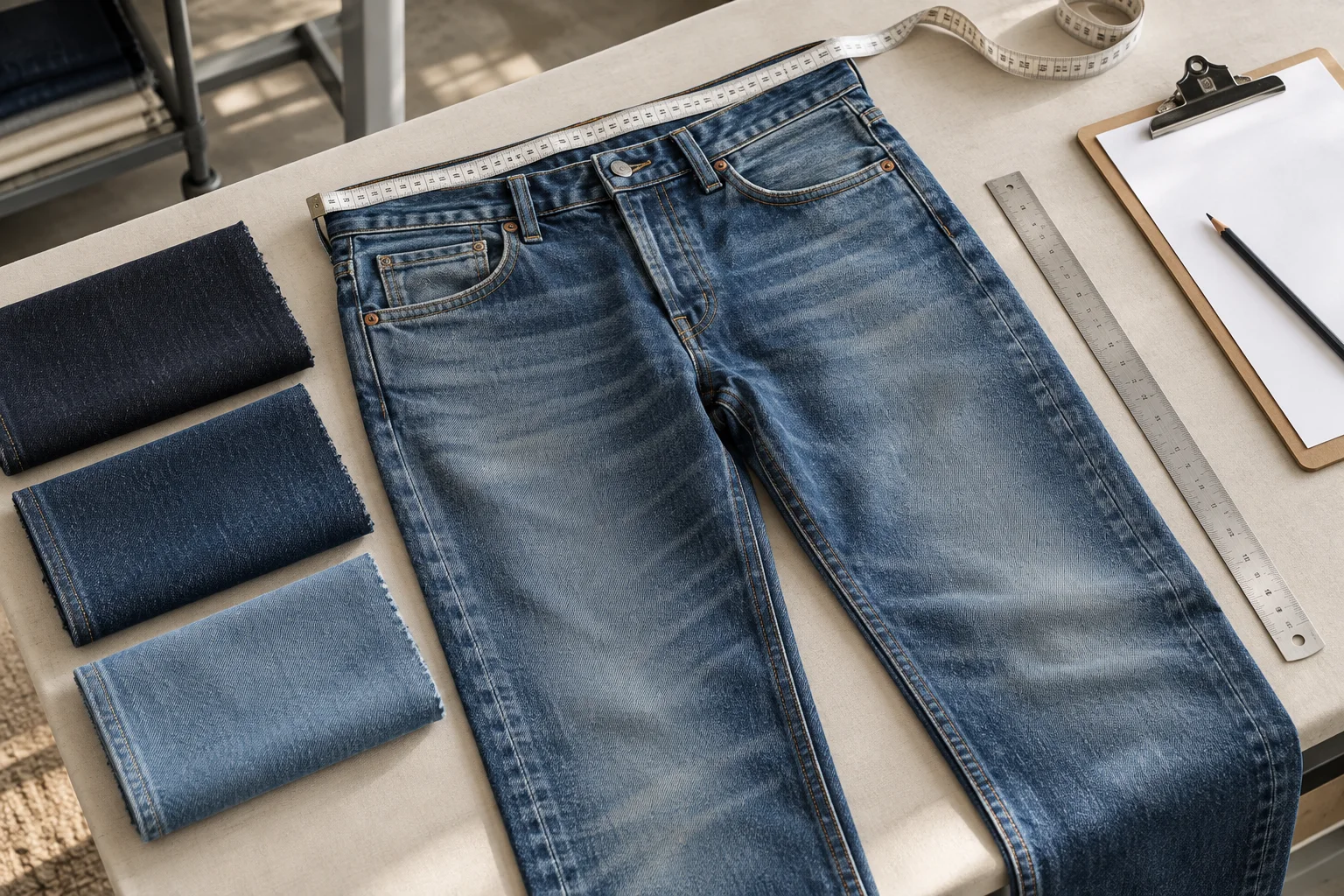
Sanforized, open-stock denim offers one way around a large custom fabric commitment.
The sanforizing process uses controlled moisture, heat, and mechanical compression to reduce later shrinkage. Some fabrics carry residual-shrinkage specifications below 2% under stated test conditions.
Keep the qualification attached to the number. Your wash recipe may differ from the supplier’s test.
Deadstock brokers can also supply Japanese or Chinese narrow selvedge denim in quantities suitable for a capsule. Where a seam uses the woven self-edge, some overlocking can be avoided.
There is a tradeoff: narrow fabric may require more meters per pair. A lower price per meter can therefore be less attractive than it first appears.
Buy according to the job the fabric needs to do. A limited release can accommodate a finite lot. A core style needs a credible replenishment plan.
3. Vet Your Denim Factory: The 5-Point Quality Control Checklist
A factory saying it has “strict QC” tells you very little. Ask what gets measured, when it gets measured, and what happens when a result fails.
These five checks are useful starting points. For the wider supplier assessment, follow our guide to auditing a jeans factory:
- Waistband Tolerance Limits: Consider an agreed tolerance such as ±0.5 cm where appropriate. Specify whether the measurement is a flat half-waist or full circumference, and check it after finishing under consistent conditions.
- Leg Twist (Torque Distortion): Review fabric skew control, cutting alignment, and the washed result. Right-hand twill behavior cannot be assessed properly from an unwashed garment alone.
- Crotch Cross-Seam Bar-Tacking: Inspect reinforcement at high-stress intersections. A 28-to-42-stitch bar tack may suit some constructions, but placement, thread, and fabric determine whether it performs well.
- Crocking & Colorfastness Testing: Agree on a method and acceptance grade. Dry rubbing at Grade 3.0 or above may be a target for certain rinsed styles. It does not promise zero indigo transfer, and wet rubbing requires separate consideration.
- Hardware Pull Strength: Document the required test for buttons and rivets. A proposed 90-newton, approximately 20 lbf, threshold needs to be appropriate to the product; it is not a universal safety standard.
Request records from comparable styles. Better still, make sure the approved requirements appear in your own production documents.
Final Decision Matrix: Which Route Fits Your Production Budget?
Before comparing countries, decide how much of your product is actually finished.
If the fit changes every time someone tries on the sample, local development may still be money well spent. If the fit, fabric, and wash are approved and repeatable, overseas production becomes easier to assess on cost and capability.
For a quick first pass:
| Operational Metric | Choose Domestic Production | Choose Overseas Production |
|---|---|---|
| Initial Working Capital | $3,000–$5,000 may fund development or a smaller capsule; the modeled 100-pair run requires $8,340 | $5,000–$8,000 may suit some small runs; the modeled order is $5,350 before adjusting for rejects |
| Target Retail Margin | May suit a business able to tolerate 40%–50% gross margin; premium pricing can improve this | Often considered for 60%–75% margin targets, subject to actual landed cost and selling price |
| Turnaround Expectation | Indicatively 3–5 weeks from fabric receipt, depending on capacity and approvals | Indicatively 8–12 weeks, depending on development, scheduling, and ocean or air freight |
| Technical Design Maturity | Still needs direct, hands-on development | Approved samples and a complete tech pack are ready |
| Finishing Profile | Raw denim, simple rinses, and finishes available locally | Complex distressing, ozone treatments, and stone or acid-wash effects where capability is demonstrated |
A retail target above $220 makes a domestic premium capsule worth investigating. A lower price with a settled fit often points toward overseas production. A lower price with an unsettled fit means there is still development work to do before either bulk order makes sense.
Use these ranges to frame supplier conversations, then replace them with written quotes and schedules.
The decision should leave you enough cash to handle a correction, place a reorder, and keep selling while the next batch is being made.
Frequently Asked Questions (FAQ)
Can I supply my own fabric to an overseas garment factory?
Yes. This is commonly arranged under a CMT—Cut, Make, Trim—model, although you should confirm which materials and services the factory includes.
For 100 to 200 pairs, shipping fabric rolls into another country can add enough freight, handling, and customs expense to weaken the saving. The duty treatment depends on the countries and production arrangement.
Ask for both options: your supplied fabric and a suitable fabric sourced through the manufacturer. Compare the complete cost, especially if the cloth you have chosen is essential to the design.
What is the most common fit mistake small brands make with denim?
One common mistake is applying the same grading logic used for forgiving knit trousers.
Denim needs careful treatment of the rise, seat, and yoke as sizes change. Adding width alone does not preserve the fit.
Skipping wash tests causes trouble too. If shrinkage has not been allowed for, the finished jeans can be substantially smaller than the approved raw sample—in severe cases, by one or two sizes.
Measure the washed garment, and try it on. The numbers and the fit should agree.
How many prototypes are typically required before bulk production begins?
Allow for two to three sample rounds initially.
The Fit Sample checks shape and proportions. The Wash/Aesthetic Sample establishes shade, whiskers, and other finishing effects. The Pre-Production (PP) Sample brings together the agreed construction, hardware, thread colors, labels, fabric, and finish.
Some projects combine rounds. Others need additional work, especially after a fabric change.
A third sample is not automatically ready for production just because it is the third sample. Outstanding problems still need resolving.
How do I prevent denim outseam twisting (leg torque) during production?
Start with the fabric and inspect again after washing.
Some 3/1 right-hand twills are prone to twist as stresses relax. Fabric finishing, cutting, and sewing can all influence the outcome.
Ask the mill about skew correction and have the factory assess washed samples before bulk approval. Cutting or pattern adjustments may help in particular cases, but a suggested 2% to 3% offset needs testing on the actual fabric. Applying it blindly can create a different problem.
Have the mill, pattern cutter, and wash team agree on the correction, then check the finished leg. That is the version your customer will live with.

Recent Comments