
The global denim market is in the midst of a dramatic transformation. Gone are the days when consumers blindly accept inflexible, frumpy and poorly fitting off-the-peg clothes. Instead, they are asking for accurate data, sustainable ecosystems and unique aesthetics. It is one of the most customized and high-margin product categories for independent fashion labels and e-commerce brands, but its technical complexity is often daunting. Denim is a living fabric that evolves throughout cutting, sewing and washing.
This in-depth guide breaks down commercial denim manufacturing to help you through this complicated process. The digital blueprint to the retail-ready garment and everything in between — will be covered. Bonus: Get unique insights from the leading production manufacturer – Kaiping Lianwang Garment Co., LTD with over 20 years of experience.
1.The Blueprint Phase: Custom Jeans and Custom Jean Jacket Prototypes
1.1 Measurements to Mappings: a Mapping of 3D Body Proportions for Denim
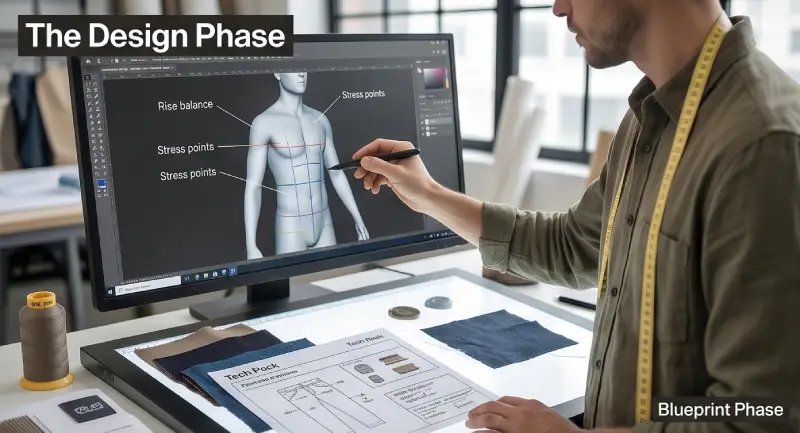
Make outstanding custom denim by beginning with human anatomy instead of flattened shapes. Traditional clothing patterning usually uses a basic 2-D flat measurement. That said, premium custom jeans require a mapping of three-dimensional body proportions. Designs have to accommodate body volume, hip curves and the physics of movement.
Rise balance (the relationship between the front and back rise) is also important when designing denim. A too-flat back rise means that you will pull the waistband down when sitting. On the flip side, if the rise in the front is too long, you will have a lot of uncomfortable bunching going on. Digital factory 3D fitting software / Virtual prototype: Designers never cut any cloth (simulating drape and stress points of fabric). At this step, the last is maintained in its exact shape while acquiring maximum comfort characteristics.
1.2 Specifying Hardware, Rivets and Thread Denier in the Tech Pack
A Tech Pack is the most fundamental outline for your apparel. If you do not have a detailed tech pack, factory workers may not be able to replicate your design accurately. That tech pack must be extremely detailed for a custom jeans and jacket production run:
- Fabric Specs : In addition to the actual weight (12 oz, 14 oz), blend and weave
- Hardware Placement — Specify precisely where all buttons, zippers, and over-reinforced rivets will be, as well as their sizes and materials.
- Thread Denier + SPI: This is the thickness of thread used (thread denier) and Stitch Per Inch (SPI). These seams in heavy-duty areas (e.g., the waistband) need to use thicker threads (Tex 105). These will also likely be a lower SPI for durability’s sake. On the other hand, for internal overlock seams, it is possible to use a lighter thread (Tex 40).
- Packaging Specification This section defines where the custom LOGO will be printed, main labels, care labels and packaging requirements.
1.3 The Sleeve and Yoke Balance: Structural Engineering for a Custom Jean Jacket
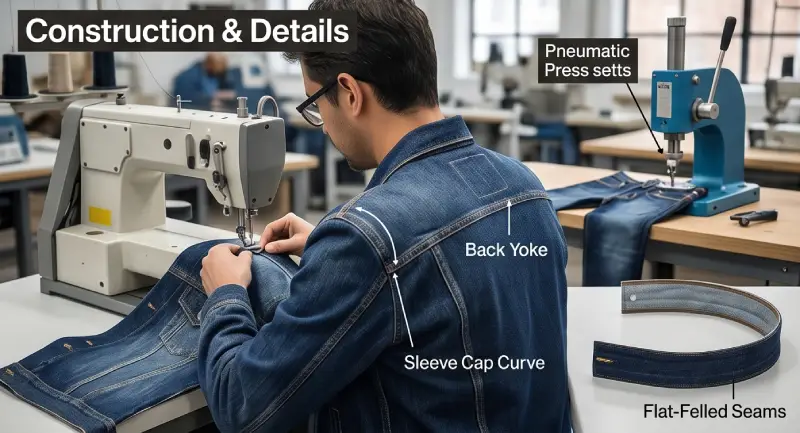
In fact, the shoulders and upper back are the trickiest aspects of building a custom jean jacket. The magic of a great-fitting denim jacket comes down to the sleeve cap vs back yoke.
In the table below, Column 1 (shoulder fit) includes [Back Yoke: Sets Shoulder Width] —> Column 2 [Sleeve Cap Curve: Controls Arm Mobility].
[Result: Balanced, Non-Restrictive Silhouette]
There should be enough width in the back yoke to allow horizontal movement. While at the same time, the sleeve cap curve must fit into the armhole 100% perfectly. If your sleeve cap is cut too high, you can barely move your arm. If it is lower, the excess fabric will be bunched up underneath your armpit. This line combines these two aspects to form a clean, structured shape with unrestricted free-flow movement.
2.Mastering Denim Shrinkage and Fabric Selection
2.1 Raw Selvedge vs Performance Stretch: Picking The Correct Type Of Denim
Picking the appropriate fabric defines your brand strategy and directs it to the right audience:
| Fabric Type | Characteristics | Best Used For | Target Audience |
| Raw Selvedge Denim | Heavyweight (14–21 oz), woven on traditional shuttle looms, features a clean self-edge. It is stiff at first but breaks in beautifully over time. | Heritage styles, premium custom jeans, and vintage jackets. | Denim purists and luxury buyers. |
| Performance Stretch | Lightweight to medium-weight (9–12 oz), blended with spandex or elastomultiester for excellent elasticity and recovery. | Modern skinny jeans, athleisure denim, and everyday comfort wear. | Mass-market consumers and active lifestyles. |
At Kaiping Lianwang Garment, the design team routinely proposes cutting-edge fabrics to prepare clients for transformational market conditions.
2.2 The 1×1 Meter test: Patternmakers determining post-wash volume shrinkage of fabric
Importantly, denim shrinks a lot in the wash (10%, at least). Why? To avoid any sizing problems, patternmakers conduct a meticulous mathematical test.
Keep in mind:
1.The most common, correct and real issue. with this step: A clean final 1×1 meters (100 cm x 100cm) square of original cloth is cut.
2.It is taken to the wash house, where it receives the specific commercial washing cycle that will apply during production.
3.After drying, the sample is measured carefully.
If the post-wash fabric measures92cm in length and 96cm in width, the shrinkage rate is calculated as:
Length Shrinkage = (100 – 92)/100= 8%
Width Shrinkage = (100 – 96)/100= 4%
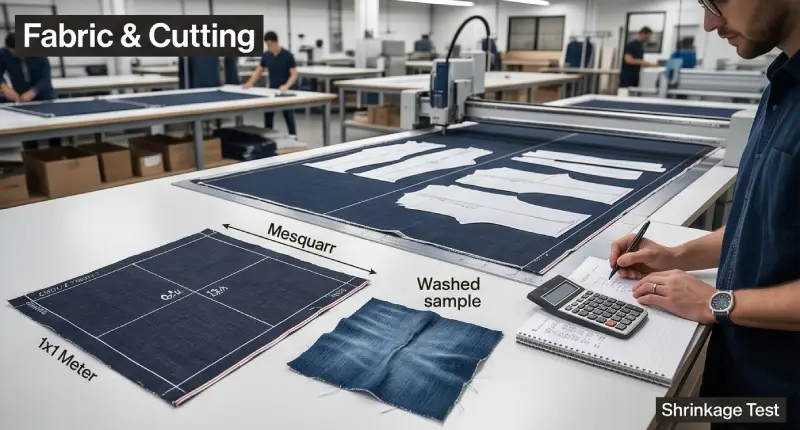
The patternmaker then increases or decreases the digital cutting patterns by these same percentages. This means that you are guaranteed your finished garment will shrink to the right size after washing.
2.3 Grainline Alignment: Avoiding Leg Twist + Uneven Shading when Cutting
Have you had on a pair of jeans and realised the side seam now cocks around towards the front of your ankle? This defect is known as leg twist. That occurs when the pieces of the pattern don’t line up properly with the sensible grainline of the fabric when cutting.
Denim is a twill weave; it has an obvious diagonal structure, and under tension, denim will twist. The trouser leg has to be perfectly parallel to the fabric selvedge when patternmakers align the center line. Also, all corresponding pieces must be cut in the same direction. As a result, panels are aligned very carefully so that there is no uneven shading (where panels appear slightly different colours once washed).
3.Precision Cut and Sew: Crafting a Custom Jean Jacket and Denim Trousers
3.1 Flat-Felled Seams & Busted Outseams: Elegant Skill Meets Durability
Denim seams add durability and style.
- Flat-Felled Seams – This technique interlocks two pieces of fabric, which double stitched them flat against each other. Super clean and durable, it’s ideal for jeans inseams and jacket armholes.
- Busted Outseams (Open Seams): This method flattens the seam allowances and presses them open, pressing on either side of the seam. All raw edges are either finished with a contrast overlock stitch (like I did in the photos) or they can be bound with bias tape. That classic appearance is especially sought after by high-end denim labels, who want the all-important selvedge ID to be visible when their jeans are cuffed up.
3.2 The Extended Parts of Fly, Pocket Bags and WaistBands
A denim garment is defined and refined by the small details. The zipper or button fly needs to be flawlessly straight so it does not pucker or gape. Cheap polyester blends should be avoided for pocket bags, which is why complete twill fabric pockets hold more strength (as they use cotton).
[Curved Waistband Construction] –> [Natural Human Pelvic contours] –> [No more back gapping!]
A curved construction is much better than a straight cut for the waist, however. Curved waist Band — conforms to the shape of the human pelvis. This shape does away with back gapping to create a fit that moves with the body.
3.5 Attachment for Rigid Hardware, 7x Reinforced Rivets/Transferred Plackets
Genuine denim hardware must be attached with industrial machinery. Common sewing machines do not have a chance to push rivets through many layers of thick denim.
Reinforced rivets in higher-stressed areas like pocket corners and the bottom of the fly need to be set with pneumatic press machines. It is a mechanical process that avoids fracturing the textile’s body under force. A similar internal interfacing secures button plackets on custom jean jackets. This additional layer secures the metal shank buttons tightly for the life of that garment.
4.The Wash House: Premium Finishing Techniques for Your Custom Jeans Line
4.1 Traditional Distressing Methods: From Stone Wash to Acid Wash Aesthetics
Raw denim is simply a blank canvas. The iconic, lived-in look is created in the washing department through skillful distressing methods:
- Real pumice stones are loaded into industrial washing machines. Tumbling stones scratch at the surface, dulling its abrasive feel and yielding dark-light tones contrasting each other beautifully in your jeans.
- Enzyme Washing: This technique is an updated method of using natural enzymes to eat away at the top layer of indigo dye. It gives it a gentle, vintage appearance without shredding the fabric fibers as harsh stones do.
- Acid Wash — Pumice stones soak in potassium permanganate, and dry tumbled with the garments. This creates bold, vintage, high-contrast, sharp patterns.
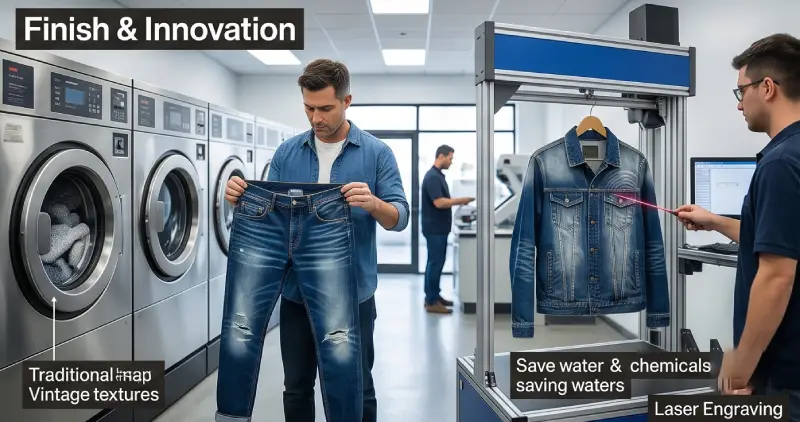
4.2 Eco-Innovation: Laser Engraving and Ozone Technology for Water Conservation
The traditional washing process of jeans consumes large amounts of water, chemical treatment and energy. Ahead of this waste, innovative manufacturers are adopting sustainable technology. Take Kaiping Lianwang Garment as another example, where energy-saving light sources and boiler steam exhaust recovery systems have been installed.
For the production line, two of these green technologies are transforming the industry:
- LASER ENGRAVING: Instead of crashing denim with harsh manual hand-scraping or chemicals, computer-guided lasers engrave artistic whiskers, fades and distressed holes directly onto the fabric. All this is done digitally, saving hours of manual work and standardising quality in every batch.
- Ozone Technology — This is a method that will use naturally occurring ozone gas to reproduce the fading effect without bleach. It completely removes toxic chemicals in the process and reduces water use by 80%.
4.4 Colour fastness and structural inspections: last quality check criteria
Quality control (QC) inspections are performed on all custom denim before the jeans can be packed and shipped. Additionally, the fabric is tested for colour fastness in molten form so that it will not bleed too much indigo dye onto consumer skin or furniture. The second is performed by inspectors to test the tensile strength of the seams.
An established manufacturer checks all products thoroughly before shipping in order to ensure high quality. They also provide all relevant national quality certificates and inspection reports prior to your order leaving the factory floor
5.Supply Chain Strategy: Low MOQ Sourcing for Custom Jean Jacket and Pants Manufacturing
5.1 Between a rock and a hard place: flexible sourcing strategy for small jeans companies
Minimum Order Quantities (MOQs) can be one of the biggest hurdles for new fashion brands. Huge minimums forced traditional denims factories to make thousands of pieces per style, shutting the door on possible new entrants.
In order to get over this obstacle, find open-minded manufacturers that are catering to OEM & ODM services. Partnering with a factory that has a specific sample department and several flexible Production lines can greatly facilitate scaling your business. It enables you to see whether the market is relevant with fewer minimum batches and decreases your upfront monetary exposure.
5.2 Sample Development Cost ⇒ ExpenditureTemplate & Production Lead Time
In the previous article, we talked about clear timelines and budgets as critical factors in turning around a fashion collection. With a seasoned manufacturing partner, you can look forward to an orderly and professional timeline:
- Quick inquiry response: You will get your first reply within 30 minutes from our side, then a full quotation and product details will be sent in next 3 hours.
- Sample Development: It is possible to create unique samples in 13 days by a fixed R&D team. The sample is not free, but the cost will be refunded directly after your order reaches the relevant production volume.
- Bulk Production: After sample approval, bulk production is 15 to 25 days. This speedy cycle allows you to release your collection without excessive waiting.
manufacturing spotlight: kaiping lianwang garment co. ltd
The decision of choosing the right manufacturing partner is the crucial one for your denim brand. Kaiping Lianwang Garment Co., LTD is a full-service apparel manufacturer located at the southern China apparel center in Jiangmen, Guangdong Province. They offer premium denim products for men, women, and children.
Lianwang Garment, which has 10 advanced production lines and an annual output of more than 600,000 pieces. From custom washes and fabrics to logo printing and retail packaging, they provide full OEM & ODM services, allowing you to customize every aspect.
The company caters to international markets such as Europe, the United States and Australia . They have tailored and quality one-to-one full-service offerings to assist you in bettering your designs and creating polished products that are market-ready. What’s more, they can guide you through sending it right to your door during shipping and have a guarantee for replacing any damaged goods.
Frequently Asked Questions (FAQ)
How long does it typically take to have denim made?
At Kaiping Lianwang Garment, however, everything is custom-made for speed and quality. Sample development takes 13-20 days, and bulk production takes 25 to 35 days. They respond to first requests in 30 minutes and full quotes in less than 3 hours.
Am I able to obtain a refund on my sample development fees?
Yes. Samples are free for a refund. The first sample cost will be refunded to you as soon as your bulk production order reaches the required quantity.
How does the consideration of quality work in the factory work when a fault occurs?
All products are inspected before shipment to ensure high-quality. The factory offers all the required quality certificates and national testing reports before shipping. Incidentally, if sales include defective goods, in rare cases, the factory substitutes those damaged products.
Can you build your factory with custom branding and hardware?
Indeed, comprehensive OEM services are offered. Everything from fabric selection to custom garment washes, specialized logo printing, custom hardware and retail packaging can be customized in your order.
Are you planning to kick off or broaden your custom jeans line? Each inquiry to Kaiping Lianwang Garment Co.,LTD will be 3 hours dedictated for your custom quotation.

Recent Comments