
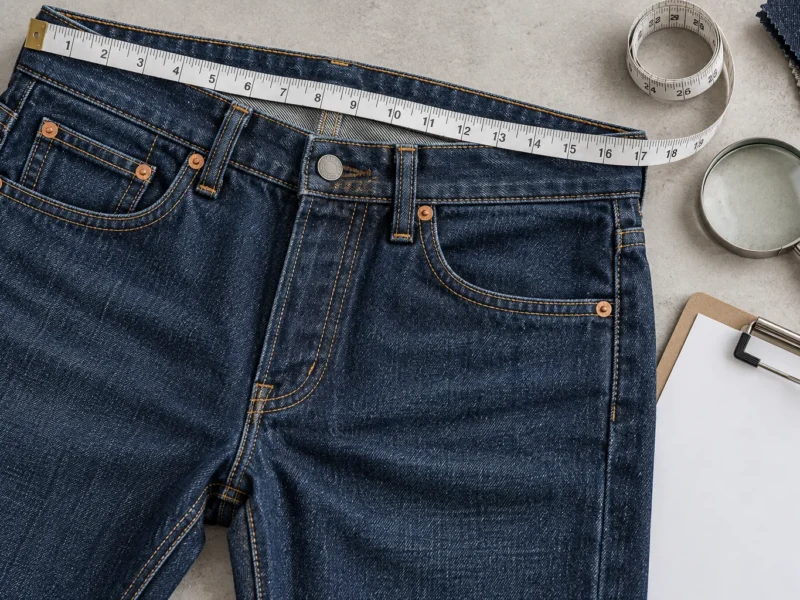
Use this denim QC checklist to inspect seams, shrinkage, fit, wash appearance and hardware from fabric approval to pre-shipment inspection. It helps denim brands and sourcing teams record defects before and after washing, compare results with approved samples, and agree on corrective action before release.
Denim QC Checklist at a Glance
| Stage | What to inspect | What to record |
|---|---|---|
| Before cutting | Fabric lot, shrinkage and grainline | Wash test results and pattern allowances |
| During sewing | Stitch balance, seam edges and reinforcements | Defects, affected operation and corrective action |
| After washing | Waist, rise, thigh, inseam, twist and shade | Measurements against the approved specification |
| Before shipment | Hardware, detection records and final sample | Sampling plan, defects and release decision |
The numerical limits below are example inspection criteria, not universal standards. Confirm test methods, measurement definitions, tolerances and sampling rules with the buyer before production.
1. Denim QC Checklist: Why Post-Wash Inspection Matters
A pair of jeans can look perfectly sound at the sewing line and come back from the washhouse with a different set of problems. The waistband has tightened. One leg has started to twist. A pocket corner that looked secure now shows a small tear.
That is what makes washed denim demanding. Sewing is only part of the job; washing changes the garment again.
A useful denim QC checklist needs to account for both stages. Otherwise, a factory may approve the workmanship before washing and miss the defects that customers will actually notice.
1.1 Why Standard Apparel QC Checklists Fail for Washed Denim
A conventional apparel checklist usually asks straightforward questions: Are the measurements correct? Are the seams clean? Does the finished garment match the approved sample?
Those questions still matter. With denim, though, the timing matters just as much.
Depending on the finish, jeans may go through enzyme treatments, stonewashing, mechanical agitation, and demanding drying cycles after assembly. Fabric relaxes, yarns move, and seams come under stress. Measurements taken before those processes cannot tell the whole story.
That is why denim inspections need specific checks for wash-induced seam slippage, uneven shrinkage along the warp, and abrasion that only becomes visible after finishing. A clean sewing inspection is a good start. It is not the finish line.
1.2 The Cost of Post-Wash Defects: Returns, Fit Inconsistencies, and Margin Loss
Customers rarely describe a problem as “dimensional instability.” They say, “These are the same size as my last pair, but they don’t fit.”
Consider a style intended to measure 32 inches at the waist that finishes closer to 30 inches after washing. The label may be correct for the order, but the garment no longer meets its specification. For the brand, that can mean return freight, replacement shipping, warehouse handling, and a customer who hesitates before ordering again.
Across a production run, the consequences grow quickly. Inconsistent fit can leave a sourcing team choosing between rework, markdowns, and unsold stock.
At Kaiping Lianwang Garment Co., LTD, post-wash inspection is therefore part of production control, rather than a last-minute check before packing. With 20+ years of manufacturing experience, more than 330 pieces of garment equipment, and over 150 workers, we apply post-wash criteria to orders serving Europe, the United States, and Australia.
The aim is simple: the fit approved during development should be the fit customers receive.
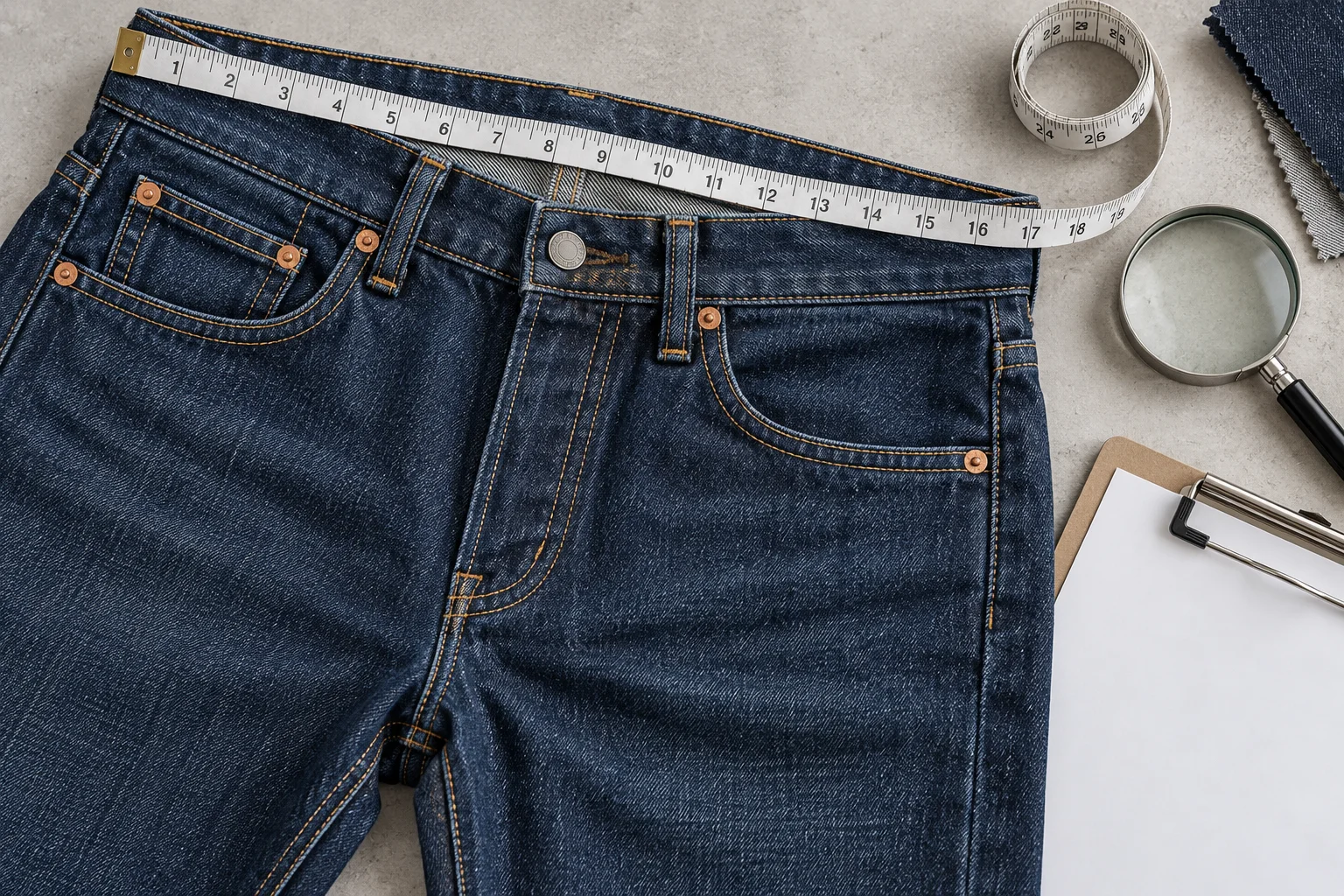
2. Fabric & Dimensional Stability: Controlling Denim Shrinkage Before Cutting
Shrinkage is easier to manage while the fabric is still on the roll. Once thousands of panels have been cut, even a small miscalculation becomes expensive.
Start with the fabric, test it using the intended wash, and give the cutting team results they can use.
Document the fabric specification, measurement points and wash allowances in your denim tech pack so development and QC teams use the same reference.
2.1 Flat Swatch vs. Tubular Wash Leg: Why Simulated Leg Mockups Prevent Fit Failure
A 50 cm × 50 cm flat swatch is useful for an initial shrinkage check. It gives the team a baseline for how the fabric responds to washing and drying.
But a square of fabric does not behave exactly like a trouser leg.
An assembled leg has seams, enclosed volume, and different points of resistance as it moves through a wash drum. Those details can affect how the fabric pulls, rotates, and settles.
A tubular wash leg mockup adds that missing context. Technicians join panels using the chainstitches and lockstitches planned for production, then process the mockup through the intended wash and drying sequence. They measure the warp and weft changes and inspect the seams for distortion.
Flat swatches and tubular tests serve different purposes. Use the swatch to understand the fabric; use the mock leg to see what happens when construction enters the picture. Confirm the result on complete sample garments before approving bulk production.
Use the proto, fit and pre-production jeans sampling stages to track revisions and lock the approved garment before bulk cutting.
2.2 Warp vs. Weft Shrinkage Dynamics Across Stretch and 100% Rigid Denim
Rigid cotton denim and stretch denim should not share a shrinkage assumption simply because they have a similar weight or appearance.
The following ranges can serve as planning references, but they are not guaranteed fabric properties:
- 100% rigid denim: After sanforization, warp shrinkage may be around 3%–5%, with weft shrinkage around 1%–2%.
- Stretch denim containing 2%–4% elastane: Warp shrinkage may fall around 3%–4%, while weft shrinkage can reach 8%–14% in some fabric and processing combinations.
Actual results depend on the fabric construction, finishing history, blend, and wash-and-dry conditions. Polyester blends also need testing on their own merits.
The practical lesson is to test the lot being cut. A result from a previous delivery is useful background, but it is not a substitute.
For a simple illustration, a 50 cm fabric width that shrinks by 10% loses 5 cm. That is enough to change the feel of a garment considerably, especially through the hips and thighs. No amount of careful topstitching can recover an allowance that was missing from the pattern.
2.3 Wash Recipe Calibration: Adjusting Patterns to Enzyme, Bleach, and Tumble Heat
A rinse, an enzyme stonewash, and a heavily bleached finish should not automatically use the same shrinkage allowance.
Review the intended denim wash and finishing process with the washhouse, then test that exact recipe on the production fabric.
Each process changes the conditions the fabric experiences. Enzyme treatments act on the cotton surface, mechanical washing works the fabric and seams, and drying temperature influences the final dimensions. Stretch fabrics need particular attention because heat can affect their recovery as well as their size.
Our 15+ person professional R&D team works with wash technicians during pre-production sampling to connect those results to the CAD patterns and cutting markers.
The sequence matters: test the proposed recipe, measure the finished samples, adjust the pattern, and check again. If the recipe changes later, review the measurements again too.
For relevant dimensions, ±1.0 cm may be used as a development target where the specification allows it. Points with tighter tolerances, including those listed below, still need to meet their individual limits.
3. Fit Precision & Skewing Control: Preventing the Dreaded Leg Twist
Leg twist is hard to ignore once you have noticed it. The jeans hang correctly at the waist, yet the lower inseam wanders toward the front of the shoe.
For the customer, it looks wrong. For the factory, it is a signal to review the fabric, cutting alignment, and wash response together.
3.1 Measuring Fabric Skew and Garment Seam Twist
Denim’s twill structure can contribute to directional movement during laundering. In an unbalanced garment, that movement may show up as a rotating leg seam.
Choose the method for the property being assessed: AATCC TM179 addresses fabric skew change after home laundering, while AATCC TM207 addresses garment seam twist before and after home laundering. Follow the buyer-specified method and edition; the purchase specification must separately establish acceptance limits.
Record the test method, reference points, laundering conditions and result together. Do not treat a simplified displacement calculation as a substitute for the specified test procedure.
For the illustrative buyer-defined leg-twist check in this article, use the following limits only with an agreed measurement procedure. These are not AATCC pass/fail limits:
- Preferred commercial target: Below 2.0%.
- Review range: 2.0%–3.0%, subject to the approved style and buyer requirements.
- Maximum acceptance limit: 3.0%. Results above this limit fail the stated criterion.
A result above 3.5% also clearly fails this framework; it is not an additional allowance. Record the defect and handle the affected lot according to the agreed sampling and disposition rules.
3.2 Critical Key-Point Measurements: Waist Rise, Thigh Circumference, and Inseam
A fit audit works best when every inspector measures the same points in the same way. Small differences in positioning can otherwise create an argument about the tape measure instead of the garment.
Check these points during in-line and final inspection, using the approved measurement guide:
- Relaxed waistband: Fasten the button and lay the waistband flat without stretching it. Suggested tolerance: ±0.75 cm.
- Front and back rise: Measure from the crotch intersection along the specified seam curve. Suggested tolerance: ±0.5 cm.
- Thigh circumference: Locate the measuring point 2.5 cm below the crotch, perpendicular to the leg line. Suggested tolerance: ±0.75 cm, using the measurement basis stated in the specification.
- Inseam length: Follow the inner seam from the crotch junction to the bottom hem edge. Suggested tolerance: ±1.0 cm.
Be especially clear about flat widths versus full circumferences. A half-thigh measurement and a full-thigh measurement are not interchangeable, and neither are their tolerances.
3.3 Sanforization and Grainline Alignment: Verifying Pre-Cut Marker Precision
Sanforization helps control shrinkage, but it cannot make up for careless spreading or cutting.
For the workflow described here, allow fabric to relax without tension for 24 hours before cutting, unless the validated fabric procedure calls for a different period. Stretch denim deserves close attention: fabric held under tension can appear stable on the table and recover after the panels are cut.
Check that pattern grainlines follow the intended warp direction, using the selvedge as a reference and checking for fabric distortion.
This is an easy control to overlook because nothing appears obviously wrong at first. The problem may only announce itself after washing, when the seam refuses to hang straight.
4. Seam Construction & Workmanship: Inspecting High-Stress Points
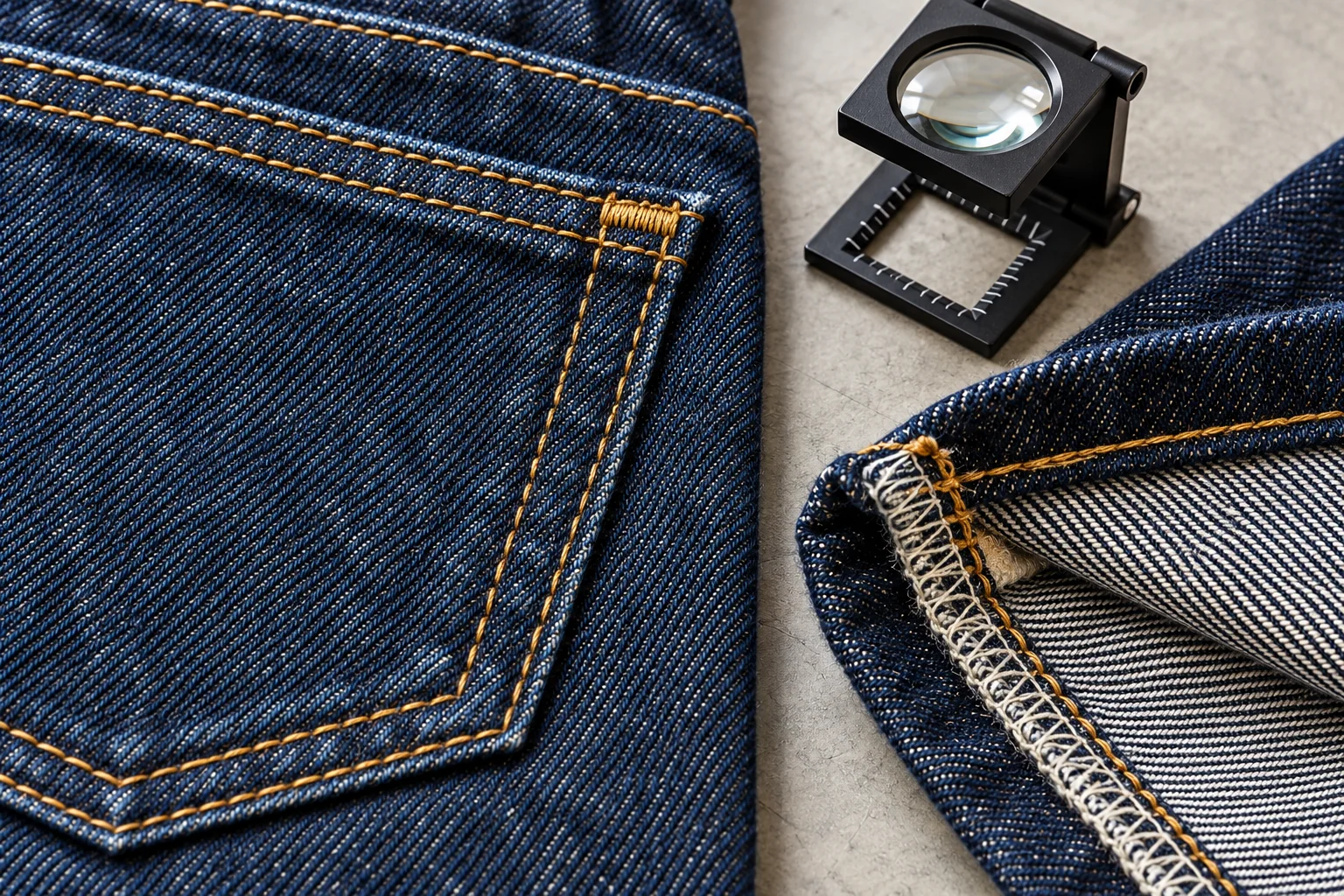
Jeans have to cope with sitting, bending, climbing stairs, and pockets loaded with everyday clutter. Good seam construction needs to support that movement.
A neat stitch line matters, but appearance alone does not show whether the fabric and thread will hold up together.
The following specifications are working targets to confirm against the approved construction sheet:
| Inspection Area | Target Stitch Type | Target SPI (Stitches Per Inch) | Critical Failure Point |
|---|---|---|---|
| Waistband (Bottom) | 401 chainstitch | 7–8 SPI | Looper unraveling, skipped stitches |
| Back Yoke & Rise | Lap seam with chainstitch | 8–9 SPI | Needle cutting, uneven gathering |
| Crotch Intersection | Double-needle lockstitch, where specified | 8–10 SPI | Seam grinning, crotch failure |
| Coin & Back Pockets | Lockstitch with bartacks | 9–10 SPI; 28–42 stitches per bartack | Missing reinforcement, fabric tear-out |
Bartack figures describe the total stitches in each bartack, not stitches per inch.
4.1 Chainstitch vs. Lockstitch Integrity: Verifying SPI and Loop Tension on Waistbands & Yokes
The ISO 401 two-thread chainstitch is commonly specified for waistband and yoke operations where the construction benefits from seam extensibility. The approved style determines where it is used.
Inspect both sides of the seam. The visible topstitching may look tidy while the underside tells a different story.
Loose looper tension can leave oversized loops that catch or unravel. Excessive tension can draw the fabric into puckers and reduce the seam’s ability to accommodate movement. Check for skipped stitches, secure seam ends, and a balanced stitch formation.
Counting SPI is useful. Stopping there is not enough.
4.2 Detecting “Hidden” Needle Cutting: Identifying Yarn Ruptures Before and After Washing
Needle cutting is particularly frustrating because the damage can be difficult to see before washing.
A worn, overheated, or unsuitable needle may damage yarns as it passes through dense denim. The stitch line can initially look acceptable. After enzyme treatment or abrasion, those weakened points may open into visible holes.
Inspect vulnerable seams under bright lighting and apply controlled lateral tension to reveal damaged yarns. Check washed samples as well as unwashed work.
If cutting appears, stop the affected operation and investigate the needle condition, size, point, machine speed, and fabric compatibility. A slim ballpoint SES needle may be appropriate for some constructions, but the replacement should be confirmed through a sewing trial.
The goal is to remove the cause before more garments reach the washhouse.
4.3 Crotch Cross-Seam & Pocket Bartack Verification: Pull-Strength & Grinning Inspection
The crotch intersection brings together several fabric layers in an area that sees repeated strain. Inspect it for skipped stitches, uneven feeding, damaged yarns, and grinning—a seam opening enough to expose the inside construction.
A manual pull check is useful for screening obvious weaknesses. It cannot reliably prove a specified force.
If the inspection plan calls for 15–20 kgf, verify that load with suitable calibrated equipment and an agreed procedure. Under the specified assessment, the seam should remain secure without unacceptable opening or damage.
Pocket entries, the fly bottom, and belt-loop attachments also need reinforcement. For the pocket bartacks described here, use 28–42 stitches per bartack, subject to the approved pattern, thread, and fabric.
More stitches do not automatically make a stronger attachment. A very dense bartack that damages the underlying fabric has missed the point.
4.4 Flat-Felled Seam (Lap Seam) Alignment: Preventing Raw Edge Exposure During Heavy Wash
Yokes and back rises often use flat-felled or lap constructions sewn on multi-needle feed-off-the-arm machines.
The folder setup deserves careful checking. If the fabric slips out of the intended fold, a raw edge can remain exposed inside the seam. Heavy washing may then turn a small construction error into visible fraying.
Inspect the underside, particularly around curved sections and changes in thickness. The outer stitch line can look straight even when the internal fold is incomplete.
Make this check before washing. It is much easier to correct a folder than to repair a batch of frayed seams.
5. Washing, Finishing, and Hardware Inspection
A finished pair of jeans has to pass two tests at once: it should look like the approved product, and it should work properly in daily use.
That means checking the wash effect and the small functional details with equal care.
5.1 Dry Processing Consistency: Evaluating Whiskers, Scrapes, and Hand-Sanding Placements
Whiskers, hand-sanding, resin effects, and chemical scraping give denim much of its character. They also introduce variation, especially when operators work by hand.
Use an approved golden master sample to define the intended result. Clear PVC measurement overlays can help inspectors compare placement consistently.
Check the angle and position of lap whiskers, the extent of thigh sanding, and the location of scraped areas. Sanding should not cross the side seam unless the design calls for it.
Symmetry should follow the approved design too. Some finishes deliberately include uneven wear effects. The question is whether the production garment matches that intention, rather than whether every mark is mirrored.
5.2 Shade-Banding Protocol: Sorting Wash Lot Variations Under Standard D65 Light Box
Two wash loads can follow the same recipe and still finish with slightly different shades. Water hardness, loading, chemical concentration, and processing conditions all influence the result.
The sensible response is to control the variation and sort it consistently.
A practical shade-banding protocol includes these steps:
- Select a reference pair from every wash lot and expand sampling as needed to assess within-lot variation.
- Compare garments with the approved standard under D65 artificial daylight and TL84 store lighting.
- Sort acceptable garments into agreed shade groups, such as A, B, and C.
- Pack matching shade bands together and, where the distribution plan allows, allocate consistent bands to individual retail locations.
Shade banding is not a way to approve an incorrect wash. Each band must still fall within the buyer’s accepted range.
The retail reason is straightforward: two pairs can look acceptable separately and noticeably different when hung side by side.
5.3 Hardware Attachment Pull-Tests: Shank Buttons, Rivets, and Zipper Cycle Audits
Customers expect buttons to stay attached and zippers to work. These are small components with a large influence on how the whole garment is judged.
Match the bulk components to the approvals recorded in your custom denim trims specification, including buttons, rivets, patches and zippers.
For the inspection plan described here, test sampled shank buttons and rivets with a calibrated pull gauge:
- Attachment pull target: Withstand 90 N, approximately 9.17 kgf or 20.2 lbf, for 10 seconds, without detachment or pulling through the denim.
- Zipper cycle audit: Complete 20 consecutive opening-and-closing cycles smoothly, with no tooth misalignment or slider-lock failure.
Use the buyer’s approved method, sample quantity, and acceptance criteria. The 90 N requirement is a stated specification here, not a universal rule for every garment or market.
For metal zippers, whether YKK or an approved equivalent brass zipper, inspect the installation as well as the component. Even a good zipper can perform poorly when the surrounding sewing distorts it.
6. The Complete Factory Denim QC Checklist (Printable / Standard Spec Sheet)
Across our 10+ production lines, an inspection sheet needs to be clear enough to use during a busy shift. Inspectors should be able to identify the requirement, record the result, and flag a problem without guessing what a checkbox means.
The framework below brings the main controls together. Confirm its limits against the buyer’s specification before using it for an order.
================================================================================
                    FACTORY DENIM QUALITY CONTROL AUDIT SHEET
================================================================================
Client: ___________________________   Style / PO: ______________________________
Date: _____________________________   Inspector: _______________________________
Fabric Blend: _____________________   Target Wash Recipe: _____________________
Spec Revision: ____________________   Fabric / Wash Lot: _______________________
--------------------------------------------------------------------------------

[SECTION A: FABRIC & PRE-CUTTING]
 [ ] Fabric relaxed tension-free for 24 hours, or per validated fabric procedure.
 [ ] Flat-swatches and tubular wash-leg results recorded.
 [ ] Tested shrinkage allowances incorporated into CAD patterns and markers.
 [ ] Full garment wash sample checked before bulk approval.
 [ ] Marker grainlines checked against the intended warp direction.

[SECTION B: IN-LINE SEWING (DUPRO)]
 [ ] SPI verified against approved construction:
     Waistband 7-8; flat-felled yoke 8-9;
     designated decorative topstitching 6-7, where specified.
 [ ] No visible needle cutting or yarn damage at back rise and crotch.
 [ ] Pocket corners, fly bottom, and belt loops reinforced as specified.
 [ ] Pocket bartacks contain 28-42 stitches, where specified.
 [ ] Waistband chainstitch loops balanced; no skipped stitches.
 [ ] Folded seam edges enclosed correctly; no raw-edge slippage.

[SECTION C: POST-WASH & MEASUREMENT]
 [ ] Buyer-specified fabric skew / garment seam-twist method recorded.
 [ ] Leg skewing target <2.0%; maximum 3.0% under this inspection plan.
 [ ] Relaxed waistband within ±0.75 cm of approved specification.
 [ ] Front and back rise within ±0.5 cm.
 [ ] Thigh measurement within ±0.75 cm on the stated measurement basis.
 [ ] Inseam within ±1.0 cm.
 [ ] Crotch seam checked for grinning and damage.
 [ ] Specified 15-20 kgf assessment verified with suitable test equipment.
 [ ] Sampled buttons and rivets withstand 90 N for 10 seconds.
 [ ] Zippers complete 20 opening-and-closing cycles without failure.
 [ ] Wash effects match the approved master sample.
 [ ] D65 / TL84 shade assessment completed; accepted shade bands recorded.
 [ ] No unacceptable streaking on visible panels.

[SECTION D: DETECTION & PRE-SHIPMENT]
 [ ] 100% needle / metal detection completed under the validated procedure.
 [ ] Detection sensitivity verified with approved test pieces.
 [ ] Where specified and validated: Fe 1.0 mm; non-Fe 1.2 mm.
 [ ] Detector compatibility with intentional metal hardware confirmed.
 [ ] Broken-needle records and quarantined goods reconciled.
 [ ] PSI sampling plan recorded: lot size, inspection level, sample size.
 [ ] Agreed critical defects: zero accepted in the inspected sample.
 [ ] Major defects assessed at AQL 2.5; minor defects at AQL 4.0.

Inspector Signature: _______________________ Result: [ ] PASS   [ ] FAIL
Corrective Action / Reinspection Record: ______________________________________
================================================================================
6.1 Pre-Production (PP) & In-Line (DUPRO) Audit Points
The pre-production meeting should bring the fabric, sewing, washing, and cutting teams to the same set of decisions.
Confirm fabric weight, the approved dry-process mockups, the wash recipe, shrinkage results, and pattern allowances. Record which sample and specification revision govern production. “We thought that was the latest sample” is an avoidable source of trouble.
During DUPRO (During Production), use a working check of 10–15 assembled garments from each production line each day, adjusting the frequency when volume, risk, or defects justify it. Inspect them before they reach the washhouse.
This is the point to catch needle damage, unstable loops, and slipping seam folds. Finding one setup problem early may prevent it from being repeated across the rest of the shift.
6.2 Pre-Shipment Inspection (PSI) Based on AQL 2.5/4.0 Standards
Final random inspection can use an agreed sampling plan based on ISO 2859-1, with AQL 2.5 for major defects and AQL 4.0 for minor defects.
Those AQL values do not define the complete plan by themselves. The lot size, inspection level, sample size, and acceptance and rejection numbers also need to be established.
For supplier evaluation beyond the shipment itself, use our guide to auditing a jeans factory to review process controls and corrective-action records.
For this checklist, the proposed classifications are:
- Critical defects—zero accepted in the inspected sample: Broken needle fragments and any other conditions designated critical by the buyer. Non-functioning zippers and pull-off buttons are also assigned zero acceptance under this proposed checklist; confirm their formal classification for the product.
- Major defects—AQL 2.5: Seam grinning, leg twist above 3.0%, measurements outside tolerance, and an incorrect wash shade.
- Minor defects—AQL 4.0: Untrimmed thread tails longer than 0.5 cm and slight wash streaking on interior pocketing, where the buyer’s defect definitions permit that classification.
A passing sample does not mean every garment in the shipment is defect-free. Final inspection supports the process controls; it cannot replace them.
7. Actionable Key Takeaways for Denim Brands and Sourcing Managers
The most useful denim quality decisions happen before the final inspection table.
By then, the fabric has been cut, the seams sewn, and the wash completed. There may still be options for sorting or rework, but the easiest opportunities to prevent defects have already passed.
For brands and sourcing teams, four habits make the checklist more effective:
- Require tubular leg tests during development. Use flat swatches for baseline data, then check assembled mock legs and full garments before finalizing shrinkage allowances and grading.
- Agree on hardware requirements in writing. Where this specification applies, require documented 90 N, 10-second attachment tests, together with the method and sampling requirements.
- Inspect during sewing. Catch exposed seam edges, needle cutting, and unstable stitches before washing makes the damage worse. Denim defects cannot simply be “unwashed.”
- Choose manufacturing partners with connected technical capabilities. Look for evidence that pattern development, sewing, washing, and QC teams share results and act on them. Capacity matters, but so does communication between departments.
At Kaiping Lianwang Garment Co., LTD, our facility in Jiangmen, Guangdong, covers 7,000+ square meters and produces more than 600,000 pieces annually across men’s, women’s, and kids’ denim collections.
We provide OEM and ODM services, supported by specialized production equipment and resource-saving measures such as energy-saving lighting and boiler steam exhaust recovery systems.
For a sourcing team, the practical value lies in repeatability: an approved sample should translate into a bulk order with consistent fit, reliable construction, and the intended wash.
Planning a denim order? Contact Lianwang Garment with your tech pack, target wash and size range to discuss sampling and agree on an order-specific denim QC checklist.
Frequently Asked Questions (FAQ)
What is the maximum acceptable tolerance for denim leg twist?
The acceptance limit should be stated in the buyer’s specification. Fabric skew and garment seam twist require the appropriate test method. Neither a method designation nor this example checklist establishes a universal commercial pass/fail limit.
In the framework used here, the target is below 2.0%, results between 2.0% and 3.0% require review against the approved style, and results above 3.0% fail the stated criterion. A heavy vintage wash may have a different buyer-approved allowance, but that needs to be agreed before production.
Use one threshold consistently in the specification, inspection sheet, and factory instructions.
Why do jeans fit tighter after an enzyme stonewash than after a raw rinse?
An enzyme stonewash typically exposes the garment to a different combination of chemistry, mechanical action, and drying conditions than a simple rinse. Those differences can change fabric relaxation, dimensions, and stretch recovery.
The amount of change depends on the actual fabric and process. An enzyme wash does not automatically produce the same shrinkage on every denim.
Test both finishes on assembled samples. If the enzyme-washed version finishes smaller, use the measured results to adjust the relevant pattern allowances before bulk cutting.
How do factories prevent broken needle fragments from reaching customers?
Needle detection is one part of a broader control process.
Factories need procedures for issuing and replacing needles, recording breakages, recovering fragments, and quarantining affected work. Finished garments then pass through a validated detection process before packing.
A dual-probe electromagnetic conveyor detector may form part of that system, provided it suits the garment and its intentional metal hardware. Verify performance with approved test pieces at the required intervals, including daily checks where specified.
Some procedures use 1.0–1.2 mm ferrous test spheres. A separate 1.2 mm non-ferrous requirement, where specified, needs equipment that can demonstrate that capability; it should not be assumed from a ferrous needle-detector setting.
When a garment triggers an alarm, isolate it, investigate the cause, and recheck it under the documented procedure before release.

Recent Comments