
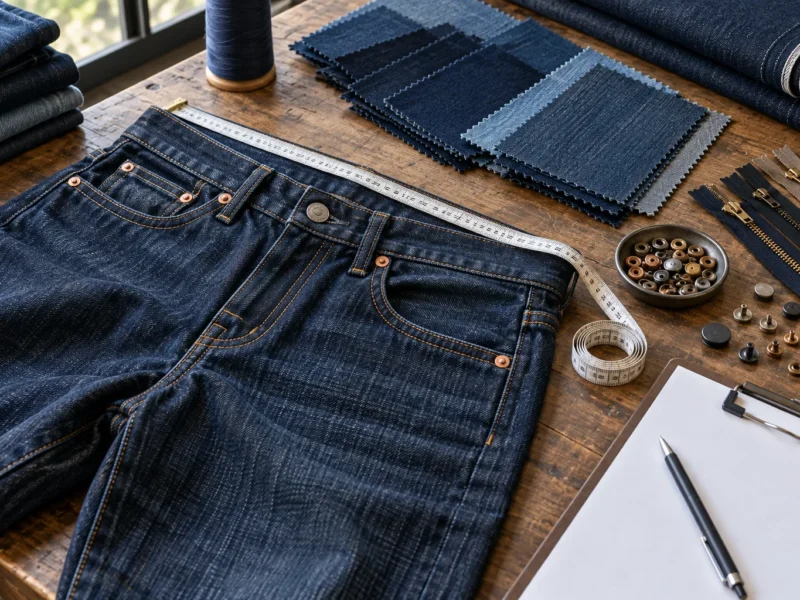
Custom jeans suppliers should be able to prove how they control fabric, shrinkage, washing, trims and bulk quality. The seven warning signs below help clothing brands spot missing evidence before approving production or paying a deposit.
The stitching looks tidy. The wash feels soft. The price leaves room for a healthy margin. Then the bulk shipment lands, and the problems start: one size fits tighter than expected, the blue changes from carton to carton, and a side seam seems determined to wander toward the front of the leg.
For a DTC brand, these are expensive surprises. They turn into returns, replacement shipments, awkward customer emails, and stock that becomes increasingly difficult to sell.
Choosing a custom jeans supplier means looking beyond a convincing sample. You need to understand how the factory controls fabric, fit, washing, hardware, and production quality—and whether it can show you the records behind its answers.
These seven red flags will help you ask better questions before your deposit becomes someone else’s working capital.
In this guide: Denim sourcing risks · 7 red flags · Supplier comparison · Vetting checklist · FAQs
Why Denim Sourcing Carries Unique Manufacturing Risks
Why Generic Apparel Checks Are Not Enough for Custom Jeans
The checks you use for T-shirts are still useful, but they won’t tell you everything about a denim supplier.
Jeans often go through substantial treatment after sewing: enzyme washing, stone washing, bleaching, or other finishing processes. That means a garment can leave the sewing line looking correct and come out of the laundry with different dimensions, a different feel, and a noticeably different shade.
Think of cutting and sewing as building the starting shape. The wash helps determine the shape your customer actually wears.
This is why denim sourcing requires close attention to wet processing, fabric shrinkage, and the relationship between the pattern room and the wash house. A well-sewn pair of jeans can still fit badly if those teams are working from different assumptions.
The useful question is simple: “What happens to this particular fabric after this particular wash?”
A capable supplier should have more than a reassuring answer. It should have test results.
The Cost of a Bad Batch: Leg Twists, Color Shading, and Dead Inventory
Imagine approving a straight-leg sample, then discovering that the side seam on part of the bulk order curves toward the shin after washing. The jeans may still close at the waist, but they no longer look like the product you photographed.
That is the commercial problem with leg twist, also called seam spirality. Small production variations can become very visible on the body.
Color creates another set of headaches. Lot-to-lot wash variation can leave garments in different shades, while crocking refers to color transferring through rubbing. These are separate issues, and your quality checks should treat them separately.
The practical point holds without it: a bad batch costs more than the manufacturing invoice. Returns handling, discounts, replacement freight, and lost customer confidence all eat into the margin.
For your own order, define how leg twist will be measured, the care cycle used and the acceptance limit. A percentage without an agreed test method does not provide a reliable basis for inspection.
7 Red Flags in Custom Jeans Suppliers
1. Quoting Prices Without Specifying Denim Weight (Oz) or Fabric Mill
“$12 per pair” sounds helpful. Until you ask what, exactly, that price buys.
A meaningful quote needs a fabric specification. At a minimum, the supplier should understand your target weight, fiber composition, stretch requirements, wash, and construction details.
An 8 oz lightweight fabric and a 14 oz rigid denim are very different starting points. Add elastane, change the finish, or request a specific mill, and both the cost and production requirements can change.
An early estimate is perfectly reasonable. An estimate presented as a firm price without those details deserves a closer look.
Ask the supplier to identify:
- The fabric mill and fabric code.
- The weight and fiber composition.
- Whether the fabric is stock material or requires a new production run.
- The approved wash and finish.
- Whether substitutions require your written approval.
Deadstock fabric is not automatically a poor choice. It can work well for a limited run. The problem is buying a repeatable product and later discovering that the original fabric is unavailable—or has quietly been replaced.
A low price is useful only when you know what is included. Compare the quote line by line using our custom denim production cost guide.
2. Promising Zero Shrinkage or Missing Post-Wash Shrinkage Test Reports
“No shrinkage. Guaranteed.”
That should be the start of a technical conversation, not the end of one.
Cotton denim can change dimensions during washing and drying. The amount depends on the fabric, finishing history, garment treatment, and care conditions. A blanket promise tells you very little.
Do not apply a generic shrinkage percentage to every denim fabric. Ask for measured results for the allocated fabric lot, approved factory wash and intended customer care cycle.
Request a warp and weft shrinkage report for the relevant fabric lot. Warp refers to the lengthwise direction; weft refers to the widthwise direction.
Then connect the report to the pattern:
“What allowance did you use, and was it based on this fabric and our approved wash?”
That second question matters. A report sitting in a folder is not much help if the pattern master used different numbers.
Also distinguish shrinkage during factory processing from residual shrinkage during customer laundering. Both can affect fit, but they need to be checked at the appropriate stage.
3. Vague Answers About In-House vs. Outsourced Wet Processing (Laundry)
Outsourcing laundry is not, by itself, a red flag. Plenty of manufacturers work with specialist wash houses.
The concern is a supplier that cannot—or will not—explain where the washing happens and who controls the result.
Ask who owns the wash recipe, how shade consistency is checked, and what happens if a batch misses the approved standard. You should also be able to identify the facility responsible for wastewater treatment and relevant discharge permits.
“Don’t worry, we’ve used them for years” is a relationship history. It is not a control process.
For a practical review of site identity, subcontractors and production controls, use our jeans factory audit checklist.
Likewise, if a supplier refers to ZDHC compliance, ask what that claim covers and request supporting documentation. Chemical management, wastewater performance, and local discharge permissions should be checked on their own terms.
The goal is to follow your jeans through the actual production route, including any subcontractors.
4. Refusing to Send Complete Pre-Production (PP) Samples with Exact Trims
The sample zipper slides smoothly. The rivets feel solid. Everything looks ready.
But are those the components that will appear in the bulk order?
A prototype may use whatever premium trims the sample room has available. That becomes a problem when the approved look depends on hardware that is later replaced with a cheaper or less suitable alternative.
Different metals, coatings, and attachment methods can behave differently during washing and wear. Rust marks around a rivet are a particularly frustrating way to discover a substitution.
Require a pre-production sample with the exact approved bulk trims, including zippers, rivets, buttons, labels, and patches. Record their specifications in the bill of materials.
Agree physical testing before production, including attachment strength, corrosion resistance and compatibility with the intended wash.
Specify the test method, force or duration, pass criteria and acceptable condition of the surrounding fabric for each relevant trim. Use our custom denim trims guide to document materials, finishes and attachment details.
A salt spray result also does not replace checking how the hardware performs in your actual garment wash.
Follow the Proto, Fit and PPS sample approval stages, and keep an approved reference sample. “It looked different when we first discussed it” is a difficult argument to settle from memory.
5. Unrealistic MOQ Flexibility on Custom Selvedge or Specialty Washes
A supplier offering 50 pairs of custom selvedge jeans may have a workable plan. Ask what “custom” means.
There is a big difference between cutting your design from existing selvedge fabric and commissioning a mill to weave a new fabric to your specification.
The first can sometimes suit a small order. The second involves mill minimums, loom scheduling, and development costs.
Specialty finishes need the same level of explanation. Laser work, ozone treatment, and wet washing have different setup and processing requirements. Equipment capacity, batch loading, and repeatability all affect whether a small run makes sense.
Sewing capacity does not remove minimums at the fabric mill or wash house. Ask the supplier to explain material availability, processing batch sizes and reorder limits separately.
Before accepting a very low MOQ, clarify:
- Which materials are already in stock.
- Which elements are genuinely developed for your order.
- Whether development charges sit outside the unit price.
- How the small-batch finish will be reproduced on a larger reorder.
Hand finishing is not inherently inferior, either. The issue is whether the promised method, appearance, and consistency match what you are paying for.
Low MOQs can be valuable. Unexplained low MOQs are where the trouble starts. Our guide to sourcing denim for small batches explains how fabric minimums, wash consistency and reorder plans affect the decision.
6. Pushy Demands for 100% Upfront Payment or Missing Milestone Terms
Payment terms tell you something about how production risk is being shared.
Payment schedules vary with order size, material commitments and supplier relationships. Ask for a written schedule that identifies the evidence required at each production milestone.
What matters is knowing what triggers each payment.
Is the deposit due after the tech pack is confirmed? Does the balance become payable after a passed third-party inspection, against a bill of lading copy, or at another agreed point? Those milestones are different, so the contract should be specific.
A demand for 100% upfront payment on a substantial first bulk order deserves scrutiny, especially when it comes with pressure to pay immediately or vague answers about defect handling.
Full prepayment does not prove a supplier is dishonest. It does, however, leave the buyer carrying more risk and with fewer funds to withhold if something goes wrong.
Before transferring money, document the production milestones, inspection access, shipment conditions, and process for resolving failed goods.
“We’ll sort it out later” gets much less comforting once the full invoice has been paid.
7. Refusing Independent Inspection or Failing to Resolve Quality Issues
A final inspection should do more than confirm that the cartons contain jeans.
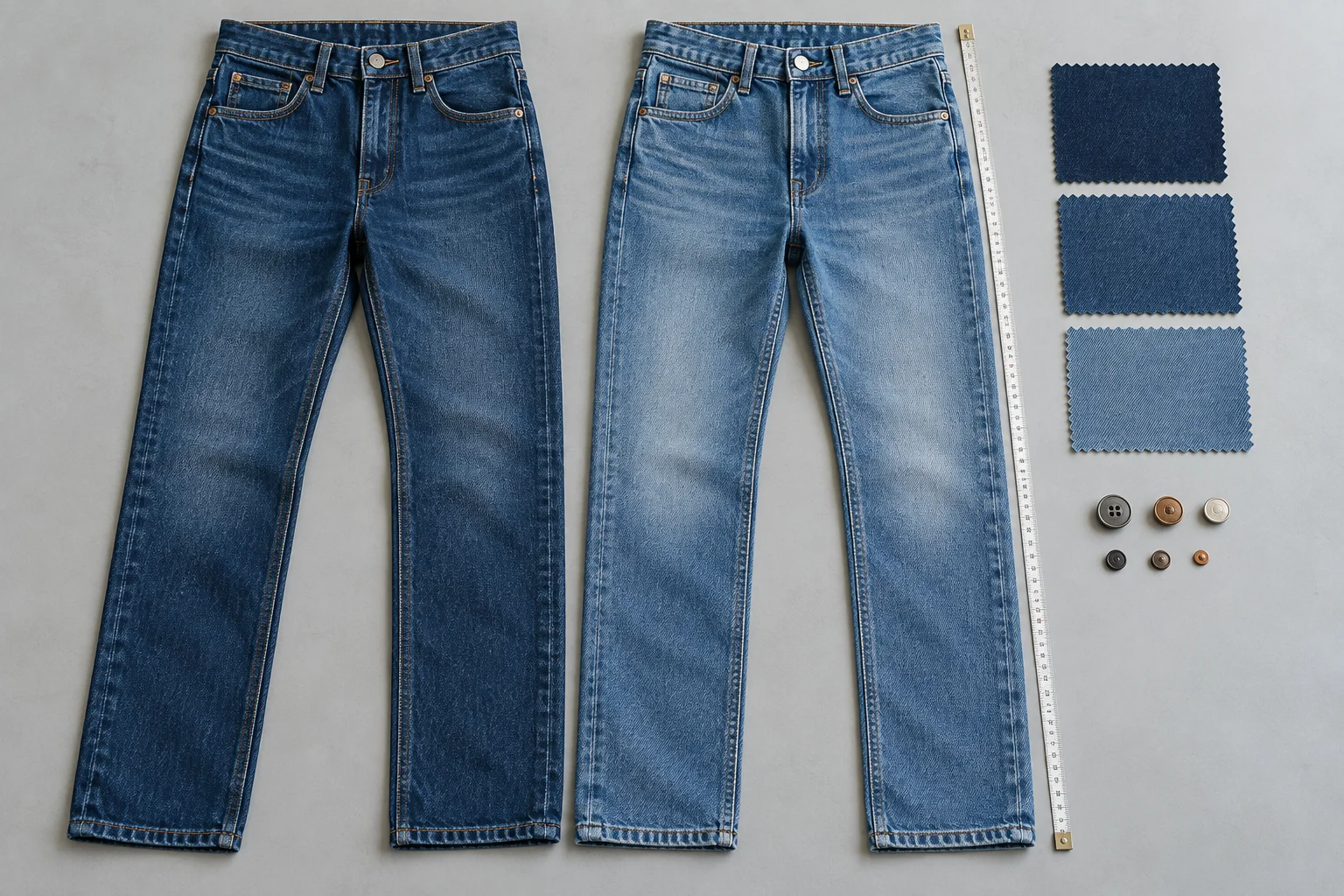
Denim requires attention to construction, measurements, appearance, hardware, and wash consistency. Potential defects include:
- Skipped or insecure chain stitching along the waistband.
- Weak or broken stitching at the crotch.
- Misaligned back yoke seams.
- Uneven back pocket placement.
- Measurements outside the agreed tolerance.
- Unacceptable shade variation or twisting.
If you specify AQL 2.5, define how it will be used. The inspection level, sampling plan, defect categories, and acceptance criteria should be agreed in advance. The number alone is not a complete inspection instruction or a guarantee that every garment is defect-free. ISO 2859-1 describes AQL-indexed sampling schemes for lot-by-lot inspection; agree the applicable plan with your inspector.
A supplier’s refusal to allow an agreed independent inspection is a serious concern. Still, a previous failed inspection should be assessed alongside the corrective action and reinspection results.
The more revealing question is often this: “What do you do when an inspector finds a problem?”
Look for a documented answer that includes containment, correction, and verification.
Comparison: Vetted Denim Specialists vs. High-Risk Intermediaries
A trading company can be a capable partner, and a large factory can still mishandle an order. The distinction worth making is between a supplier that provides evidence and one that relies on reassurance.
| Assessment Metric | Supplier Warning Sign | Evidence to Request |
|---|---|---|
| Manufacturing Scale | Cannot identify the workshops handling the order | Identifies production sites, subcontractors and the capacity allocated to your order |
| Shrinkage Testing | Offers verbal promises of “no shrink” | Provides relevant warp/weft test results and explains the pattern allowances |
| Wash Facility | Gives vague answers about laundry location and controls | Identifies the wash facility and supplies relevant process and environmental records; claimed heat/steam recovery systems can be verified |
| Hardware Standards | Uses unspecified or untested trims | Uses approved bulk trims tested against documented attachment, corrosion and wash requirements |
| Experience & QC | Cannot show how quality is managed through production | Provides relevant QC records, corrective actions and reinspection results |
The Technical Denim Vetting Checklist Before You Send a Deposit
5 Essential Questions for the Factory Pattern Master & Wash Master
Sales teams are useful for pricing and coordination. For these questions, involve the people responsible for the pattern and the wash.
- “What shrinkage allowance did you apply in the warp and weft directions for this specific fabric code?”
Ask to see the test results behind the allowance and confirm that they reflect your intended wash. - “Can you provide the 4-point fabric inspection score and skewness results for the bulk fabric?”
Check that the records relate to the rolls or lot allocated to your order, rather than a different material used during sampling. - “What are the wet and dry rubbing colorfastness results after the approved enzyme or stone wash?”
If using AATCC TM8 for colorfastness to crocking, agree on the method and required rating before testing. - “How are pocket corners, belt loops, and zipper fly stops reinforced?”
Ask the factory to identify the bar-tacking or other approved reinforcement on the sample. “Standard construction” can mean different things to different factories. - “How do you monitor temperature and pH during neutralization after chemical treatments?”
Where neutralization is part of the process, request the control procedure and relevant production records.
You do not need to become a wash technician to assess the response. Look for answers tied to your product, supported by records, and consistent across the people involved.
Product Specifications for Leg Twist and Hardware Performance
A useful specification turns “the jeans should look right” into something both sides can measure.
Use the following specification checklist to record measurable product requirements and the response to a failed inspection.
Seam twist: Record the measurement method, reference points, wash and drying procedure, number of care cycles, acceptance limit and defect classification. Attach an approved measurement diagram or reference sample.
Hardware: Record the approved trim codes, attachment test method, force and hold time, acceptance criteria, and appearance requirements after the intended garment wash. Include checks for detachment, fabric damage and staining.
Also document what follows a failure: rework, replacement, reinspection, and responsibility for the related costs.
Those details give the acceptance criteria practical value. Otherwise, both parties may agree that there is a problem while disagreeing about who has to solve it.
Frequently Asked Questions (FAQ)
What is the normal tolerance for denim leg twist in production?
There is no single tolerance that should be applied to every denim product without defining the test method.
Fabric construction, garment design, wash conditions, and the measurement procedure all matter. Agree on a limit for your product and evaluate it after the specified care cycle.
Why is my denim sample softer than the mass production order?
The sample and the bulk order may not have experienced the same processing conditions.
A small sample drum and a full-size industrial laundry machine, for example, can differ in loading, mechanical action, and how the garments interact with the treatment. Softener application, drying, and the fabric lot may also affect the result.
Ask the supplier to document the approved wash recipe and validate it under conditions that represent bulk production. Keep a sealed reference sample for comparison.
“Use the same wash” is a useful intention. A repeatable process needs more detail.
Can custom denim be sourced sustainably without high failure rates?
Yes, but environmental performance and product consistency both need evidence.
Low-liquor-ratio washing, ozone treatment, and suitable heat or steam recovery systems can form part of a more resource-efficient production setup. Their value depends on how they are operated, maintained, and matched to the product.
Ask for relevant environmental records alongside the usual fit, shade, shrinkage, and construction checks. Experience and equipment are encouraging; neither removes the need to verify the results.
A dependable denim supplier can explain how your jeans will be made, show how the process is controlled, and respond clearly when something falls outside the agreed specification. That is a much stronger basis for a working relationship than a beautiful sample alone.
Planning a custom jeans order? Send Lianwang your tech pack and sourcing requirements, including target quantity, fabric, wash and delivery date, to discuss sampling and production feasibility.

Recent Comments