
Why Selvedge Denim Costs More: Factory Cost Breakdown
A $200 pair of jeans and a $40 pair can look surprisingly similar on a shop shelf. Both have five pockets, metal rivets, and blue denim. Turn up the cuffs, though, and you may spot a small detail that hints at a very different production process: the clean, woven edge of selvedge fabric.
Does that little edge explain the entire price gap? No. Branding, distribution, and retail margins matter too. But the manufacturing differences are real—and they start long before anyone sews a pocket.
At Kaiping Lianwang Garment Co., LTD, we see those differences at the cutting table and on the sewing floor. Our facility in Jiangmen, Guangdong, covers more than 7,000 square meters, and our team draws on over 20 years of denim manufacturing experience to serve brands in Europe, the United States, and Australia.
From that factory perspective, the extra cost comes down to a series of practical compromises: slower weaving, less flexible cutting layouts, more demanding fit development, and additional time at the machine. None sounds dramatic on its own. Together, they add up.
1. The Loom Equation: Why Slow Weaving Multiplies Base Fabric Costs
The first cost difference appears at the mill. Before the fabric reaches a garment factory, the way it is woven has already shaped its price.
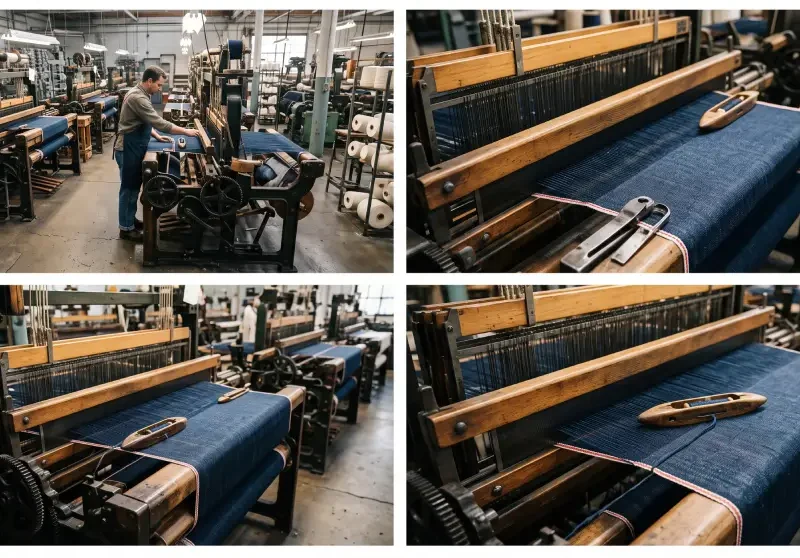
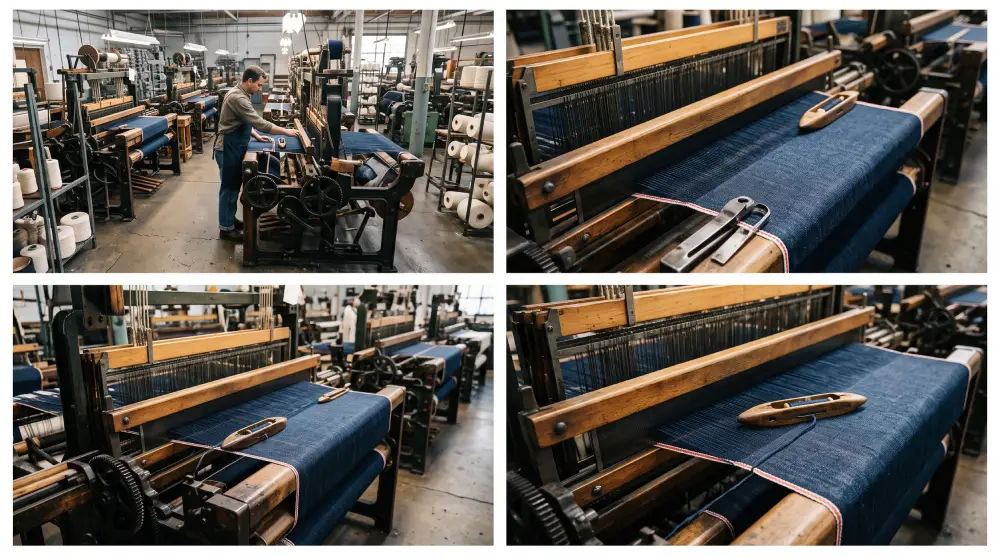
Shuttle Looms vs. Modern Projectile Looms: Speed, Texture, and Output
Modern projectile and air-jet looms are built for output. Depending on the machine and fabric specification, insertion rates can exceed 800 to 1,000 picks per minute. The vintage shuttle looms used in our comparison, including older Toyoda and Draper models, work at roughly 90 to 120 picks per minute.
That is a substantial gap. Picks per minute do not tell the whole production story—fabric width, weave density, and downtime also matter—but they help explain why narrow shuttle-woven cloth costs more to produce.
Older looms also need maintenance and operators who understand their particular habits. A machine with decades of working life behind it rarely runs on enthusiasm alone.
The appeal is partly in the fabric these setups can produce. Combined with the right yarns, loom settings, and finishing, shuttle weaving can bring out:
- Slub character: Variations in yarn thickness that create raised lines and an uneven hand.
- Nep detailing: Small fiber knots that give the surface a speckled, textured appearance.
- Tonal depth: Differences in yarn structure and indigo coverage that make the cloth look less flat as light moves across it.
These qualities are not automatic. A shuttle loom does not guarantee beautiful denim, and modern looms can make textured cloth too. The point is that a mill producing a particular heritage fabric may accept slower output and more hands-on attention to get the result it wants.
That choice has a cost.
The Narrow-Width Penalty: Real Fabric Consumption Metrics
Fabric width creates another constraint. Commercial denim commonly arrives in rolls around 58 to 60 inches wide. Traditional narrow selvedge fabric may measure only 29 to 31 inches.
For the five-pocket jeans used in this comparison, approximate consumption is:
- Commercial fabric, 58–60 inches wide: 1.4 linear yards per pair.
- Narrow selvedge fabric, 29–31 inches wide: 2.8 linear yards per pair.
There is an important distinction here: twice the linear yardage does not automatically mean twice the fabric area, because the selvedge roll is about half as wide. The real costing exercise combines width, price per yard, and how efficiently the pattern pieces fit.
Think of wrapping an awkwardly shaped parcel with a narrow strip of paper. You may have enough paper in total. Using it neatly is another matter.
Yarn selection adds to the bill. Premium programs may specify extra-long-staple or other carefully selected cotton, including Supima, Xinjiang long-staple cotton, or high-grade African cotton. The choice depends on the mill and the intended fabric; selvedge itself does not prescribe a cotton grade.
Rope dyeing can add further processing. Bundles of yarn pass through repeated indigo dips and oxidize between them. Controlled dye penetration leaves a lighter core beneath the blue exterior, giving the finished denim the potential to develop distinct fades as the surface wears away.
2. Behind the Cutting Table: The True Cost of Rigid Pattern Engineering
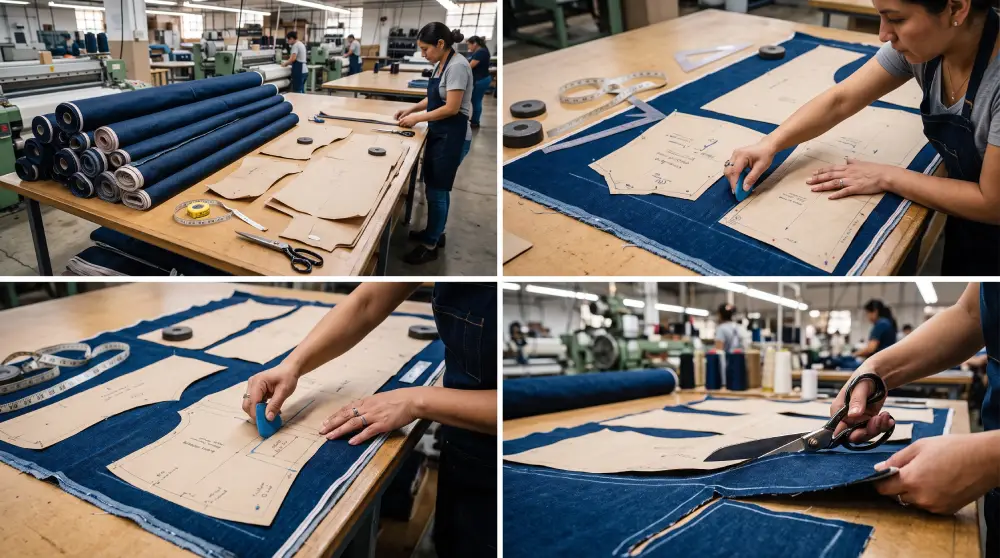
Once the cloth reaches our factory, the challenge changes. We are no longer asking how quickly it can be woven. We are asking how to turn a narrow, expensive roll into jeans that fit properly without wasting more fabric than necessary.
Zero Geometric Nesting: Why Selvedge Forces Low Marker Efficiency
With wide denim, a marker planner has room to arrange front legs, back legs, pockets, and yokes around one another, within the fabric’s grain and direction requirements. Conventional layouts in our comparison reach approximately 85% to 90% utilization.
A classic exposed-selvedge outseam removes some of that freedom. The relevant leg edges must follow the woven edges of the roll, so the largest pattern pieces cannot simply move wherever they fit best.
Smaller pieces can still fill some gaps. But the edge requirement limits the whole layout.
For the selvedge styles described here, marker efficiency falls to roughly 68% to 72%. That leaves around 28% to 32% outside the usable pattern pieces, although some offcuts may have secondary uses.
Edge defects are especially troublesome. A flaw in the very strip intended to become the visible selvedge outseam may make a panel unusable. Moving the pattern inward would lose the detail the buyer specified.
Our R&D team of more than 15 people works through these problems during development. Adjusting a rise curve, reviewing waistband pitch, or changing the placement of smaller pieces can recover a little yield.
A few percentage points may seem trivial. Across a production order, they are anything but.
The Loomstate Challenge: Calculating Pre-Shrinkage & Leg Twist Tolerances
A good-looking sample is only half the job. It also needs to behave as expected when it meets water.
The working shrinkage ranges in this comparison are:
- Sanforized denim: Approximately 1% to 3% residual shrinkage after mechanical preshrinking.
- Unsanforized loomstate denim: Approximately 8% to 12% shrinkage during the initial soak or wash.
Actual results depend on the fabric and washing conditions, so these figures are starting points for testing, not substitutes for it. Unsanforized and loomstate are also not perfectly interchangeable terms: an unsanforized fabric may still have received other finishing treatments.
Then there is leg twist. Right-hand twill can shift as the fabric relaxes and shrinks, causing the seam to rotate around the leg. Some wearers appreciate a little twist as part of a vintage look. Too much can change the appearance and feel of the fit.
Consider a sample that fits well before washing but loses more length than expected afterward. The sewing may be excellent; the customer still receives jeans that are too short.
Our sample department therefore develops batch-specific shrinkage allowances, markers, and grading adjustments. Initial ODM fit development typically takes 10–20 days, including the work needed to understand how the fabric responds. Catching a distortion in a sample is considerably cheaper than discovering it in a bulk wash.
3. Inside the Workshop: Specialized Machinery and Skilled Labor Time
Selvedge fabric can be sewn on modern equipment. It does not require every operation to happen on a vintage machine or at a single-tailor station.
However, when a brand specifies heavy raw denim, traditional seams, heritage hems, and particular hardware, the production route becomes more demanding. Those choices explain much of the extra labor cost.
Vintage Heritage Machines: Maintenance, Chain Stitching, and Speed Limits
Modern sewing machines may run at more than 4,000 stitches per minute and include automatic thread trimming. That speed is useful, but it is not always practical when an operator reaches a thick seam intersection in rigid denim.
Across our fleet of more than 330 pieces of equipment, specialized operations require the right machine, careful setup, and regular maintenance. Examples include:
- Union Special 43200G hemming: This machine is associated with the twisted, rippled hem fading known as “roping.” The result develops through the interaction of feeding, stitch formation, fabric shrinkage, and wear.
- Chainstitch inseams and waistbands: For heavy 14oz–18oz denim, operating speeds may be held around 1,500–2,000 RPM in the setups described here. Reliable feeding and stitch formation take priority over maximum speed.
- Solid copper hidden rivets: Thick pocket corners need accurate positioning and controlled setting pressure. Poor installation can damage the fabric or leave hardware that does not sit securely.
A conventional lockstitch hem generally produces a flatter finish. A heritage chainstitched hem can develop a more pronounced, wavy fade. Neither makes a pair of jeans worthwhile by itself, but customers who request the latter expect it to be done properly.
That is where specialist equipment earns its place.
Assembly Line vs. Single-Tailor Stations: The Wage Gap in Minutes per Pair
On an efficient commercial line, work is divided into short, repeatable operations. One person may set pockets while another handles an edge-finishing step. Some individual tasks take only seconds.
The conventional assembly benchmark used here is 18 to 25 minutes per pair.
Our more than 150 skilled production workers handle demanding selvedge styles through modular workstations, where the fabric and construction details require additional attention:
- Heavy 16oz cloth needs careful guidance through the feed system.
- An exposed selvedge outseam is preserved rather than trimmed away in a standard overlocking operation.
- Open seam allowances require pressing.
- Thick cuffs need steady handling during hemming, particularly at bulky intersections.
For these styles, assembly time can reach 60 to 90 minutes per pair.
The difference is easy to miss when looking at finished jeans. An operator pauses, adjusts a folded edge, or slows down over several layers. Repeat those small interventions across the garment, and the minutes accumulate.
Every finished product also goes through inspection before shipment against applicable requirements and the agreed quality specification. Dropped chainstitches or uneven tension may require repair; damaged components may need replacement or rejection. Even when a fault is repairable, the extra handling still costs time.
4. The Value Proposition: Cost-per-Wear, Patina, and Longevity
Higher production costs explain part of the price. Whether that price represents good value is a separate question.
For someone who enjoys substantial fabric and gradual fading, selvedge can be rewarding. For someone who mainly wants lightweight stretch jeans, the same characteristics may be drawbacks. Expensive denim still has to suit the person wearing it.
Fading Anatomy: How Core-White Indigo Fiber Unlocks High-Contrast Honeycombs
Ring-dyed indigo yarn has a blue outer layer and a lighter core. As friction removes surface color, the contrast becomes visible.
This is not exclusive to selvedge. Non-selvedge denim can also be rope-dyed and fade well, while dye penetration, sulfur treatments, garment washing, and finishing all influence the result.
On suitable raw denim, repeated movement can produce familiar patterns:
- Whiskers: Horizontal creases around the upper thighs and lap.
- Honeycombs: Clustered folds behind the knees.
- Train tracks: Parallel fading lines along the outseams, where the seam structure affects abrasion.
The interesting part is how individual the result becomes. Two people can buy the same jeans and end up with different fades because they sit, walk, work, and wash them differently. The fabric keeps a quiet record of use.
Durability deserves a little more caution. Raw denim often retains sizing, which contributes to its initial stiffness. Stiffness alone does not prove strength, and a selvedge edge does not guarantee a longer-lasting garment. Yarn quality, fabric construction, fit, stitching, washing, and repairs all matter.
Cost-per-wear offers a useful way to think about value. A $200 pair worn 200 times costs $1 per wear. A $40 pair worn 20 times costs $2. Those are illustrative numbers, not a lifespan forecast—the deciding factor is how much useful wear the owner actually gets.
Factory Breakdown Table: Conventional vs. High-End Selvedge Jeans
The figures below summarize the production comparison discussed here. They are indicative factory benchmarks, not universal specifications for every conventional or selvedge order.
| Production Variable | Conventional Fast-Fashion Denim | High-End Selvedge Denim (Factory Metrics) |
|---|---|---|
| Loom Weaving Speed | 800–1,000+ picks/min on modern equipment | 90–120 picks/min on the vintage shuttle looms compared |
| Fabric Roll Width | 58–60 inches | 29–31 inches |
| Fabric Consumption | Approximately 1.4 linear yards per pair | Approximately 2.8 linear yards per pair |
| Cutting Marker Efficiency | 85%–90% | 68%–72% with selvedge outseam placement |
| Hardware & Trims | Lightweight alloy hardware and hollow zinc rivets | Solid copper rivets and custom donut buttons, where specified |
| Assembly Time | 18–25 minutes per pair | 60–90 minutes per pair |
| Quality Control Scrap Rate | Below 2% in the stated benchmark | 5%–8% in the stated benchmark; confirm how scrap is defined when costing |
| Production Cycle | 45–60 days for the mass-batch comparison | 25–35 days for the factory’s agile OEM/ODM program, subject to order readiness |
The production-cycle row needs context. More labor per garment does not necessarily mean a longer calendar lead time. Order size, material availability, approvals, and available capacity all affect scheduling. A smaller prepared order can finish sooner than a large conventional run.
Also, these are production variables rather than a dollar-by-dollar quotation. An exact unit cost still requires the fabric price, size range, order quantity, wash, trims, and construction specification.
5. Is the Investment Justified for Brands and Wearers?
For a brand, selvedge makes sense when the fabric and construction support what its customers actually value. For a wearer, it makes sense when the fit, feel, and aging process justify the purchase.
The red line inside a cuff is a detail. The garment around it has to do the work.
Craftsmanship as a Moat: Why Heritage Brands Cannot Mass-Produce
Large factories can produce selvedge jeans. The obstacle is usually how comfortably the work fits their production model.
A line organized around high volume and standardized operations may find narrow-fabric cutting, heavy cloth, and slower heritage details commercially unattractive. It can accommodate them, but doing so may require different scheduling, equipment, or operator skills.
For smaller labels and heritage brands, those same details can provide meaningful differentiation. Traceable fabric sourcing, consistent fit, carefully installed hardware, and well-executed seams give customers something concrete to evaluate.
Still, selvedge is not an automatic stamp of authenticity. If the fit is poor or the stitching fails, an attractive cuff will not save the purchase. The strongest offering is a complete garment whose details justify its story.
Sourcing Authentic Selvedge: Red Flags in Marketing-Driven Counterfeits
When sourcing fabric or finished jeans, inspect how the edge is made. Color alone proves very little: genuine selvedge does not have to include a red identification line.
Two imitations deserve particular attention:
- The overlocked mock selvedge. A supplier may finish the cut edge of wide denim with colored overlock thread. Look closely at the structure. Overlocking wraps sewing thread around a cut edge; genuine selvedge is formed during weaving.
- Applied woven ribbon. A separate strip of red-and-white tape may be sewn onto ordinary denim. Open the seam allowance and check whether the strip is attached with a separate row of stitching or is integral to the fabric.
Decorative tape is not inherently a problem when it is described honestly. Presenting it as a loom-woven self-edge is.
For brands, a fabric swatch and an opened seam sample are far more useful than a distant photograph of a rolled cuff.
Frequently Asked Questions (FAQ)
Q1: Does selvedge denim always mean raw, unwashed denim?
No. “Selvedge” describes the woven self-edge. “Raw” generally describes denim that has not been garment-washed.
The two often appear together, but they are different characteristics. Selvedge jeans can be washed, stonewashed, or distressed, just like jeans made from wider fabric.
Q2: Why does selvedge fabric feel so stiff and uncomfortable during initial wears?
With raw selvedge, much of that stiffness comes from the fabric’s weight, construction, and retained sizing used during weaving. Selvedge itself is not the cause.
Wear and washing gradually soften the cloth. A heavy pair may take several weeks to feel more relaxed, although the timing varies. It should still fit sensibly from the start; persistent discomfort is not a craftsmanship requirement.
Q3: Can a brand produce custom selvedge denim with low minimums?
Yes, depending on the fabric and customization required. Using available mill fabric is generally more straightforward than commissioning an exclusive weave or dye specification.
Our facility supports OEM and ODM partnerships covering fabric sourcing, custom branding, and sample development. Our stated service targets include sample development within 10–20 days, technical specifications and quotations within 3 hours of a sufficiently detailed inquiry, and bulk manufacturing in 25–35 days.
Minimum quantities and delivery dates should be confirmed against the actual project, including material availability and approvals.
Q4: How should customers care for raw selvedge to maximize patina?
Consistent wear helps establish creases that can develop into visible fades. Some denim enthusiasts wait 3 to 6 months before the first wash, but that is a preference, not a requirement. Wash the jeans sooner if they are dirty or need freshening up.
Follow the maker’s care instructions, especially for unsanforized fabric. A gentle approach is to turn the jeans inside out, use cold water and mild detergent, avoid aggressive spinning, and hang them to dry.
Care should support regular wear. There is little value in preserving a perfect fade on jeans you no longer enjoy putting on.
To develop a custom denim collection or review technical wash samples, send your tech pack to our engineering team. Include your target fit, fabric weight, wash reference, quantities, and preferred construction details so we can assess the project and prepare a useful quotation.
Our one-to-one OEM/ODM service covers the process from sourcing and sample development through bulk production—with the practical aim of making jeans that work as well in everyday wear as they do in the sample room.

Recent Comments