
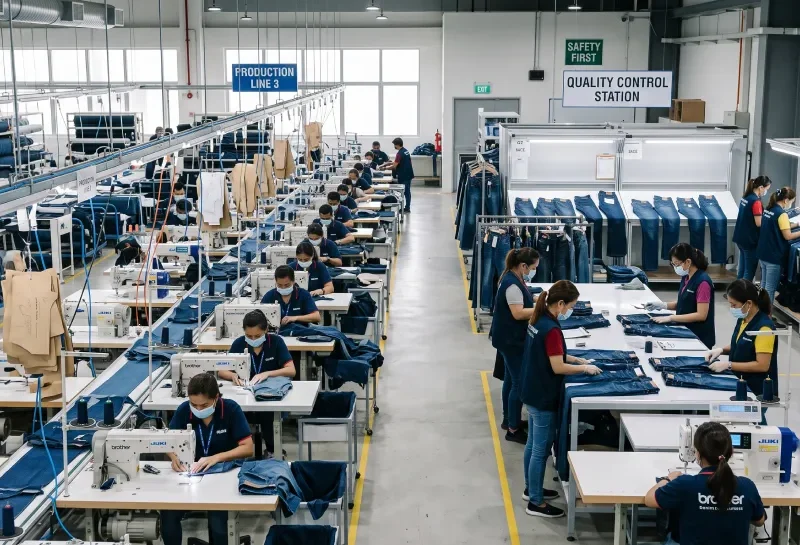
The wrong jeans manufacturer can cost you $18,000 and six months of runway before you’ve even shipped your first order. I’ve seen it happen — killer designs, solid marketing, and a production partner who delivered crooked stitches and mismatched washes.
Here’s the reality: finding jeans manufacturers isn’t about finding “the best” factory in the world. It’s about finding the right match for your specific business.
In 2026, smart brands know better. They understand that denim — with its complex fabric requirements, wash variations, and construction standards — requires partners who’ve already made the costly mistakes you’re about to encounter.
By the end of this guide, you’ll know exactly what quality metrics matter in 2026, which countries excel at what, how to navigate MOQ requirements, and why sustainability is now table stakes.
The Jeans Manufacturer Trap That Sinks Brands Before Launch
Most startup founders treat jeans manufacturing like any other product sourcing. They browse Alibaba for 30 minutes, pick the cheapest quote, and wonder why their 500-unit order arrives two months late, badly constructed, and 20% over the promised price.
Last month a client did exactly that. Samples looked perfect. Production arrived with zippers that broke within 50 wears, pockets off-center, and wash colors that didn’t match. Cost? $18,000 gone. The quotes were 30% lower than established manufacturers.
The better question isn’t “who’s cheapest?” It’s “who won’t cost me more later?”
2026 Quality Standards: What Separates Average from Exceptional
AQL Inspection Standards
Acceptable Quality Limits aren’t optional — they’re your baseline protection. What serious jeans manufacturers use:
- Major defects: AQL 2.5 (≤2.5% allowable)
- Minor defects: AQL 4.0 (≤4.0% allowable)
- Critical defects: AQL 0.1 (zero tolerance)
If a manufacturer says “we don’t really follow AQL” or “it depends” — walk away. That’s amateur hour.
Multi-Stage Quality Control
Exceptional manufacturers QC through every stage:
- Pre-production: Fabric approval, tech pack verification
- In-line: Random spot-checks during cutting/sewing
- Post-wash: Shrinkage testing, color matching
- Final inspection: AQL compliance before shipping
- Third-party: Optional SGS/BV/Intertek verification
Ask them to walk you through their in-process QC. The best have dedicated QC managers on the floor — not just the owner doing “quick looks.”
Defect Rate Benchmarks
Get real numbers:
- Excellent: <1% defect rate
- Professional: 1-3%
- Acceptable: 3-5%
- Problematic: >5%
Factories that track and share these metrics have nothing to hide. Those that deflect — run.
Certification Requirements 2026
These aren’t marketing fluff anymore:
- OEKO-TEX Standard 100 – harmful substance testing
- Bluesign – sustainable chemical management
- ISO 9001 – quality management systems
- GOTS (if using organic)
- ZDHC compliance – responsible chemical use
- B Corp – overall social/environmental performance
Don’t take their word. Ask to see current certificates. Verify they’re facility-wide, not just for one product line.
Global Jeans Manufacturing Destinations Ranked (2026 Data)
The global denim market reached $97.34 billion in 2025, projected to grow to $164.21 billion by 2034 (5.98% CAGR). Here’s where it’s made and what each destination excels at in 2026.
Turkey: The Quality Benchmark
Turkey has emerged as the global benchmark for quality denim manufacturing. Heavy investments in sustainable infrastructure and mastered construction quality.
Why brands choose Turkey:
- Unmatched technical capability for mid-premium segment
- Strong English communication
- EU proximity reduces shipping time/carbon footprint
- Sustainable manufacturing leaders (many zero-discharge facilities)
Cost: $15-30/unit bulk (15-30% premium vs. Asia)
Best for: Brands targeting EU/US markets who want quality without luxury pricing
Italy & Japan: Premium Craft
For luxury denim, these two dominate.
Italy:
- Fabric innovation and technical mastery
- Artisanal finishing techniques
- Premium hardware integration (YKK, Prym custom work)
- Small-batch flexibility (100-200 units possible)
Japan:
- World’s finest selvedge denim
- Meticulous construction standards
- Heritage manufacturing techniques
- Indigo dyeing mastery
Cost: $40-100+ per unit depending on complexity
Best for: High-end designer brands, heritage labels, Bespoke programs
China: Volume and Ecosystem
China produces over 3 billion meters of denim annually — roughly 40% of global capacity.
Quality spectrum:
- Tier-1 factories: World-class (comparable to Italy/Japan)
- Tier-2: Solid mid-market (80% sweet spot, improved dramatically past decade)
- Tier-3: Low-cost, inconsistent quality
China’s advantages:
- Mature fabric and trim ecosystem (everything sourced locally)
- Most technical capabilities in one place
- Reliable logistics infrastructure
- Wide pricing range ($8-25/unit bulk)
China’s challenges:
- Minimums often higher (500+ units typical)
- English communication varies by region
- Quality varies dramatically by factory tier
Best for: Brands comfortable vetting specific factories who want scale
Pakistan & India: Vertically Integrated Strength
Pakistan: Vertical integration — many manufacturers own mills and control cotton-to-garment production. Strong wash capabilities, cost-effective mid-range production.
India: Massive textile ecosystem, strong cotton production, improving sustainability certifications. Often 10-20% cheaper than Pakistan for comparable quality.
Cost: $6-18/unit bulk
Best for: Brands prioritizing budget over speed, those needing volume flexibility
Bangladesh: Low-Cost Assembly
Bangladesh excels at high-volume basic jeans production. Post-Rana Plaza investments in sustainability have paid off — major factories upgraded facilities.
Key data:
- Exported 200+ million jeans pairs in 2023
- Very low labor costs → lowest unit prices ($4-12 possible at scale)
- Fabric often imported (limits vertical control)
Risks: Political instability, quality control generally lower than Pakistan/India, longer lead times
Best for: Brands with high-volume, basic styling who can absorb quality risk
Mexico & Nearshoring Hotspots
Mexico’s denim exports to the US grew 22% in 2024 as brands chase shorter supply chains.
Advantages:
- 2-3 week lead times vs. 6-8 weeks from Asia
- Easier factory visits (day trip from California/Texas)
- Tariff advantages for USMCA-compliant production
- Better minimums (often 200-300 units acceptable)
Cost: 20-40% higher than Asian equivalents, but offset by shipping/tariffs
Best for: D2C brands wanting speed, US brands avoiding China tariffs, quick-turn seasonal drops
Emerging: Vietnam, Tunisia, Egypt
Vietnam — growing denim capacity, strategic tariff avoidance for US brands, quality improving rapidly.
Tunisia/Egypt — EU gateway through Mediterranean routes, lower labor than Turkey but close proximity.
Key insight: Country averages mean nothing. I’ve seen Chinese factories out-Italian Italian-made quality. And vice versa. Judge the individual facility’s portfolio, certifications, and sample quality — not the flag on the map.
MOQ Requirements and Cost Structures in 2026
Let’s get real about numbers. Your MOQ determines which manufacturers will even talk to you.
MOQ Breakdown by Order Size
| Your Target Order | Factory Type That Will Take You | Typical MOQ per Style | Realistic Lead Time |
|---|---|---|---|
| 50-200 units | Startup-friendly boutique | 50-150 units | 4-6 weeks |
| 200-500 units | Small/medium specialist | 200-300 units | 5-7 weeks |
| 500-1,000 units | Mid-size denim factory | 500-1,000 units | 6-8 weeks |
| 1,000-5,000 units | Large-scale producer | 1,000+ units (often per wash) | 8-12 weeks |
| 5,000+ units | Major exporter | Varies (they want you) | 10-16 weeks |
What Drives MOQ?
Three things determine what a jeans manufacturer requires:
- Wash Complexity — Each wash treatment creates separate production runs. Want three washes? That’s three separate MOQs potentially.
- Fabric Sourcing — Stock fabrics lower MOQs (100-200). Greige goods programs can go to 50-100 units per style. Custom woven fabrics? Expect 500+ minimums.
- Automation Level — AI-powered cutting tables enable smaller batches. Ask if they have automated nesting systems. Digitized cutting rooms can handle 20-30% lower minimums.
2026 Cost Breakdown Per Unit
Here’s realistic cost ranges for bulk production (FOB pricing):
| Segment | Fabric + Trim | Sewing + Wash | Total (FOB) |
|---|---|---|---|
| Economy | $3-5 | $2-4 | $6-10 |
| Mid-market | $5-12 | $4-8 | $11-20 |
| Premium | $12-25 | $10-20 | $25-45 |
| Luxury | $25-50+ | $20-50+ | $50-100+ |
Sample costs are separate — expect $200-800 per style for initial prototypes (reusable in production if approved).
Your retail pricing math: Multiply cost-of-goods by 3-4x for healthy margins. If your jeans cost $18 to make, retail at $54-72. If they cost $45, you’re looking at $135-180 retail.
What’s Included vs. What’s Extra
FOB pricing typically includes:
✓ Fabric and trims (buttons, zippers, rivets)
✓ Cutting, sewing, washing
✓ Thread, labels, hangtags
✓ QC and packaging
✓ FOB port loading
Usually extra:
✗ Shipping (freight to your warehouse)
✗ Customs duties (destination country)
✗ Insurance
✗ Third-party inspection fees ($300-800 per shipment)
✗ Re-work costs (if you reject samples)
Get everything in writing. Surprise costs kill margins.
Sustainability Trends: The New Minimum Expectation
Two years ago, “eco-friendly denim” was a differentiator. In 2026 it’s table stakes. Major retailers won’t even consider manufacturers without sustainability credentials.
Water Reduction Technologies
Denim finishing has been the most water-intensive stage. 2026 leaders:
- Ozone washing — replaces traditional water immersion, reduces water use by 90%
- Laser finishing — creates whisker/distressed patterns without sandblasting, 90% water reduction
- E-flow/Nano bubbles — uses pressurized air bubbles, minimal water
- Closed-loop systems — reputable factories now recycle 95% of wash water
Ask your potential partner: “What’s your water consumption per finished pair?” Good answer: <100 liters. Average: 150-200L. Old-school: 300-700L.
Chemical Management
ZDHC (Zero Discharge of Hazardous Chemicals) compliance is now baseline. Look for:
- Restricted Substance Lists (RSL) testing reports
- Bluesign certification for chemical suppliers
- Safe chemical management systems
- Training programs for workers handling dyes/chemicals
Manufacturers without ZDHC compliance will struggle to keep major retail clients in 2026.
Traceability and Transparency
Brands increasingly demand supply chain visibility. Leaders offer:
- QR codes on hangtags linking to production details
- Participation in platforms like TrusTrace or Retraced
- Batch-level traceability for sustainability claims
- Transparent wage disclosure and worker welfare programs
EU regulations (2023-2025) now mandate supply chain due diligence for textiles. USA’s SB-184 and similar state laws follow. Your manufacturer needs systems to support this.
Circular Economy Integration
Forward-thinking facilities now offer:
- Recycled denim programs — accepting post-consumer garments for material recovery
- Repair/services — extending product life
- Take-back logistics — managing returned goods
- Design-for-disassembly — making garments easier to recycle
Not all brands need this yet, but it signals a manufacturer thinking long-term rather than short-term cost cuts.
Your Action Plan: Source the Right Manufacturer This Week
Stop browsing endless supplier directories. Here’s exactly what to do:
Week 1: Define Your Parameters
Get specific before reaching out:
- Order size per style (actual numbers, not “few hundred”)
- Targeted retail price (determines COGS budget)
- Timeline (launch date, production window)
- Quality tier (fast fashion, mainstream, premium)
- Must-haves (sustainable, certain certifications, wash capabilities)
Example brief: “500 units, 3 styles, 2 washes each (6 total), $16-20 COGS target, need OEKO-TEX certified, 8-week lead time, EU market.”
Week 2: Build Your Shortlist (5-8 Factories)
Don’t contact 50. Focus on 5-8 that genuinely match your criteria.
Where to find them:
- Trade shows — Première Vision, Kingpins, Denim Première
- Vetted platforms — Techpacker, Maker’s Row, Kompass
- Industry recommendations — ask other brand founders
- Certification databases — OEKO-TEX, Bluesign, B Corp directories
- Direct outreach — to factories in your target countries with relevant portfolio
Your outreach should include: Your brief, request for MOQ/pricing on your specific requirements, portfolio of similar work, lead time estimate.
Week 3: The Sample Round (3 Finalists)
Order samples from your top 3 candidates. This isn’t optional.
Sample evaluation checklist:
- fabric quality and weight accuracy
- stitching consistency and seam integrity
- hardware operation and feel
- wash color matching
- fit consistency (if more than one size)
- attention to details (bar tacks, rivets, label application)
- packaging quality
Red flags in samples:
✗ Fabric weight different than promised
✗ Inconsistent stitching between samples
✗ Shoddy hardware or broken zippers
✗ Wash colors don’t match
✗ Sample took >3 weeks
✗ Poor communication during sample process
Week 4: Due Diligence & Commitment
Before signing anything:
- Video tour their floor — live, scheduled, not pre-recorded
- Request 2-3 client references — contact them directly
- Verify certifications — check expiry dates, scope
- Review payment terms — standard is 30% deposit, 70% before shipment or at port
- Understand defect handling — what happens if 10% fails QC?
- Walk away from anyone refusing video or references
Working with Lianwang Garment
We work with brands at every stage — from first samples to scaling production.
What sets us apart:
- Transparent pricing (no surprise costs)
- Multi-stage QC with documented reporting
- Sustainable manufacturing (closed-loop water, ZDHC compliance)
- MOQ flexibility (as low as 100 pieces per style for stock fabric programs)
- Direct factory communication — you work with the team making your garments
If you’re ready to source denim manufacturing, contact us with your brief. We’ll give you honest feedback on whether we’re the right fit — and if not, we’ll point you toward partners who match your needs.
Expect AQL 2.5 for major defects during final inspection, multi-stage QC (pre-production → final inspection), and certifications like OEKO-TEX or Bluesign. Top manufacturers achieve 40-60% water reduction through advanced finishing tech. Ask about their defect rate statistics — below 3% is professional, below 1% is exceptional.
Turkey leads in quality denim manufacturing globally. Italy excels at luxury/premium craftsmanship. Japan dominates artisanal selvedge. China produces the largest volume (>3 billion meters annually) but quality varies by factory tier. Pakistan offers vertically integrated strength. For sustainability and fast turnaround, many brands now prefer Mexico (nearshoring), Egypt, or Tunisia for EU-market proximity.
Standard MOQs range from 500-1,000 units per style. Low-end factories may accept 200-300 pieces. Startup-friendly manufacturers often go as low as 50-150 units with stock fabrics. AI-powered cutting has enabled smaller batches — ask about their technology. Expect higher MOQs with complex wash treatments — each wash adds separate setup costs.

Recent Comments