
Launching or scaling a denim brand is an exciting venture, but it comes with a notorious industry secret: denim is one of the most technically complex products in the apparel world. Unlike standard apparel sourcing, creating a perfect pair of jeans requires navigating intricate fabric shrinkage, chemical washes, and heavy-duty hardware.
Therefore, how to choose the right denim jeans manufacturing partner is the single most critical decision for your business. To build a sustainable, scalable fashion brand, you need more than just a standard clothing factory. You need a specialized denim OEM manufacturer that possesses deep technical expertise.
1. Why General Clothing Factories Fail Compared to a Specialized Jeans Manufacturer
Many emerging e-commerce brands make the mistake of sourcing their jeans from general cut-and-sew apparel factories. This decision almost always leads to inconsistent fitting, poor wash quality, and high return rates that eat away at your profit margins.
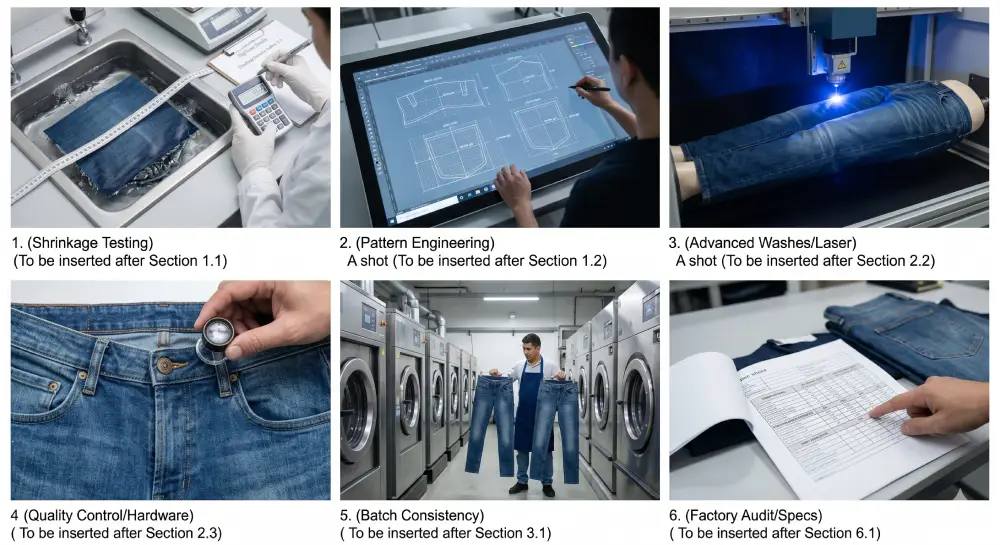
1.1 The Science Behind Shrinkage and Post-Garment Washing of Denim
The standard knit or woven fabrics hold up throughout the production process. Indigo denim, on the other hand, is an almost living fabric. The extreme wet process, such as stonewashing, acid washes or bleaching, applies extreme stress and shrinkage to the raw denim fabric.
In a conventional clothing manufacturing facility, the fabric is typically obtained on static patterns. Meanwhile, a dedicated denim supplier determines an exact shrinkage formula per fabric blend (per blended garment) before cutting it. The cloth is prone to unpredictable shrinkage in both length and width during the wash cycle, so your pattern has to be imprecisely oversized in order for the post-wash garment to correspond with your finished spec sheet.
1.2 Pattern Engineering versus Standard Adjustments to Clothing Tech Pack
A denim pattern engineering in itself is a very specialised subject. You can not factor how a 12oz 100% cotton denim dies in weight compared to an 11oz tri-blend stretch denim, as it’s specific & compare your tech pack adjustment with it. Custom manufacturers have specialized R&D teams who know that seam slippage, pocket placement, and yoke angles shift after copious amounts of industrial washing. Without this engineering expertise, you can expect your jeans to have twisted side seams and distorted pockets.
1.3 Expensive Return Rates — Why Fit Inconsistency Kills New Brands
Fit is king in fashion e-commerce. Data shows that fit issues are involved in more than 70% of online fashion returns (1). Unlike women’s denim brands, where it is expected that every colorway will fit differently, which means a truly great size range should only be 1-2 sizes wide, with most denim brands’ inconsistent sizing (due to not all pairs being made the same) ends up killing their own brand. For example, if your medium-wash jean is the perfect fit, but your black-wash jeans in exactly the same size do not fit right if you are too small, then you will pay expensive return fees for delivery and receive negative reviews and angry customers who will tarnish your brand image.
2.Core Checklist: How to Evaluate Your Denim Jeans Supplier Candidates
Auditing Potential Denim Jeans Suppliers: More than Price Quotes. Utilize this comprehensive checklist to truly test out their technical and sourcing skills.
2.1 Fabric Sourcing Capability (Raw Selvedge, Organic Cotton and Stretch Blends)
Your manufacturer has to have a strong supply chain of quality fabric mills. Regular recommendations of fashionable, high-performance fabrics from a high-tier partner will sharpen the Edge of your brand. You have to be able to provide these textiles ==>
- Best Raw Selvedge Denim for Heritage Brands
- GOTS-certified organic cotton for sustainable brands.
- They are multi-component stretch blends (like cotton-Tencel-elastane) that exhibit shape memory without bagging out.
2.2 Development of advanced washes (replicating aging textures and whiskering)
The wash of denim largely determines the value of a pair; replicating natural-looking hand-whiskers and 3D creases to mimic authentic vintage textures and delicate scraping requires great artisanship and technical ability. Check the chain of command where you would send your design inspiration and get physical samples from their sample room.
2.3 Standardized Quality Control for High-Stress Denim Components and Accessories
Denim items go through frequent washing and extended periods of use, which increases the risk for failure in areas often subject to high levels of stress. A — Your supplier is subject to rigorous quality control. Metal rivets, buttons with shanks and YKK zippers should all fasten securely and be treated to prevent rust. Also, the jeans need to utilize a double-needle chain stitching on their waistband and seat seams to avoid splitting under strain.
3.The Hidden Pitfall: Ensuring Repeatable Wash Consistency with Your OEM Manufacturer
The dreams that indie denim brands are most often plagued with do not end there: as we all experienced the impeccable first sample, followed by a bulk delivery looking nothing like what was expected. Getting wash consistency that can be repeated over hundreds of pieces is nigh on impossible.
3.1 What Happens in Batch Color Variation from the First Sample to Repeat Orders?
Industrial denim washing is a biochemical process that can be controlled using physical factors of influence.
The math equation to achieve consistent washing would be [Water Chemistry] + [Chemical Ratios] + [Ambient Temperature] + [Load Size].
Without strict control processes in the factory, color and texture variations will be substantial from batch to batch.
3.2 The “Gray Scale” Tolerance Standard with Your Supplier
You need an official commercial tolerance agreement based on the AATCC Gray Scale for Color Change to protect your brand against extreme color deviations.
| Grade | Description |
|---|---|
| Grade 5 (Exact match) | No visible change in colour |
| Grade 4 | Minor, allowable color difference |
| Grade 3 or worse | Readable variation (Causes automatic QC rejection) |
Before doing the bulk production, agree on a strict Grade 4 to 5 tolerance range between all finished goods with your supplier.
3.3 A 3% Change in Water Temperature: A Case Study on How Your Indigo Color Changes
Imagine a modern production outage, but in the context of a mid-sized fashion brand. The brand agreed on a gorgeous, mid-indigo washed-to-death sample created using a stable water temperature of 45°C, yet on a winter bulk production run, the industrial efforts at heating an entire run’s worth of water suddenly suffered from an insignificant but absolute 3% change, which dropped the wash water temperature to 43.6°C.
This temperature drop, although insignificant, reduced the activity of these cellulase enzymes used to metabolize the indigo dye. As a result, these enzymes did not remove the expected amount of surface dye. The brand’s entire shipment of 2,000 pairs of jeans turned out a full shade darker than the prototype, forcing them to push back their product launch by six weeks in order to rectify the colour.
4.Decoding Low MOQ Terms: Real Cost vs. Hidden Fees from a Jeans Supplier
Minimum Order Quantity (MOQ) terms are often the largest obstacle, especially for brands starting on their own. But you need to pay close attention to how these minimums are set.
4.1 Truth About Denim Factory Minimum; Fabric MOQ vs Dyeing MOQ
If a jeans supplier offers low MOQs of 100 or 200 pieces per style, you are obliged to ask the follow-up question: Does this low MOQ relate to the fabric, or is it just due to garment construction?
You may be able to get a factory to agree to cut and sew 100 jeans, but denim fabric mills typically want at LEAST 1,000 – 3,000 meters per custom fabric order. Should you fail to meet the fabric minimum, your factory will be forced into buying off-stock fabrics on the open market, which significantly limits your scope of customization and risks fabric variance when reordering at any time in the future.
4.2 Negotiating Sample Fees and Surcharges for Small-Batch Testing
If you are just looking to test the market without risking much capital, find a nimble OE partner capable of small-batch testing. Most of the different top-quality makers have adaptable design policies. For instance, select factories offer a payment structure where your sample development costs are refunded in full as soon as your bulk order exceeds a certain quantity. This approach allows for iteration on your designs with a much lower upfront monetary risk.
4.3 Managing Production Lead Time during Peak Denim Sourcing Seasons
Global fashion calendar gets heavily backlogged in the supply chain management prior to major retail trading spikes, especially Autumn/Winter and holiday rushes. In such crunch times, regular production pipelines may go from weeks to months easily.
For an agile inventory, collaborate with a high-experience-level manufacturing facility (for example, more than 7,000 square meters of production area and two plants full of ~330 new-generation garment machines). It is indeed the upmarket (large-scale) manufacturers that offer facilities for bulk production within 15 to 25 days, and make your supply chain agile.
5.Sustainable Jeans Manufacturing: Eco-Friendly Laundries and OEM Manufacturer Standards
Denim is among the most troubled in terms of sustainability, with an unglamorous environmental history that modern consumers are increasingly demanding be addressed. Integrating ecological practices in your manufacturing strategy is no longer a choice; it’s necessary for new brand constructing capability.
5.1 Laser & Ozone Technologies: Savings of up-to 80% in Water Usage
In fact, the denim distressing process is entirely dependent on human sand blasting combined with pumice stones and a great deal of clean water. Innovative manufacturers are equipped with advanced laser and ozone technologies, which have been developed in recent years.
- Laser Machines: Burn indigo dye to achieve realistic whiskering and distressing without chemicals or water.
- Ozone Machines: Use gas to create an effect similar to natural sun-bleached or faded looks, achieving up to 80% savings in water and chemicals.
5.2 Certs (GOTS, OEKO-TEX and local sewage permits) verification
If you want to meet E-E-A-T (Experience, Expertise, Authoritativeness and Trustworthiness) standards and avoid waking up in the middle of a greenwashing scandal, then verify the certificates of environmental compliance that your partner has. Confirm that they have genuine, current documentation before dispatching, including:
- GOTS (Global Organic Textile Standard): Ensures the claims of organic fiber, from field to finished product
- OEKO-TEX Standard 100 — Ensuring your finished jeans do not contain high levels of toxic chemicals.
- Local Government Sewage and Discharge Permits: Identifies that the laundry plants treat and recycle their wastewater correctly, rather than discharging the water into local waterways.
5.3 Supply Chain Resilience: Do Your Due Diligence on Backup Laundries of your Factory
At the same time, environmental regulations are becoming stricter in every part of our world. Picture a scenario where the main washing station of one of your factories fails an environmental inspection, and that factory is immediately closed by local authorities, and all production stops instantly.
Always make sure the OEM partner is ethical to the environment by incorporating their facilities with energy-saving lighting sources and boiler steam exhaust recovery systems. And be sure they have thoroughly vetted 100% compliant backup laundries for every single type of linen, to protect your supply chain against abrupt regulatory closings.
6.3 Red Flags to Look for During Your First Jeans Manufacturer Audit
If you are visiting your factory in person or carrying out a remote evaluation of a potential partner, be on the lookout for these 3 crucial red flags.
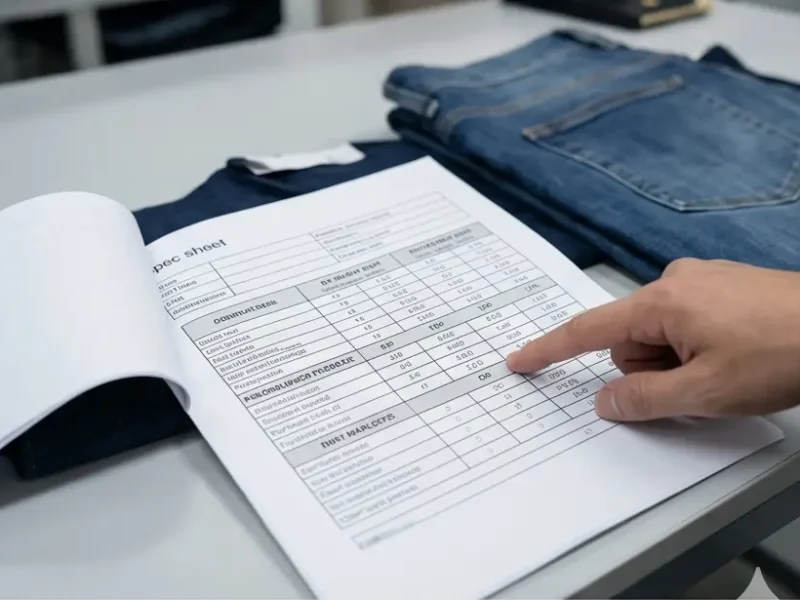
6.1 RED FLAG No one can provide dimension specs before wash and after wash
If a maker cannot instantly furnish a complete diagram detailing exactly pre-wash and post-wash measurements in their current productions, run away. The absence of documentation is telling — they are not mathematically planning or monitoring for fabric shrinkage, ensuring you don’t get sizing problems on your bulk orders.
6.2 Red Flag #2: Washing Process outsourced to unknown 3rd parties
Most small manufacturers produce jeans in-house and sidestep the essential washing process by outsourcing it to poorly regulated, low-cost third-party workshops. This practice prevents monitoring of quality control, chemical safety or environmental compliance. Ensure that your manufacturer manages an end-to-end, strike-a-light factory network in which the whole processing chain is completely auditable.
6.3 Red flag#3: Metallic hardware on sample racks was rusty/oxidized
Examine the hardware on older sample garments when inspecting a factory’s showroom. If your copper rivets and brass zippers are starting to tarnish, rust, or are collecting a green oxide on them as they age, then you will know the factory used poor-quality, low-grade metal alloy trims. The better the hardware, the longer it should store and wash without rusting.
7.Conclusion: Partnering with the Right Denim OEM Manufacturer for Scalability
In order to create a great, scalable denim brand, you need to find an appropriate partner who meets your expectations regarding Quality, Speed and Technical knowledge.
Kaiping Lianwang Garment Co., LTD is one great manufacturing solution for independent brands seeking efficient scale. Based in Jiangmen, Guangdong Province — China’s southern gateway to the world of high-end fashion garment production and a veritable denim industry centre — Lianwang is a qualified denim clothing supplier and high-class manufacturer offering men’s, women’s and children’s jeans suitable for decades of use.
With more than 20 years of background in expert fabrication, a plant of more than 7,000 square meters with over 330 top-level garment machines, and an R&D design team with greater than 15 members, they can create even more than 600,000 high-grade garments yearly. Mexico’s end-to-end OEM & ODM customization services include everything from custom fabric sourcing, pattern engineering, wash development and quality assurance.
By collaborating with an experienced, organized and sustainable denim brand, you can solve fit inconsistencies, which result in reducing your returns rates, allowing you to scale your fashion label easily in a very competitive landscape.

Recent Comments