
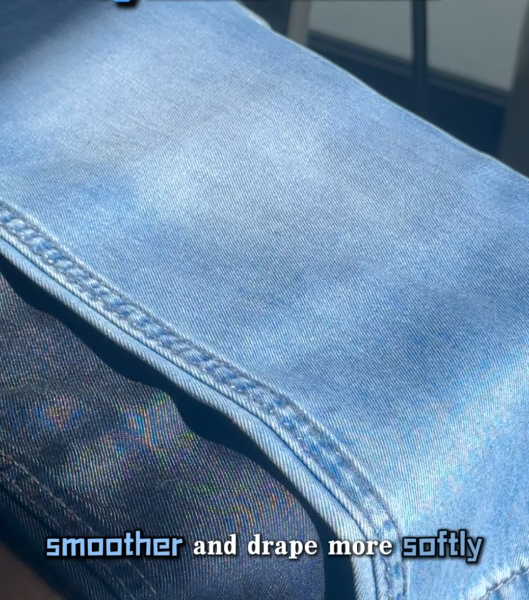
What Is Lyocell Denim and How Is It Made?
Lyocell denim is basically a mashup: regenerated cellulose fibers woven into that familiar diagonal twill we call denim. One part is the fiber (lyocell), the other is the weave (denim). For a breakdown of traditional denim components, see our guide to what jeans are made of. Put them together and you get something that looks like jeans but drapes like a soft shirt.
Cotton has ruled denim for what feels like forever. But water shortages and pickier customers have pushed brands to try new things. That’s how lyocell denim went from a niche eco-experiment to a regular on womenswear racks, relaxed menswear lines, and resort collections.
Lyocell vs. Tencel™ Denim: Understanding the Naming Difference
Here’s a confusion I see all the time: people use “lyocell” and “Tencel™” as if they’re the same thing. They’re not. Lyocell is the generic fiber name—regulated by the FTC and BISFA. Tencel™ is a trademark owned by Lenzing AG in Austria.
Why does this matter? Simple. All Tencel™ lyocell is lyocell, but not all lyocell is Tencel™. If you’re paying extra for Tencel™, you’d better ask for the official Lenzing swing tags and transaction certificates. No paperwork, no legal right to put that name on your labels. Meanwhile, generic lyocell from a certified Asian mill can perform just fine at a lower price—as long as the mill actually enforces strict solvent-recovery standards. That “as long as” is doing a lot of work there.
Inside the Closed-Loop Manufacturing Process
Lyocell starts with wood pulp—usually eucalyptus, beech, or spruce. The mill dissolves that pulp in a non-toxic organic solvent called N-methylmorpholine N-oxide (NMMO). Then the solution gets pushed through tiny spinnerets into a water bath, forming smooth, continuous filaments.
The clever part is the closed-loop system. Modern plants recover and reuse over 99% of the water and NMMO. Chemical discharge into local waterways? Practically zero.
Land and water footprint is also much smaller than conventional cotton. Eucalyptus needs no artificial irrigation and grows on land you couldn’t farm anyway. Lyocell production uses up to 50% less water than cotton farming, and it skips the harsh carbon disulfide chemicals that traditional viscose relies on.
Key Properties of Lyocell Denim: Pros and Cons
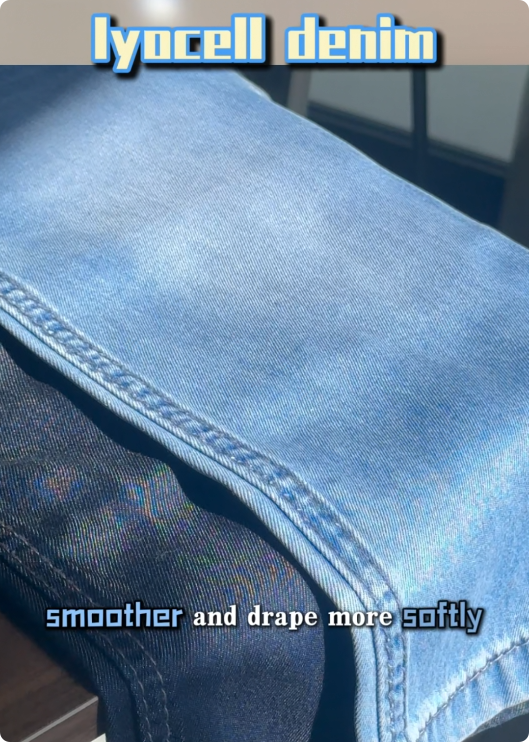
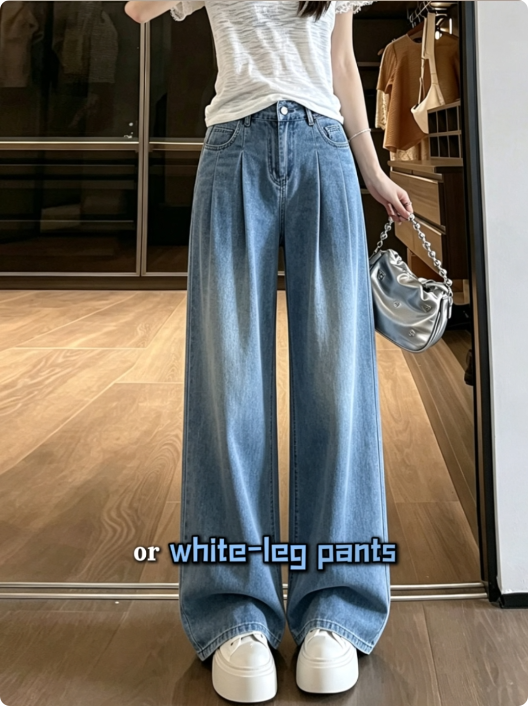
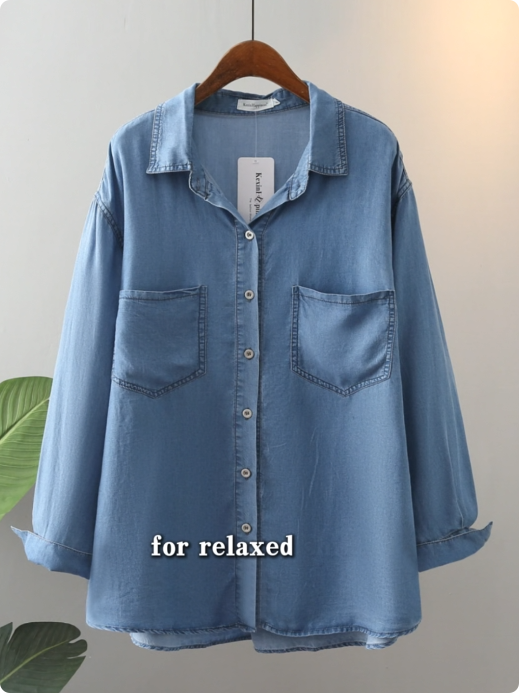
No fabric fits every silhouette. Before you place a bulk order, you need to weigh the strengths against the trade-offs. The images below are styling illustrations; fiber composition should always be confirmed on the garment label.
Why Wearers and Brands Love Lyocell Denim (The Pros)
- Silky, Fluid Drape: Lyocell fibers have a smooth, round cross-section. The fabric glides over the body instead of standing stiffly away from it. Wide-leg trousers, belted dresses, flowing shirts—this is their fiber.
- Superior Summer Moisture-Wicking: Lyocell absorbs roughly 50% more moisture than cotton, and it releases that moisture back into the air fast. You stay cool and dry even in humid 30°C (86°F) heat.
- High Wet Strength: Conventional viscose loses up to 50% of its strength when wet. Lyocell? It keeps about 85% of its dry tenacity in water. That’s why it handles industrial garment washing far better than standard rayon blends.
- Hypoallergenic and Skin-Friendly: The fiber surface is microscopically smooth, so it creates minimal friction against sensitive skin. Fast moisture evaporation also slows bacterial growth, which means less odor between washes.
Real-World Drawbacks You Need to Know (The Cons)
- Higher Fabric Cost: Closed-loop machinery and specialized solvents aren’t cheap. 100% lyocell denim typically runs 25% to 45% more per yard than comparable ring-spun cotton denim.
- Lack of Rigid Structure: If you’re making heritage selvedge jeans or structured workwear, 100% lyocell will disappoint. It just doesn’t have the stiff body needed to hold sharp, architectural silhouettes.
- Mechanical Recycling Challenges: Pure cellulosic fabrics can be chemically recycled. But blend lyocell with elastane or polyester and fiber separation during post-consumer mechanical recycling becomes difficult and expensive. That’s a real problem the industry hasn’t fully solved.
Lyocell Denim vs. Cotton Denim: Side-by-Side Comparison
To pick the right base cloth for your line, compare lyocell denim directly against traditional 100% cotton denim across six core metrics.
| Performance Dimension | 100% Lyocell Denim | 100% Cotton Denim |
|---|---|---|
| Drape & Handfeel | Fluid, silky, cool to the touch; zero stiffness | Crisp, structured, initially rigid; softens with wear |
| Breathability & Moisture | High absorption; rapid evaporation; cool in heat | Breathable, but absorbs and traps sweat against skin |
| Durability & Abrasion | High tensile strength; lower surface abrasion resistance | Exceptional abrasion resistance; built for heavy wear |
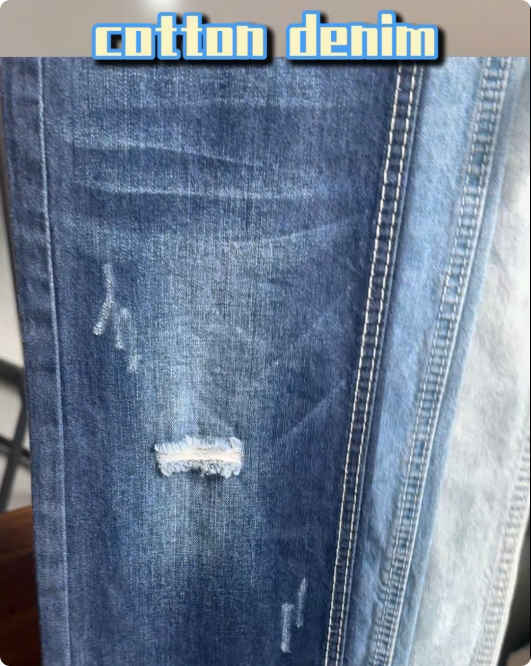
| Fade Character | Soft, diffused, low-contrast fading; high color retention | High-contrast whiskers, honeycombs, and vintage fades |
| Wash Shrinkage | Moderate (3%–5% if unsanforized); sensitive to heat | Moderate to high (3%–10% raw; 1%–3% sanforized) |
| Fabric Cost (FOB) | Higher (approx. +25% to +45% over standard cotton) | Lower baseline cost; wide range of budget options |
Comfort, Moisture Management, and Warm-Weather Performance
In hot, humid weather, the gap between cotton and lyocell shows up fast. Cotton absorbs sweat easily—that’s fine—but once it’s saturated, it traps the moisture. Heavy jeans end up feeling damp and clammy.
Lyocell handles sweat differently, through microscopic channels called nanofibrils. These fibrils pull moisture away from the skin, then move it to the fabric’s outer surface where it evaporates quickly. One Los Angeles contemporary brand switched its summer palazzo jean from 10 oz cotton to 8.5 oz 100% lyocell. The result: customer returns citing “too heavy for summer” dropped by 38% in a single season. Not bad for a fabric swap.
Indigo Dye Affinity and How Lyocell Denim Fades Over Time
Dye affinity is one of those technical details buyers overlook—until it bites them. Lyocell absorbs indigo and reactive dyes much more deeply than cotton. Because the dye penetrates uniformly, you get strong initial colorfastness.
But that deep absorption changes how the fabric behaves in the laundry. Traditional cotton denim uses ring-dyeing, where indigo coats the outer yarn while the core stays white. Our indigo dye and denim color guide explains this effect. Abrasion reveals sharp, high-contrast whiskers and honeycombs.
Lyocell denim? It fades soft, diffused, and even. Even with heavy enzyme or laser washing, 100% lyocell rarely achieves crisp vintage contrast. So if your collection needs authentic 1990s distressing, a cotton-rich blend is the smarter technical choice. Lyocell will give you a beautiful, gentle fade—just not that hard-edged vintage look.
Choosing the Right Lyocell Denim Blend and Fabric Weight (oz / GSM)
Get the blend and weight wrong and your garment looks sloppy instead of refined. Here’s a practical sourcing framework.
100% Lyocell Denim vs. Cotton-Lyocell Blends
100% Lyocell Denim gives you maximum fluidity and a subtle sheen. It shines in relaxed, unstructured pieces—drawstring pants, pleated culottes, maxi dresses, resort overshirts. The catch: pure lyocell wrinkles easily and offers minimal hip or tummy support.
Cotton-Lyocell Blends (e.g., 60/40 or 70/30) balance comfort with authentic denim structure. Usually, mills put cotton in the warp (vertical) yarns for classic indigo character and lyocell in the weft (horizontal) yarns for softness against the skin. A 65% cotton / 35% lyocell blend feels noticeably softer than regular jeans yet holds a clean straight-leg shape. Add 1% to 2% elastane and you’ve got high-recovery stretch denim for fitted styles.
Recommended Fabric Weights (6 oz to 12 oz) by Garment Silhouette
Fabric weight is measured in ounces per square yard (oz) or grams per square meter (GSM). Match the weight to the garment category and you avoid costly sampling errors. See our denim weight guide for related weight comparisons:
- Lightweight (6–8 oz / 200–270 GSM): Best for denim shirts, chambray-style tops, summer dresses, and flowing skirts. At this weight, 100% lyocell drapes almost like heavy silk.
- Mid-Light (8–10 oz / 270–340 GSM): Ideal for warm-weather bottoms—wide-leg trousers, baggy jeans, tailored shorts that need movement without sheerness.
- Mid-Heavy (10–12 oz / 340–405 GSM): Built for structured straight-leg jeans, relaxed mom jeans, and light trucker jackets. Here, cotton-lyocell blends (like 70/30) beat 100% lyocell on seam stability and daily durability.
Common Quality Challenges in Lyocell Denim Production & Washing
Sourcing good fabric is only half the job. Lyocell behaves differently from cotton on the factory floor, and weak production controls can ruin a bulk order. Use a denim QC checklist when reviewing samples and bulk production.
Preventing Fibrillation and “Frosting” During Washing
The top defect in lyocell garment washing is fibrillation. Under wet friction, the outer layer of lyocell fibers splits into microscopic hair-like fibrils. When those fibrils tangle, they scatter light and create a pale, fuzzy, “frosted” look along seams and pockets. It’s not a great look.
Experienced laundries follow three strict rules to keep the surface clean:
- Cellulase Enzyme Polishing: Bio-polishing enzymes gently remove loose surface fibrils without weakening the base cloth.
- Temperature Control: Wash temperatures stay low to moderate (30°C–40°C) to prevent fiber swelling.
- Low Mechanical Friction: Lower drum RPM, higher water-to-garment ratios, anti-crease lubricants. Washing garments inside out also shields the twill face from drum abrasion.
Managing Seam Slippage, Knee Bagging, and Wash Shrinkage
Lyocell yarns are very smooth, so they slide past each other more easily than cotton yarns. Poorly stitched garments often suffer from seam slippage—fabric pulling apart at stress points like the seat or crotch.
During a production audit for a European womenswear brand, a 7.5 oz lyocell trouser sample failed ASTM D434 seam slippage testing at just 18 lbs of force. To fix it before bulk cutting, the factory enforced three mandatory QC checkpoints:
- Reinforced Stitching: Stitch density bumped to 10–12 stitches per inch (SPI), seam allowances widened to 1.5 cm with 5-thread safety overlocking.
- Wash-Blank Shrinkage Testing: Every dye lot tested before cutting so patternmakers can account for measured shrinkage. Follow the proto, fit, and PPS sampling stages before bulk approval.
- Elastic Recovery Testing: Knee bagging measured after 30 minutes of tension. If 100% lyocell bags out, switching to a 70% cotton / 28% lyocell / 2% elastane blend solves the issue immediately.
How to Wash and Care for Lyocell Denim Jeans
Clear care instructions cut customer returns and extend garment life. Worth the effort.
Best Practices to Prevent Shrinking and Surface Fuzz
Share these five rules with your customers:
- Turn Inside Out: Flip jeans inside out and zip them up before washing to shield the indigo face from drum friction.
- Wash Cold on Gentle: Cold water (max 30°C / 86°F), delicate cycle, or a light hand wash. Hot water accelerates shrinkage and fibrillation.
- Use Mild Detergent: Skip harsh alkaline detergents and bleach. A neutral liquid detergent made for delicates or darks works best.
- Avoid Long Soaking: Never soak lyocell denim for hours. Prolonged immersion swells cellulose fibers and increases dye bleed.
- Line Dry in the Shade: High-heat tumble drying shrinks and fuzzes lyocell fast. Reshape damp jeans and hang them to dry away from direct sunlight.
Frequently Asked Questions About Lyocell Denim
Is Lyocell Denim Stretchy?
No. 100% lyocell denim has no inherent elastic stretch. Like cotton, lyocell is a non-stretch cellulosic fiber. The diagonal twill weave gives a little mechanical give, and the fluid drape feels less restrictive than rigid cotton—but don’t expect stretch. For true stretch and recovery in fitted jeans, pick a lyocell denim blended with 1% to 3% elastane (spandex).
Is Lyocell Denim Durable Enough for Everyday Jeans?
Yes—when the weight and construction match the style. At the fiber level, lyocell actually has higher tensile strength than cotton, both dry and wet. That said, lightweight 6–8 oz 100% lyocell wears down faster than 14 oz raw cotton. For everyday jeans, go with a 9–11 oz cotton-lyocell blend and reinforced seams.
Does Lyocell Denim Shrink in the Wash?
Yes, it can. Lyocell is a wood-based cellulosic fiber, and unwashed or poorly pre-shrunk lyocell denim may shrink 3% to 5% in length—especially in hot water or a hot dryer. Reputable factories pre-wash and sanforize during production to control residual shrinkage. Wash cold and line dry, and your jeans should stay true to size for years.
Watch: Lyocell Denim Fabric and Styling
See the fabric drape and relaxed garment examples in this short video explanation of lyocell denim. Use the video as a visual reference and verify the fiber blend and care instructions with your supplier.
For sourcing, request the fiber composition, fabric weight, shrinkage and colorfastness results, and an approved wash sample before placing a bulk order. Our small-batch denim sourcing guide covers supplier comparisons and sample planning.
