
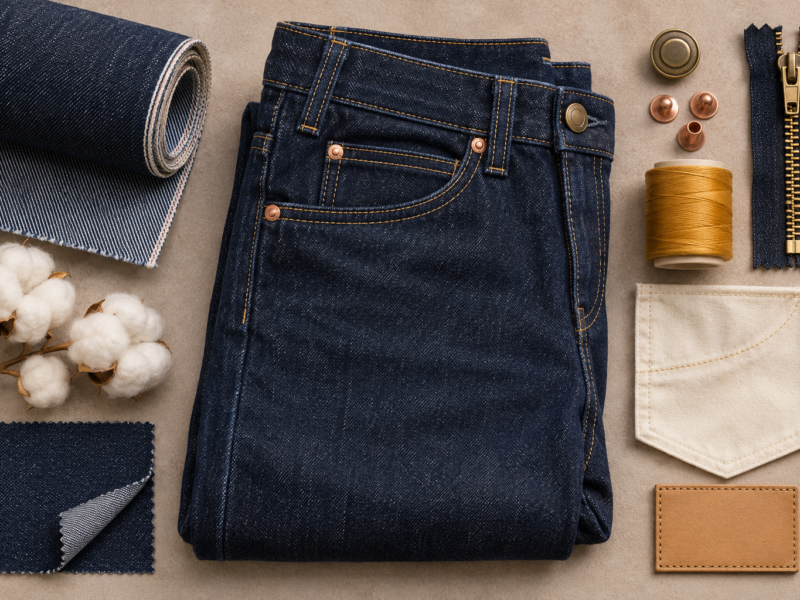
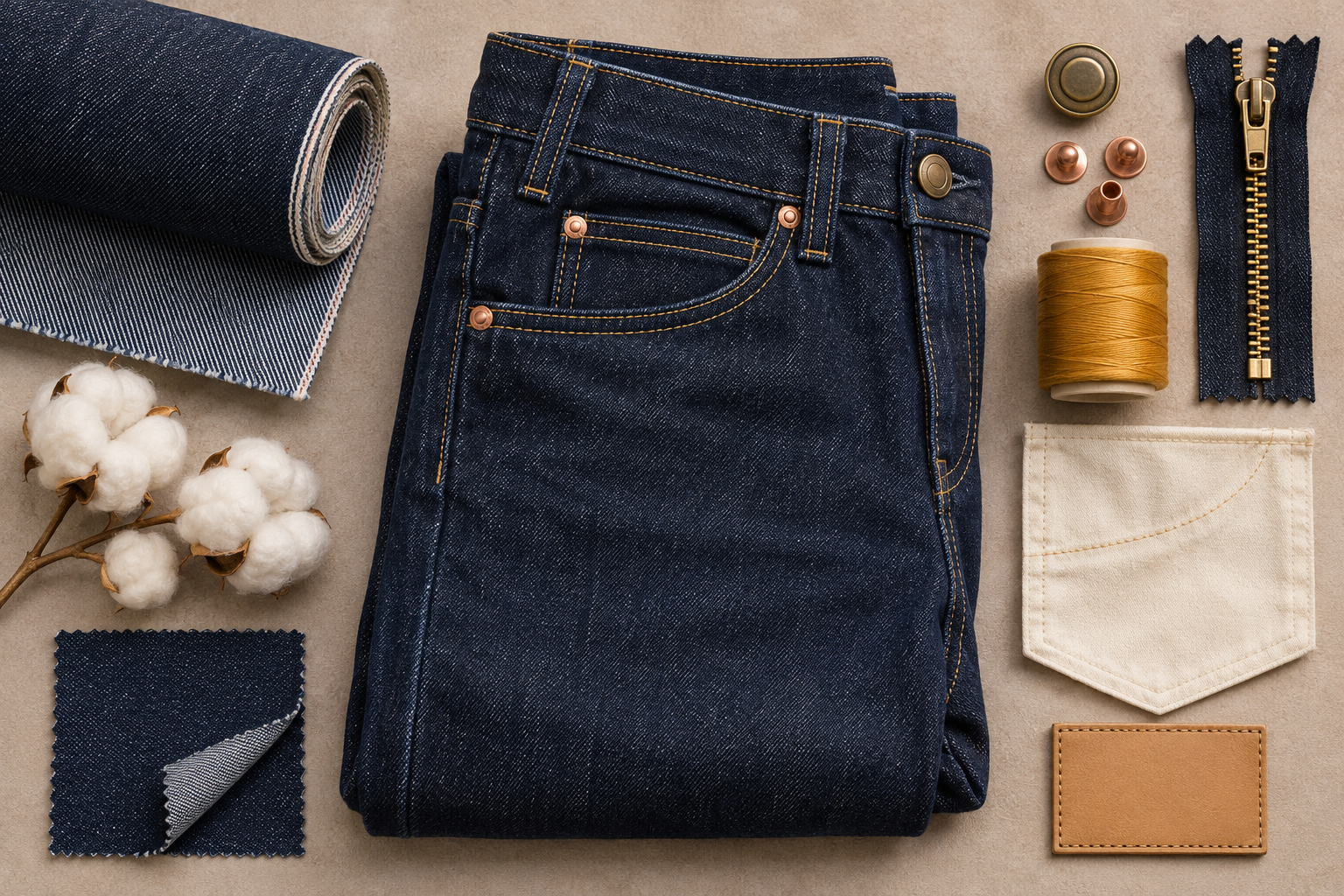
Jeans are usually made from denim: a cotton twill fabric, sometimes blended with elastane, polyester or other fibers. A finished pair also includes sewing thread, pocket bags, a zipper or buttons, rivets, labels and patches. The composition label tells you the fabric’s fiber percentages; it does not list every trim. This guide explains how denim is woven, what common blends do, and which details to inspect when buying or sourcing jeans.
Core Raw Materials: What Is Denim Fabric Made Of?
Cotton: Staple Length and Why It Controls Durability
Not all cotton is created equal. Short-staple cotton—think Upland varieties—has been the workhorse of traditional workwear for good reason: it’s tough and affordable. Long-staple cotton, on the other hand, is what you’ll find in premium denim. The fibers are finer, the handfeel is smoother, and the tensile strength is noticeably higher. Fiber quality matters, but yarn construction, fabric weight, washing and garment construction also affect durability.
Indigo Dye: Natural vs. Synthetic Rope and Slasher Dyeing
Ever wondered why jeans are blue on the outside and white on the inside? Simple: the warp yarns get dyed with indigo, while the weft yarns stay undyed or ecru. That’s the magic behind that classic fading pattern.
Rope and slasher dyeing are two ways to apply indigo to warp yarns. The resulting shade and fade also depend on dye penetration, yarn and finishing choices. For a fuller explanation, see our guide to indigo dye and why jeans are blue.
The 3×1 Twill Weave: How Structure Creates Strength
The 3×1 right-hand twill is what gives denim its signature diagonal lines. The diagonal structure affects drape, appearance and abrasion behavior. Actual tear strength depends on the yarn, density and finishing, not the weave alone.
Denim Fiber Blends: Exact Ratios, Stretch, and Shrinkage Data
100% Cotton Rigid Denim vs. Comfort Stretch (99/1 and 98/2)
| Blend | Handfeel | Stretch / Recovery | Wash Performance | Typical Silhouettes |
|---|---|---|---|---|
| 100% Cotton | Stiff, breaks in over time | N/A (no stretch) | Holds shape well | Straight, rigid, raw denim |
| 99/1 Cotton/Elastane | Slight give, comfortable | Depends on yarn and finishing | Test for bagging | Slim, tapered |
| 98/2 Cotton/Elastane | Noticeably stretchy | Depends on yarn and finishing | Test for bagging | Skinny, super-skinny |
| 70/28/2 Cotton/Poly/Elastane | Soft, lightweight | Variable | Depends on yarn quality and wash | Fashion-forward cuts |
Why Cheap Stretch Jeans Bag Out at the Knees
Knee bagging depends on yarn design, fabric recovery, fit and care. Some dual-core constructions are designed for better recovery, but performance should be checked with stretch and recovery tests after laundering. Excess heat can damage elastane.
How Blends React to Industrial Washing and Shrinkage
Shrinkage varies by fabric construction, finishing and wash recipe. Ask the mill for warp and weft shrinkage results, then test the actual garment wash before approving a size spec. Stretch and polyester blends may respond differently to enzymes and bleaching, so review a wash sample rather than assuming a fixed percentage.
Beyond the Fabric: The Hidden Hardware and Trims in Jeans
Metal Zippers, Rivets, and Tack Buttons (Brass vs. Zinc Alloy)
Let’s talk hardware. Zippers, rivets and tack buttons vary by metal, plating and construction. Check zipper operation, attachment strength and corrosion resistance against your specification. Our custom denim trims guide covers buttons, rivets, zippers and patches in more detail.
Pocket Bags: T/C Blends vs. 100% Cotton Twill
Ever had a pocket tear within months? Pocket failure can come from thin fabric, weak seams or abrasion. Cotton twill and polyester-cotton pocketing are both used; compare fabric weight, seam construction and abrasion results for the intended product. It’s a small detail, but it’s one of those things that separates a well-made pair from a disposable one.
Heavy-Duty Stitching Thread and Leather Patches
That signature orange or gold topstitching? It is often a strong polyester or core-spun thread, with the thread size chosen for the seam and appearance. As for the patch on the back—genuine leather is the classic choice, but Jacron (washable kraft paper) and PU patches are common alternatives. Each has its trade-offs in terms of durability and feel.
How Yarn Spinning and Denim Weight (oz) Change Feel and Fit
Ring-Spun vs. Open-End Spinning: Texture and Fading
Ring-spun yarn gives you pronounced slub texture, a softer feel, and those natural vintage fades that denimheads chase. Open-end yarn? Lower cost, more uniform surface, and that classic 1980s aesthetic. Neither is inherently better—it depends on what you’re after.
Denim Weight Guide: Matching oz/GSM to Silhouette and Season
- Lightweight (6–9 oz): Shirts, relaxed summer trousers (chambray, lightweight twill)
- Midweight (10–12 oz): Year-round slim and straight-leg jeans—the core market range
- Heavyweight (13–16+ oz): Raw denim, baggy/carpenter silhouettes that rely on fabric weight to hold their structure
Fabric weight is measured in ounces per square yard or GSM. Washing and shrinkage can change the measured weight per area. For a garment-level comparison, read our guide to how much jeans weigh.
Selvedge vs. Standard Width Denim Fabrics
Shuttle-loom selvedge denim comes in narrow 28–30 inch widths with self-finished edges. Its narrow width can increase fabric consumption during cutting, while the finished edge has collectible appeal. Modern rapier and air-jet looms produce standard-width denim—57–58 inches for 100% cotton, 52–54 inches for stretch—which is what most mass-market brands use.
Finishing Processes: From Raw Loomstate to Vintage Wash
Mill Finishes: Singeing, Desizing, Mercerizing, and Sanforization
Four key steps happen at the mill: singeing burns off surface fuzz, desizing removes starch, mercerizing enhances luster and dye uptake, and sanforization pre-shrinks the fabric. Not every denim uses every finish; the mill chooses steps to achieve the target look, handfeel and dimensional stability.
Garment Washes: Enzyme, Stonewash, and Laser Finishing
Traditional wet washes—enzyme, stonewash, hand-whiskering—are still around, but laser and ozone finishing are changing the game. Their resource use depends on the complete process and equipment. Compare actual process data when evaluating environmental claims.
Sustainable Denim Materials and Next-Generation Fibers
Organic, Regenerative, and Recycled Cotton
Organic cotton avoids synthetic pesticides. Regenerative cotton goes further, focusing on soil health and carbon sequestration. Recycled cotton? It’s great in theory, but it usually needs blending with long-staple virgin cotton to maintain tensile strength. Pure recycled cotton denim tends to be weaker—there’s a trade-off.
Hemp, Tencel (Lyocell), and Bio-Based Stretch Alternatives
Hemp can add a distinct texture and strength, depending on the blend and yarn. Tencel Lyocell offers fluid drape and a cool handfeel—ideal for summer wide-leg jeans. And new stretch-fiber options are being developed. Check supplier data for performance and end-of-life claims.
For a practical inspection process, use our denim QC checklist to assess seams, shrinkage, fit and hardware.
How to Check Jeans Quality from the Composition Label
4 Quick Checks Before Buying or Sourcing Denim
- Check the care label for fiber content and elastane percentage—fiber percentage alone does not predict shape retention; check recovery test results.
- Inspect twill weave density and interior stitch density (SPI). SPI should suit the seam and fabric; inspect seam strength and consistency.
- Feel the fabric weight and test zipper smoothness. A sticky zipper is a bad sign.
- Verify sustainability certifications and shrinkage test reports—especially important for brand sourcing.
Frequently Asked Questions About Denim and Jeans Materials
Are all jeans made of 100% cotton?
Nope. Many modern jeans include elastane for stretch, polyester for durability, or blends of both. Pure cotton rigid denim is still popular among enthusiasts, but the average pair on the shelf today has some synthetic content.
What is the best fabric blend for jeans that won’t stretch out?
There is no universal best ratio. For stretch jeans, compare the fabric’s stretch and recovery after laundering, then check fit and knee bagging on a wear sample.
What is the difference between denim and jeans?
Denim is the fabric. Jeans are the garment made from it. Simple as that.
How much cotton vs. spandex should good jeans have?
Many comfort-stretch jeans use around 1–2% elastane, but the right ratio depends on the design and yarn construction. Check the care label and test recovery rather than judging by percentage alone.
