
What Does “Tapered” Mean in Jeans?
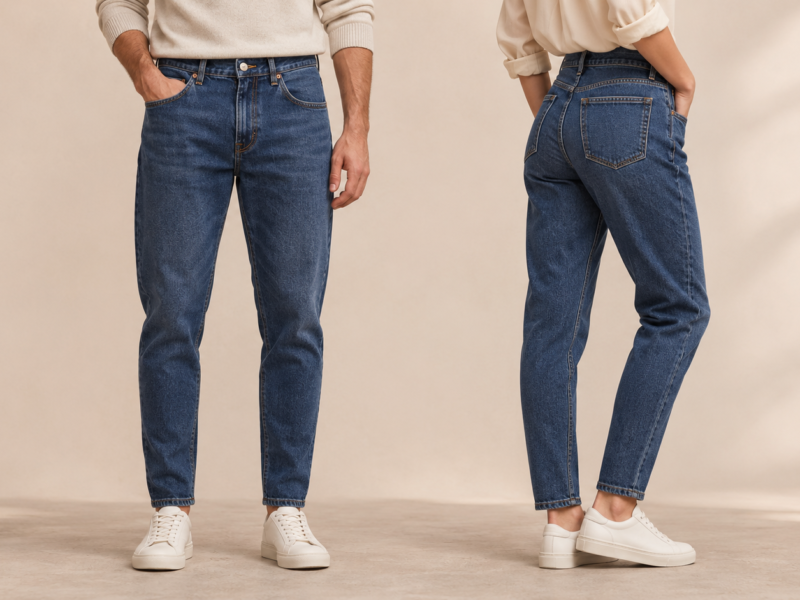
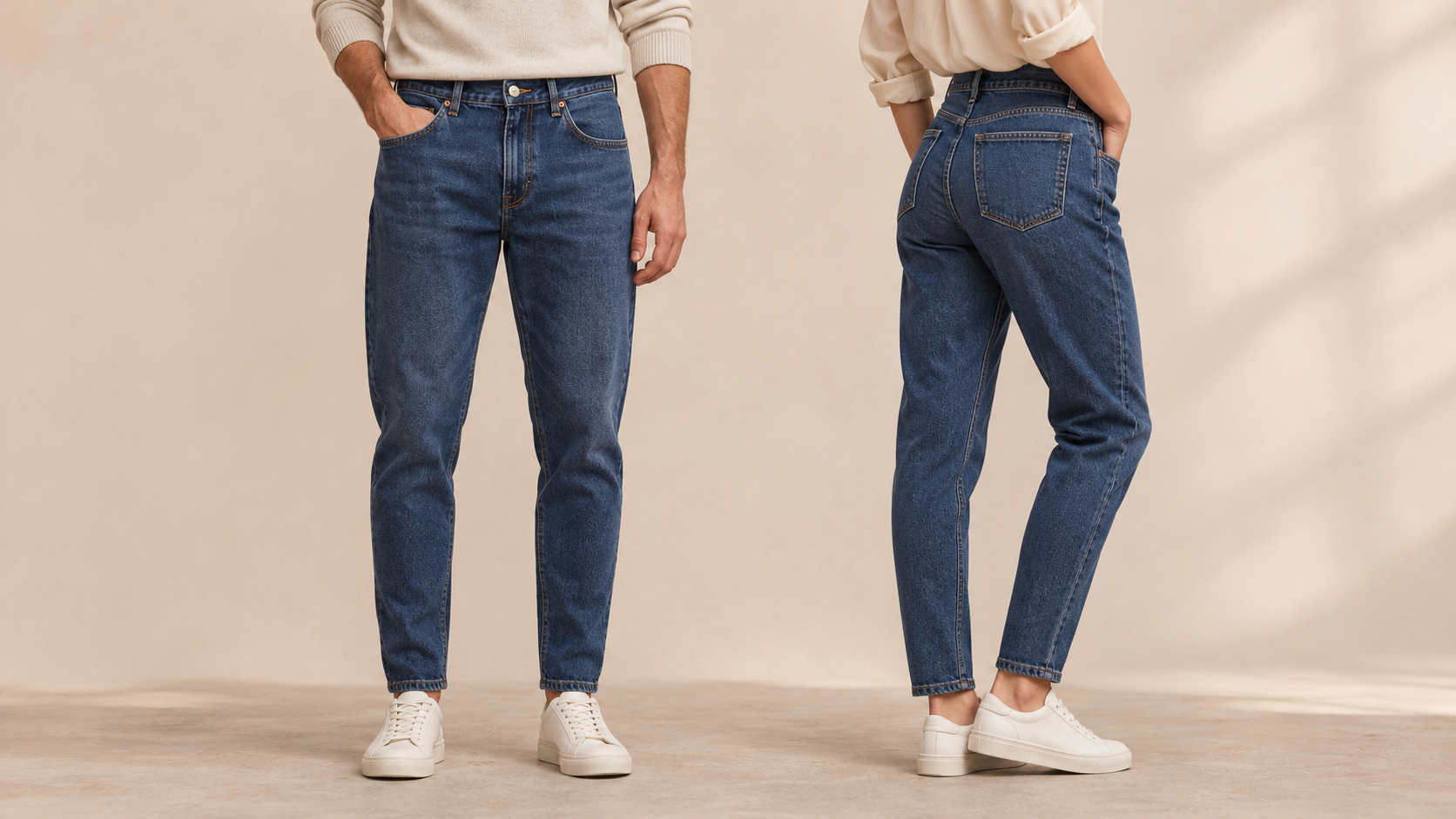
Tapered jeans are denim trousers cut in an inverted trapezoid shape that provides comfortable room through the seat and thighs before gradually narrowing from below the knee to the ankle. This tailored leg opening creates a clean silhouette while leaving room for upper-leg movement.
For years, denim buyers faced an annoying trade-off. You either wore baggy straight legs that swallowed your shoes, or you squeezed into skinny jeans that pinched your thighs. However, the tapered fit solves this exact dilemma. By keeping the top block relaxed and trimming excess fabric below the knee, tapered jeans deliver the best of both worlds.
In fact, this balance makes tapered jeans a versatile option. First, they follow the natural anatomy of the human leg, which is wider at the thigh and narrower at the ankle. Second, they eliminate messy fabric pooling around your heels. As a result, you get all-day comfort in the upper leg alongside a crisp, intentional look at the hem.
Tapered vs. Straight, Slim, and Skinny Jeans: Key Differences
Many shoppers struggle to tell denim cuts apart on a store rack. Therefore, comparing tapered vs. slim vs. skinny and straight fits side by side makes choosing much easier. Use the four-dimension breakdown below to see how each cut behaves on the body.
| Fit Type | Thigh Room | Knee Width | Leg Opening (Flat) | Overall Silhouette |
|---|---|---|---|---|
| Tapered | Regular to roomy | Slightly narrowed | Narrow (6.0″–7.5″) | Inverted V; clean, modern, and sharp |
| Straight | Regular | Equal to thigh | Wide (7.5″–8.5″+) | Vertical column; classic and vintage |
| Slim | Snug | Snug | Narrow (6.5″–7.25″) | Close-fitting without feeling painted on |
| Skinny | Tight | Tight | Very narrow (5.5″–6.25″) | Second-skin; hugs every contour |
Tapered vs. Straight-Leg Jeans
The main difference in the tapered vs. straight jeans debate happens below the knee. Straight-leg jeans maintain a uniform width from the thigh all the way down to the hem. Consequently, the fabric hangs in a vertical line and covers much of your shoe.
In contrast, tapered jeans narrow progressively toward the ankle. Choose straight-leg jeans if you want a timeless, 1990s vintage vibe or plan to wear heavy work boots daily. On the other hand, pick tapered jeans if you want a streamlined, leg-lengthening silhouette that puts your footwear front and center.
Tapered vs. Slim and Skinny Fit Jeans
A common misconception is that tapered jeans are just another name for slim or skinny jeans. However, that assumption is completely wrong. Slim and skinny jeans stay tight from the waistband through the seat, crotch, and thighs. If you have muscular legs or hate feeling restricted when sitting down, those cuts quickly become unbearable.
Conversely, a tapered fit only refers to the narrowing of the lower leg. You can buy a relaxed-thigh or athletic-thigh pair that still features a sharp taper at the ankle. Therefore, tapered jeans eliminate the tight, restrictive feeling in the seat while preserving a sleek finish below the knee.
Types of Tapered Jeans Explained (From Subtle to Aggressive)
Not all tapered jeans look or feel the same. Instead, they exist on a spectrum ranging from barely noticeable to sharply angled. Understanding these four core categories will help you pick the right cut for your body type and personal style.
Regular & Straight Tapered Jeans
Regular tapered jeans offer the most versatile, everyday entry point into this fit. A classic industry benchmark is the Levi’s 502 Taper, which features a standard seat and thigh with a gentle narrowing below the knee. Typically, the flat leg opening sits around 7.0 to 7.25 inches on a size 32 waist.
Because the taper is subtle, these jeans work seamlessly for office commutes, weekend errands, and travel. Furthermore, they are the safest choice for first-time buyers transitioning away from classic straight-leg denim.
Athletic Tapered Jeans
If you lift weights, cycle, or naturally carry more mass in your glutes and quads, standard denim rarely fits right. Usually, buying jeans that fit your thighs leaves you with a two-inch gap at the waist. Athletic tapered jeans are engineered specifically to fix this proportion issue.
They feature a roomier top block, a slightly higher rise, and extra fabric through the thighs. Meanwhile, the leg narrows cleanly below the knee so you do not look like you are wearing oversized parachute pants. For example, a size 32 athletic taper often measures 12.5 inches across the thigh—nearly an inch wider than a regular cut—while keeping a crisp 7.0-inch hem.
Relaxed, Low-Tapered & Carrot-Fit Jeans
For streetwear lovers and fashion-forward dressers, relaxed tapered and carrot-fit jeans bring bold proportions. These cuts provide generous room through the hips, seat, and thighs. Next, they angle aggressively inward from the mid-calf down to a tight ankle opening.
As a result, the silhouette resembles a carrot: wide at the top and sharply pointed at the bottom. Additionally, this volume pairs effortlessly with boxy heavyweight hoodies, oversized tees, and chunky retro sneakers.
Slim Tapered Jeans
Slim tapered jeans sit right between a classic slim cut and a traditional taper. A prime example is the Levi’s 512 Slim Taper, which hugs the thigh closely before narrowing even further to a 6.25- to 6.5-inch leg opening.
Unlike skinny jeans, a slim taper still leaves a sliver of breathing room around your skin. Consequently, it delivers a sharp, tailored look for lean builds without clinging to your calves like leggings.
The Sizing Pitfalls: How to Avoid the “Calf Trap” and Knee Bagging
On paper, tapered jeans sound foolproof. Yet many shoppers buy a pair online only to leave them collecting dust in the closet. In most cases, poor fit comes down to two overlooked technical issues: calf clearance and denim fabric composition.
Solving the “Calf Trap” (Why Tapered Jeans Ride Up)
Have you ever stood up from a chair only to feel your pant legs stuck halfway up your shins? Denim enthusiasts call this the “calf trap.” It happens when the taper narrows too aggressively below the knee for someone with muscular or developed calves.
When you sit, your calf muscle widens and pushes outward. If the jean’s knee-to-hem drop is too steep, the fabric grabs your calf and refuses to slide back down when you stand. Therefore, you end up tugging at your hems all day long.
To avoid this headache, perform a quick knee-to-hem clearance check before buying:
- Pinch test: While standing, pinch the denim fabric at the widest part of your calf. You should have 0.5 to 1.0 inch of pinchable fabric on the side.
- Squat test: Sit down or do a quick half-squat in the fitting room, then stand straight up. If the hem stays caught on your calf instead of dropping smoothly to your shoe, the taper is too aggressive.
- Check the knee measurement: For a smooth drape, look for a knee width that is at least 1.0 to 1.5 inches wider than the flat leg opening.
Rigid Selvedge vs. Stretch Denim: The 1%–2% Elastane Rule
Fabric composition and stretch completely change how a tapered jean fits, moves, and ages. Because tapered legs have less room around the knee and calf, choosing the wrong fiber blend leads to either stiff discomfort or saggy knees. Follow this simple elastane breakdown when reading care tags:
- 100% Cotton (Rigid / Raw Selvedge): Pure cotton denim develops unmatched fades and lasts for years. However, it offers zero give. If you buy 100% cotton tapered jeans, choose a subtle or athletic taper rather than a tight slim taper. Otherwise, the fabric will bunch behind your knees and restrict stair-climbing. Also, remember that unsanforized or raw rigid denim may shrink after washing; check whether the fabric is sanforized and follow the maker’s care instructions.
- 98%–99% Cotton + 1%–2% Elastane (The Golden Ratio): In our experience testing hundreds of denim fits, 1% to 2% elastane is the sweet spot for tapered jeans. This tiny amount of stretch allows the knee and calf to flex naturally when you move. Better yet, the high cotton content ensures the fabric snaps back into shape instead of stretching out permanently.
- 3% or More Elastane (High Stretch): Avoid jeans with 3% to 5% elastane, spandex, or polyester blends unless you strictly want jegging-like comfort. Initially, they feel ultra-soft in the fitting room. Unfortunately, recovery varies with fiber blend and fabric construction. Check for unsightly “knee bagging” and a stretched-out, sloppy leg opening.
How to Match Tapered Jeans Leg Opening with Your Footwear
A great pair of tapered jeans can still look awkward if the hem fights your shoes. When the leg opening is too narrow, it gets stuck behind the tongue of a bulky boot. Conversely, when it is too wide, it swallows sleek sneakers whole.
The secret is measuring the flat leg opening—lay the jeans flat and measure straight across the bottom hem from edge to edge. Then, match that exact number to your footwear using the guide below.
| Taper Category | Flat Leg Opening | Ideal Footwear Pairings | Shoes to Avoid |
|---|---|---|---|
| Narrow Taper | 6.0″ – 6.5″ | Low-top sneakers, GATs, loafers, sleek high-tops | Wide work boots, chunky hiking boots |
| Classic Taper | 6.75″ – 7.25″ | Chelsea boots, derbies, everyday sneakers, chukkas | Ultra-bulky winter boots |
| Relaxed Taper | 7.5″+ | Red Wing / Timberland work boots, chunky dad sneakers | Very slim, low-profile dress loafers |
Narrow Taper (6.0″–6.5″ Leg Opening) — Sneakers & Minimalist Shoes
A narrow 6.0- to 6.5-inch leg opening frames sleek footwear better than almost any other cut. Specifically, it works wonders with minimalist leather low-tops, German Army Trainers (GATs), canvas sneakers, and suede loafers. Furthermore, if you wear trendy high-tops, a narrow hem can sit neatly on top of the collar with light, controlled stacking.
However, never force a 6.25-inch opening over wide, heavy work boots. Doing so creates a mushroom effect where the boot flares out awkwardly beneath a tight ankle.
Classic Taper (6.75″–7.25″ Leg Opening) — Chelsea Boots & Everyday Wear
If you only want one pair of tapered jeans in your rotation, aim for a 6.75- to 7.25-inch leg opening. This is the undisputed golden zone of denim tailoring. Because it is neither too tight nor too loose, it glides smoothly over the elastic shaft of a Chelsea boot without catching.
Moreover, it still tapers enough to look crisp with everyday sneakers, desert boots, and casual derbies. As a result, you can switch shoes from morning to night without changing your pants.
Relaxed Taper (7.5″+ Leg Opening) — Chunky Boots & Workwear
Heavy footwear demands visual weight at the ankle. If you love heritage work boots like Red Wing Iron Rangers, Timberlands, or chunky 1990s dad sneakers, look for a relaxed taper with a 7.5-inch or wider leg opening.
This slightly broader hem drapes cleanly over thick boot collars and laces. Consequently, your proportions stay balanced from your shoulders all the way down to the ground.
Mastering the Hem: No Break, Cuffing, or Stacking?
Beyond width, the length of your inseam dictates the final vibe of your outfit. Here is how to handle the three main hem styles:
- No Break (Cropped): The hem hits right at the top of your shoe or shows a hint of sock. This clean look works best for shorter builds and pairs effortlessly with loafers or low-top sneakers.
- Cuffing (Single or Double Turn-Up): Folding the hem up by 1 to 1.5 inches adds structure and shows off selvedge ID stitching. It is ideal for medium-to-tall heights wearing Chelsea boots, work boots, or retro trainers.
- Natural Stacking: Letting 1 to 2 inches of extra fabric ripple softly above the shoe creates a relaxed streetwear aesthetic. Stick to narrow or slim tapers for stacking, because wide hems tend to fold clumsily instead of stacking cleanly.
How to Style Tapered Jeans for Any Occasion
Learning how to wear tapered jeans is straightforward once you master proportion. Because the lower leg is clean and narrowed, you have total freedom with your upper layers. These two unisex outfit formulas work across body types and seasons.
Effortless Casual & Streetwear
Start with a pair of light-wash, vintage-fade, or lightly distressed relaxed tapered jeans. Next, balance the narrower ankle with a slightly boxy top—such as a 400 GSM heavyweight cotton tee, a dropped-shoulder hoodie, or a cropped chore jacket.
Finally, finish the outfit with retro runners or classic basketball sneakers. Because the tapered hem stays off the ground, it acts like a spotlight for your shoes while keeping the relaxed top half looking intentional rather than sloppy.
Smart-Casual & Office Ready
For workplaces with relaxed dress codes or evening dinners, fabric wash matters most. Choose dark indigo raw denim or solid jet-black tapered jeans with zero distressing and tonal stitching.
Pair them with a crisp Oxford button-down, a fine-gauge merino crewneck sweater, or a structured unlined blazer. Then, ground the outfit with suede Chelsea boots, penny loafers, or minimalist white leather sneakers. The sharp ankle line mimics tailored trousers, making denim look completely office-appropriate.
Can You Tailor Straight Jeans into Tapered Jeans?
Yes, you can easily turn an existing pair of straight-leg jeans into a custom tapered fit. In fact, many denim enthusiasts buy straight-leg jeans that fit their waist and thighs perfectly, then visit a tailor to dial in the exact leg opening they want. Still, knowing how to communicate with your tailor prevents costly mistakes.
Always Taper from the Inseam (Especially for Selvedge Denim)
When you ask a tailor to tailor tapered jeans, give them one non-negotiable instruction: ask the tailor to assess the inseam first, especially if preserving a selvedge outseam.
Here is why that single detail matters so much. First, if you own selvedge denim, tapering from the outseam will cut off and destroy the iconic woven selvedge ID strip. Second, the outseam of most jeans features distinctive flat-felled stitching and natural vintage roping that a standard sewing machine cannot replicate. Third, taking fabric off the outside seam pulls the back pockets outward toward your hips, ruining the seat’s symmetry. By working strictly along the inner leg seam, your tailor preserves the jeans’ original character and pocket alignment.
Cost, Limits, and When to Buy New Instead
In the United States and most major markets, tapering a pair of jeans typically costs between $20 and $40, depending on whether you also need a hem adjustment. That is a small investment to rescue a $100+ pair of quality denim.
However, tailoring has physical limits. As a general rule, do not ask a tailor to take in more than 1.5 to 2.0 inches total (about 0.75 to 1 inch per side) from the knee down. Removing more fabric than that twists the grain of the denim, causes the seams to spiral around your shins, and ruins the natural drape. If your straight jeans are vastly too baggy in both the thigh and lower leg, skip the tailor and invest in a dedicated tapered cut instead.
Frequently Asked Questions About Tapered Jeans
Are tapered jeans still in style?
Yes, tapered jeans remain firmly in style and serve as the modern middle ground in denim fashion. While ultra-skinny jeans have faded out and ultra-baggy silhouettes trend in streetwear, tapered jeans offer timeless versatility. Because they combine upper-leg ease with a tidy ankle, they outlast fast-moving micro-trends.
Are tapered jeans good for short guys and petite builds?
Absolutely—tapered jeans are arguably the single best denim cut for shorter and petite frames. Wide, straight hems often puddle over shoes and visually shorten your legs. In contrast, a clean taper creates an uninterrupted vertical line that makes you look taller and leaner. For the sharpest result, check the fit and hem your inseam to achieve a no-break or slight-break finish right at the top of your shoes.
How should tapered jeans fit around the ankle?
A properly fitted tapered jean should sit close to your ankle without hugging your skin tightly. Specifically, you should be able to slip two fingers comfortably between the denim hem and your ankle bone. Additionally, you should never have to struggle or pull your heel aggressively just to get your foot through the leg opening.
Should I size up or down in tapered jeans?
In most cases, you should buy your true waist size. However, pay close attention to the fabric blend and thigh cut before checking out. If you have athletic thighs and are buying a 100% cotton slim taper, consider sizing up one inch in the waist—or better yet, switch to an athletic tapered fit in your true size for a gap-free waistband.
