
To judge embroidered denim jeans quality, you only need to lock onto five hard indicators—fabric structure, embroidery execution, stitch density, clean finishing, and belt loop placement. Pass all five, and you can place your order with confidence. Let any one of them fail badly, and that batch will almost certainly create headaches for you on the after-sales side. This guide is written by Kaiping Lianwang Garment Co., LTD, a manufacturer with 20+ years of denim experience, annual output above 600,000 pieces, and exports to Europe, the US, Australia, and beyond. The standards below come from real production lines and real inspections—use them directly as your sourcing and QC checklist.
1. Fabric Structure
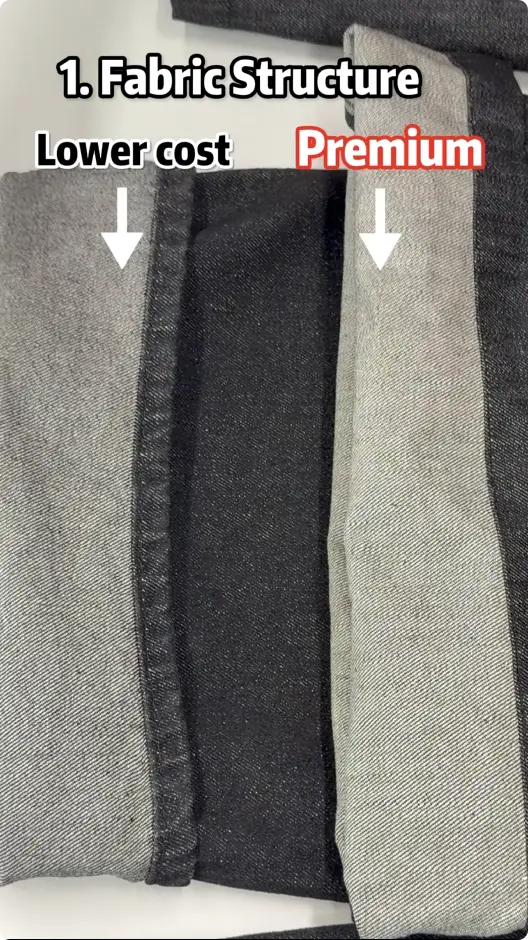
Start with the fabric. It’s the foundation everything else sits on, quite literally. Embroidery needs a strong, stable base—weak fabric will tear, sag, or distort before you can say “wardrobe malfunction.” Heavyweight denim handles dense embroidery like a champ. Lightweight denim? It puckers under heavy stitching, and not in a charming way. Stretch denim is another beast entirely—the elastane can make embroidery warp in ways that make you question your life choices.
So evaluate the weave carefully. A tight twill weave gives needles excellent stability. Loose weaves? Trouble, usually. We study these fabric dynamics constantly in our factory—it’s part of why we can recommend fashionable fabrics to clients with confidence.
Here’s a quick field test: stretch the embroidered area. The fabric should snap back into shape quickly, and the embroidery shouldn’t yank the surrounding threads with it. If the fabric puckers dramatically, the structural integrity is questionable at best. A quality pair keeps a smooth surface. And while you’re at it, ask your supplier about fabric weight—make sure it actually matches the embroidery design. It sounds obvious, but you’d be surprised how often it gets overlooked.
2. Embroidery Execution
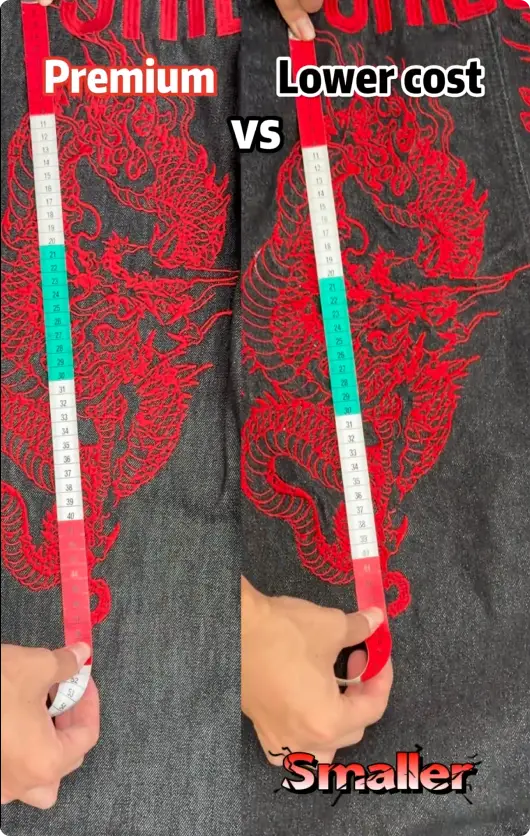
Now let’s talk about the embroidery itself—the part everyone actually sees. Good execution means precise, sharp designs. Crisp edges. No loose loops floating around on the surface. Thread colors should be vibrant and consistent throughout.
Poor execution shows up in jagged lines, missing stitches, and color registration issues—that’s when different thread colors don’t align properly and start overlapping where they shouldn’t. It looks messy, and it is messy. Getting it right requires serious machinery: we run more than 330 pieces of garment equipment and maintain 10+ production lines to handle complex designs.
When you’re evaluating execution, zoom in on the fine details. Small letters and intricate patterns are genuinely hard to embroider—which is exactly why they reveal a manufacturer’s true skill level. If the small details are blurry, that’s a red flag. Reject it. Good technology prevents thread breaks and tension problems, and you should demand perfection in every aspect. No exceptions.
3. Stitch Density
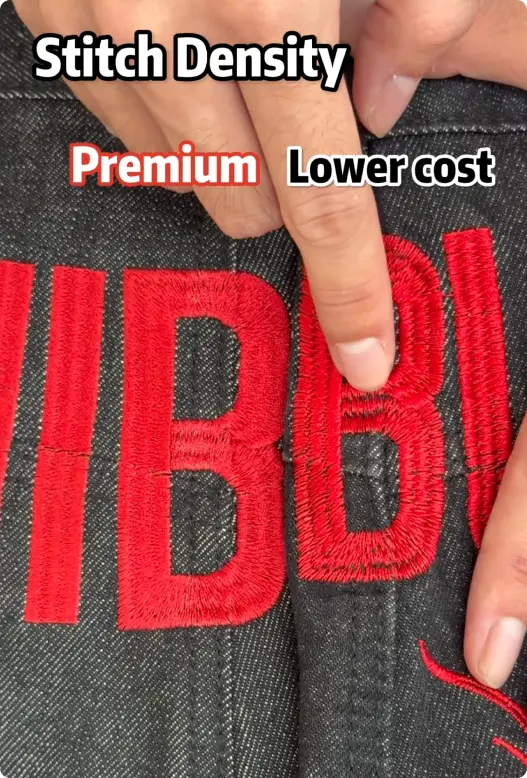
Stitch density is one of those things buyers often miss, and it’s a shame because it’s a massive quality indicator. Density just means how many stitches land in a given area. Get it right, and the embroidery looks full and rich. Get it wrong, and you’ve got problems.
Too low? The fabric shows through, and the whole thing looks cheap and unfinished. Too high? The embroidered area turns stiff as a board, and the fabric can actually tear around the edges. Balance is everything. Our 15+ person R&D team tests these metrics constantly to make sure stitch count matches fabric type.
You can test it yourself, too. Touch the design—it should feel solid but still somewhat pliable. Then hold the jeans up to a bright light. If light shines through the embroidery easily, the density is too low, and the design will look patchy and thin. This one detail separates good from great. Oh, and speaking of not cutting corners: our production period runs 25–35 days, and we never rush it at the expense of density. Some things just shouldn’t be hurried.
4. Clean Finishing
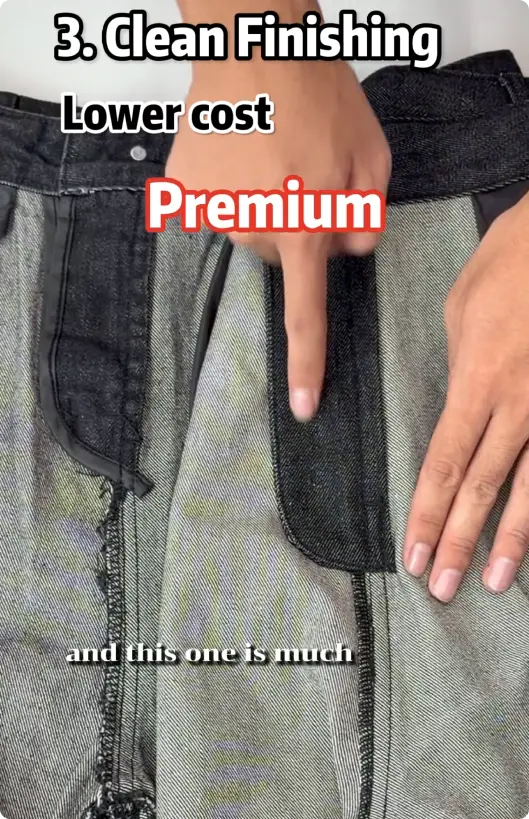
Here’s a truth most buyers learn too late: flip the jeans inside out. The reverse side tells you everything. Premium jeans and cheap jeans look completely different from the inside, and the gap is wider than you’d think.
Embroidery usually needs a backing material for stabilization. Good manufacturers remove it cleanly after stitching. If big stiff chunks of backing are still clinging on in there, that’s poor finishing—and it can actually irritate the wearer’s skin. It needs to be trimmed neatly or washed out, full stop. While you’re inspecting, check for loose or dangling threads. A premium factory meticulously trims every jump thread. Messy threads inside? That’s a lack of care, plain and simple.
We take clean finishing seriously—every product gets fully inspected before shipment, so no messy threads reach the final consumer. It’s part of why our products ship to Europe, the United States, Australia, and beyond, backed by full quality control and a fast delivery rate. One more thing: check the washing process too. Sometimes washing degrades poor embroidery threads, so look for color bleeding onto the denim. Bottom line—a clean interior equals a comfortable, high-quality garment.
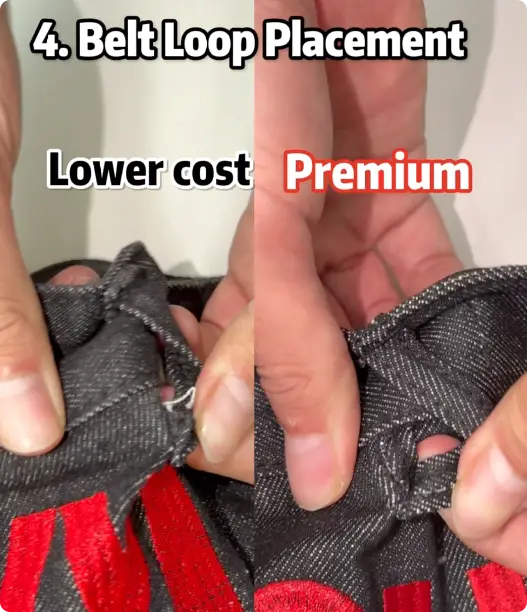
5. Belt Loop Placement
Belt loops. Yes, really. Buyers overlook them constantly, but they’re deeply connected to overall garment quality. Loops must be perfectly aligned and strongly attached, and here’s the tricky part—they often intersect with rear embroidery designs. Back pocket embroidery must not interfere with loop placement. If the embroidery makes the waistline too bulky, sewing machines struggle to attach the loops securely, and the whole thing becomes flawed.
Proper planning during the design phase is crucial. Our team of professional, highly sensitive (in the attentive sense, not the crying-at-commercials sense) members provides one-to-one comprehensive service, helping you shape design ideas so your products actually meet the market. They make sure embroidery files accommodate functional parts like loops.
Also, check the bar tacks securing the loops—those tight zigzag stitches used for reinforcement. They need to be dense and accurately placed. Weak bar tacks rip easily under tension, and nobody wants that. Our 150+ production team keeps a close eye on these structural details. In the end, a well-placed belt loop keeps the jeans both beautiful and functional—which, come to think of it, is a pretty good summary of quality overall.
Frequently Asked Questions (FAQ)
Q: How can I verify the quality before placing a bulk order?
First, always request a physical sample—free samples are available, and the sample cost gets refunded directly when you meet the order quantity. Second, inspect stitch density and fabric structure closely. Trust your hands and eyes over any spec sheet.
Q: Do you provide quality certifications?
Yes, we do. We focus heavily on providing relevant certificates and reports for national quality requirements before shipment, so you can trust our manufacturing standards completely.
Q: What happens if I receive defective embroidered jeans?
We offer excellent after-sale service, including door-to-door guide service during shipment. And if defective goods turn up during selling, the broken one gets replaced. Simple as that.
Q: Can you help me design the embroidery?
Absolutely. We have professional team members providing one-to-one comprehensive service, giving you design ideas to help your products meet the market.
Conclusion
Checking the quality of embroidered denim takes careful attention—there’s no shortcut. Verify the fabric structure first. Then evaluate the precision of the embroidery execution. Check stitch density for durability. Make sure the finishing is clean inside. And finally, verify belt loop placement and structural integrity. Do all five, and you’ll spot problems before they cost you.
Better yet, partner with an experienced manufacturer and most of these problems solve themselves. Your brand delivers premium products consistently, and you sleep better at night. We hope this guide helps your future sourcing endeavors—and if you’re ever in Jiangmen, the factory door is open.

Recent Comments