
If you’re asking how much do a pair of jeans weigh, a typical adult pair weighs about 650 grams (1.43 pounds / 23 ounces). The average can vary widely by fabric, fit, size, and finish. A lightweight stretch pair may come in around 350 grams (0.77 lbs), while heavyweight raw selvedge jeans can tip the scale at more than 1,200 grams (2.65 lbs).
The final weight depends on several things: the cut, the fabric, the size, and how the jeans were finished. If you sell clothes online, ship vintage denim, or are trying to keep your suitcase under an airline’s limit, those details can matter. A few extra ounces may seem trivial at home; at the post office or airport, they can be the difference between one price bracket and the next.
At Kaiping Lianwang Garment Co., LTD, we’ve spent more than 20 years making denim across 10+ production lines, with annual output above 600,000 pieces. That experience has taught us that small choices in fabric and construction can add up quickly. Here’s a practical guide to what affects the weight of a pair of jeans.
How Much Do Jeans Weigh? Average Weight by Fit and Style
So, how much do jeans weigh in everyday use? Most adult pairs fall around 450 to 900 grams (1.0 to 2.0 pounds), with a straight-leg midweight pair near 650 grams. The cut makes a real difference: wide legs and utility styles use more fabric than slim silhouettes, so they tend to weigh more.
Dry Weight Breakdown: Grams, Ounces, and Pounds Table
These estimates are for finished, dry garments measured under standard retail room conditions. The baseline is men’s size 32 and women’s size 28, made from midweight 12.5 oz twill.
| Fit / Style Category | Grams (g) | Ounces (oz) | Pounds (lbs) | Typical Yield & Cut Driver |
|---|---|---|---|---|
| Child Denim (Ages 6–10) | 250 – 380 g | 8.8 – 13.4 oz | 0.55 – 0.84 lbs | Minimal pattern square footage |
| Skinny / Slim Fit | 450 – 600 g | 15.8 – 21.1 oz | 0.99 – 1.32 lbs | Tapered legs, stretch spandex blend |
| Straight Leg (Median) | 600 – 700 g | 21.2 – 24.7 oz | 1.32 – 1.54 lbs | Industry Baseline Standard (650g) |
| Bootcut / Flare | 680 – 780 g | 24.0 – 27.5 oz | 1.50 – 1.72 lbs | Flared hem volume, extra lower yardage |
| Wide-Leg / Relaxed Baggy | 750 – 900 g | 26.5 – 31.7 oz | 1.65 – 1.98 lbs | High pattern surface area across legs |
| Cargo / Multi-Pocket Utility | 850 – 1,100 g | 30.0 – 38.8 oz | 1.87 – 2.43 lbs | Gusseted side flaps, snaps, twin pockets |
Men’s vs. Women’s Blue Jeans: Does Sizing Change the Scale?
Yes. When comparing how much do blue jeans weigh, color itself makes little difference; a larger waist or longer inseam usually means more denim, and more denim means more weight. Fabric weight, cut, pockets, and finishing matter more than whether the indigo is light or dark.
Take two pairs made from the same 13 oz fabric: a petite women’s W25/L28 pair and an extended-size men’s W38/L34 pair. The smaller pattern may use roughly 1.1 to 1.2 linear meters of fabric and weigh around 490 grams. The larger pair may need 1.7 to 1.9 meters, bringing its weight to about 790 grams. That’s a difference of roughly 300 grams (10.6 oz) from sizing alone.
Fabric Oz vs. Garment Weight: The Denim Label Confusion
A common point of confusion: the weight printed on a denim label usually describes the fabric, not the finished jeans. See our guide to selvedge denim for more on how denim construction and fabric choices affect the finished garment. “12oz Denim” doesn’t mean the pants weigh 12 ounces. If only the jeans weighed that much, they’d be lighter than many T-shirts.
What Does “12oz Denim” Actually Mean? (Oz/yd² vs. GSM)
Denim fabric is classified by its weight per area, measured in ounces per square yard ($oz/yd^2$) or grams per square meter ($g/m^2$ or GSM):
\(\text{GSM} = \text{Fabric Oz/yd}^2 \times 33.906\)
- 12 oz/yd² twill works out to about 407 GSM.
- A typical adult straight-leg pair uses about 1.4 to 1.6 square meters of cut fabric, before pocketing and trims are counted.
- Multiply the GSM by the fabric area to estimate the weight of the main panels before sewing.
Lightweight vs. Midweight vs. Heavyweight Selvedge Jeans
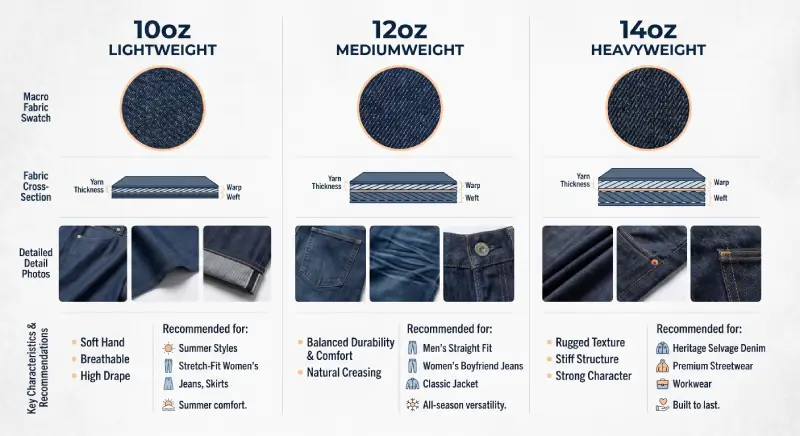
For a quick comparison, denim generally falls into three weight brackets:
- Lightweight (<11 oz / <370 GSM): Often used for summer collections, stretch-skinny jeans, and casual shirts. A finished pair typically weighs around 400–550 grams. These jeans are flexible and easier to pack, which is welcome when suitcase space is already tight.
- Midweight (11 oz – 14 oz / 370–475 GSM): The familiar, wear-it-most-of-the-year option. Finished jeans usually weigh 600–800 grams. This range balances durability and comfort, and it makes up much of our production for European and US fashion brands.
- Heavyweight Selvedge (15 oz – 25 oz+ / 500–850+ GSM): Made on traditional shuttle looms with dense, ring-spun warp yarns, heavyweight selvedge has a sturdier feel. A finished raw pair often weighs 1,000–1,400 grams (2.2–3.1 lbs). Some new pairs are so stiff they can stand upright on their cuffs—a party trick with a short shelf life, perhaps, but a good sign of how substantial the fabric is.
The Hidden Weight Drivers Most Guides Miss
Fabric density gives you a starting point, but it doesn’t tell the whole story. During development, teams verify fabric, measurements, wash results, and trims; our denim quality control checklist outlines those inspection points. Washing, pocket linings, buttons, zippers, and patches all contribute to the number on the scale.
Wash Loss: How Heavy Stone Washing Strips 10%+ Garment Mass
Washing changes the denim’s surface and can reduce its weight. The right wash also affects the final hand feel and appearance; learn more about how denim washing softens stiff jeans. Raw, unwashed jeans still carry starch and sizing agents, along with loose surface fibers. Later finishing removes some of that material.
- Pumice Stone Washing: Jeans tumble with abrasive volcanic stones, which wear away indigo and scour the fabric surface.
- Enzyme Washing & Acid Bleaching: Cellulase enzymes break down tiny fibers on the fabric’s surface, helping soften the twill.
- Mass Loss Variance: Extensive stone, enzyme, and bleach treatments can remove 8% to 15% of the dry fiber weight. For example, a raw 13.5 oz pair entering the wet-processing facility at 750 grams might weigh just 660 grams after washing and final inspection.
Hardware, Pocket Linings, and Trims Weight Impact
The small details have a way of adding up. Hardware and other trims can contribute 50 to 80 grams to a standard pair, and more than 120 grams to a technical utility style.
- Metal Trims: A die-cast steel shank button, five heavy brass fly rivets, and a #5 brass zipper together add about 20–35 grams.
- Back Pocket Linings: Twill pocket bags, typically made from 4.5 oz bleached poly-cotton, add around 30–45 grams per pair.
- Waistband Patches: A genuine 3 mm vegetable-tanned leather back patch weighs about 18–25 grams. A jacron paper tag, by comparison, weighs under 3 grams.
Real-World Scenarios: Shipping, Packing, and Laundry
Shipping Jeans for Resellers: Beating the 1-Pound (16 oz) Postal Cliff
For sellers on cross-border platforms and secondhand marketplaces such as eBay, Poshmark, and Mercari, the 16-ounce (1-pound) mark can affect shipping costs. The package matters too, of course—not just the jeans.
- A standard cardboard box adds about 150–220 grams (5.3–7.7 oz). That can push a 14 oz women’s slim pair over the 1-pound threshold and into a pricier shipping bracket.
- The Reseller Strategy: Try a lightweight 10×13 inch poly mailer instead of a rigid corrugated box. A 2-mil mailer weighs only about 12–15 grams (0.4–0.5 oz).
- Fold the jeans neatly and use the lighter mailer where the platform’s packaging rules allow it. Skinny jeans, light washes, and smaller sizes may stay under the 15.99 oz cutoff this way. The switch can save $3 to $5 in domestic parcel postage per shipment.
+--------------------------------------------------------+
|             SHIPPING WEIGHT OPTIMIZATION               |
+--------------------------------------------------------+
| Corrugated Box Tare:   180g (6.3 oz) -> OVER 1 LB TIER  |
| 2-Mil Poly Mailer:      14g (0.5 oz) -> UNDER 1 LB TIER |
+--------------------------------------------------------+
Luggage & Backpacking: Estimating Carry-On Weight Capacity
Many international airlines set carry-on limits at 7 kg (15.4 lbs) or 10 kg (22 lbs). Denim can use up that allowance faster than you might expect.
One standard straight-leg pair weighs around 650–700 grams—roughly the weight of 3 to 4 lightweight performance T-shirts (150–180g each). Three pairs of classic jeans add up to more than 2.1 kg (4.6 lbs), taking about 30% of a 7 kg allowance. If you’re packing light, consider lightweight blended denim under 11 oz, or wear your heaviest midweight pair on travel day.
Dry vs. Wet Weight in Laundry: Drum Capacity and Spin-Dry Energy
Cotton twill is absorbent, so a pair of jeans can feel surprisingly heavy once it’s soaked.
- Saturated cotton twill can absorb 120% to 150% of its dry mass in water.
- Four pairs that weigh 2.6 kg (5.7 lbs) when dry may reach 5.7–6.5 kg (12.5–14.3 lbs) during the rinse cycle.
- Operational Caution: Avoid cramming too many jeans into a household washing machine. Wet denim clumps together, which can throw the drum off balance and wear down its drive bearings. A high-speed spin cycle of 1,200+ RPM removes more moisture before tumble drying and can reduce the dryer’s energy use.
How to Weigh Jeans at Home Without a Garment Scale
You don’t need an industrial textile scale. A kitchen or postal scale will usually do the job, and a luggage scale can work in a pinch.
The Kitchen Scale & Postal Scale Method
- Wipe the surface of an electronic food scale.
- Place a light, rigid plastic container or cardboard sheet over the scale platform.
- Press Tare / Zero to reset the display to 0.00 g/oz.
- Fold the jeans into a neat square, about 8×8 inches, so the hems don’t hang over the edges.
- Center the folded jeans on the tray and record the reading.
The Luggage Scale Luggage-Loop Hack
- Turn on a digital hook-style luggage scale.
- Button the jeans securely at the waist.
- Thread the scale’s nylon strap through the two main front belt loops, then loop the hook through the anchor clasp.
- Lift the scale straight up by its handle until the jeans hang freely.
- Wait for the screen to beep and hold the reading.
Frequently Asked Questions About Denim Weight
Can a pair of jeans weigh over 2 pounds?
Yes. Jeans made from heavyweight selvedge denim, especially in the 16 oz to 25 oz+ range, can weigh more than 2 pounds (907 grams). Reinforced tactical cargo trousers can cross that mark too, particularly when they have multiple pockets, double-knee panels, and steel rivets.
How much does wet denim weigh compared to dry denim?
Wet jeans often weigh 2.2 to 2.5 times their bone-dry weight. A standard pair that weighs 650 grams (1.43 lbs) dry can retain around 800–1,000 grams of water, bringing the total to 1.45 to 1.65 kg (3.2 to 3.6 lbs) before the water is spun out.
What is the lightest denim weight available for hot weather?
For hot climates, commercial denim can be as light as 6.5 oz to 8.5 oz (220–290 GSM). These featherweight fabrics often blend fine, long-staple cotton with lyocell, rayon, or linen. The goal is to keep the fabric breathable without giving up tensile durability.
Need help with specialized fabric selection or custom manufacturing? Kaiping Lianwang Garment Co., LTD runs a 7,000+ square meter factory in Guangdong, China. Its team includes 150+ skilled workers, 330+ specialized machines, and an in-house R&D group of 15+ technicians. The company develops private-label collections for global markets.

Recent Comments