
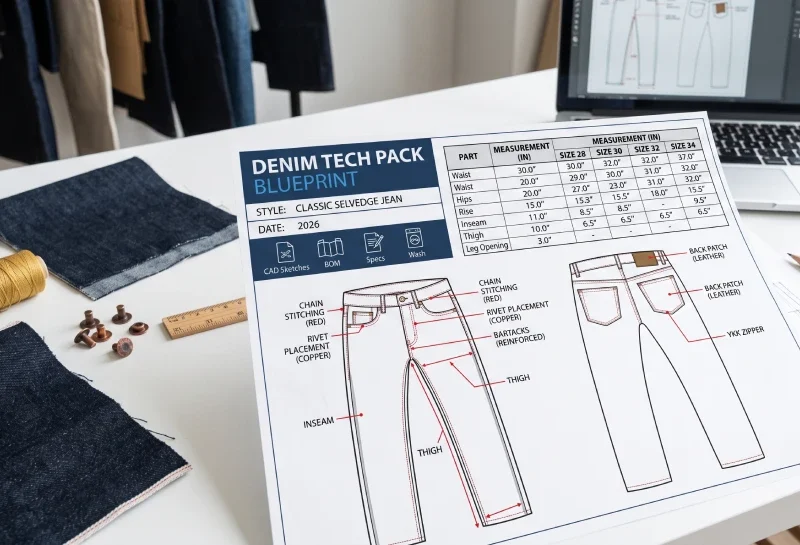
Overall, the global market for denim jeans is anticipated to grow to USD 96.1 billion by 2026. Consumers are still focused on the same high-quality fits, vintage washes and methods of sustainable manufacturing. It turns out, though, that starting a denim brand is intricate pattern making, fabric sourcing and chain management business.
You have to begin with a strategy when building a successful denim brand. A cherry picker who will have his hand down and negotiate mərrit on the basis of time spent as a way to build an incentive with no incentive whatsoever; you also need mastery over manufacturing processes and pricing architectures. A step-by-step guide to establish a successful denim line in 2026
Step 1: Market Positioning Before You Start a Denim Brand
Finding Your Denim Niche: Raw Selvedge, Streetwear, or Eco-Friendly Apparel
The very first step, however, and arguably the most important one to take, is to define your niche. It is not easy or cheap to generate customers for a generic denim brand. With that in mind, well-performing independent brands hone in on specific product categories:
- Raw Selvedge Denim — Designed for denim fetishists who love shuttle loom weaving and heavier fabric weights as well as deep indigo fades.
- Streetwear & Fashion Denim: Defined by oversized silhouettes, pronounced rips n’ tears, engineered pockets and experimental washes.
- Eco-Friendly & Sustainable (Organic Cotton, Recycled Fibers And Water Saving Finishing) Apparel: For the conscious consumer
For example, contemporary users rely on brands that deliver lower environmental footprints. Early on, when you have specific brand positioning, it helps you with fabric suppliers, wash houses and the correct demographic.
How Much Does It Cost to Start a Denim Brand?
Your startup costs will vary based on your order volume, either production model or hardware (or both). For a DTC denim brand that is launching new styles at about 300–500 units each, we would realistically expect an initial budget to be in the $10k—$25k range.
Below is the proper budget allocation necessary to shield your cash flow whilst at the start stages of growth:
- Product Development & Sampling (15%What is this?No more than an hour of our annual salary!): This section features tech packs, pattern grading, fit trials and physical wash samples.
- Manufacturing & Bulk Inventory (45%): Raw material acquisition, hardware development & cost, labor and shipping duties.
- Branding & Web (10%): Logo, custom packaging, leather backpatches, Shopify completion
- Pre-Launch & Visitor Research (30%): Create content, gift influencers, and test paid ads.
Controlling your upfront cash outlay for your inventory will ensure you maintain good cash flow levels. Hence, a reliable partnership with quick-response apparel manufacturers is vital for early survival.
Step 2: Tech Pack Creation for Starting a Denim Line
Essential Components of a Denim Tech Pack
A tech pack is a blueprint where all of the details about your jeans are outlined. A detailed tech pack is essential for your design to be accurately manufactured at garment factories.
DENIM TECH PACK BLUEPRINT
1. CAD Design & Flat Sketches (Front, Back, Stitch Details)
2. Bill of Materials (BOM): Fabric, Thread, Hardware, Back Patch
3. Measurement Spec Sheet & Pattern Grading Table
4. Construction Details: Chain Stitching, Rivet Placement, Bartacks
5. Wash & Finishing Guidelines (Target Color Swatches)
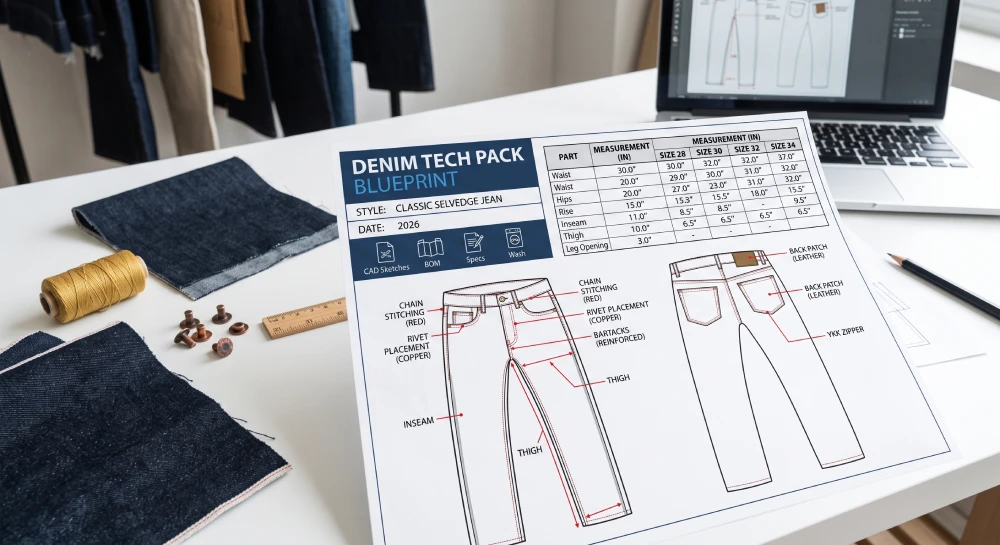
The tech pack will need to have:
- Each size in your line, such as waist circumference, front rise, back rise, inseam, thigh and leg opening.
- Specifications — Including YKK zipper details, shank buttons and copper rivets.
- Cut & Sew Details: Chain stitching along the waistline & hems, lock stitched and heavy bartack reinforcements on tension points.
Master the Shrinkage Rate: Designing for Raw vs. Finished Measurements
Denim acts differently from a normal woven material. During the first washing, tumbling and solution finishes, raw cotton materials lose a substantial amount of shrinkage.
As an example, 100% cotton rigid denim can shrink from 3% to 8% in length and width. This is why pattern makers apply shrinkage factors to flat patterns before cutting fabric.
Example: if you have a 32-inch finished waist, but your raw pattern may need to be cut out at 33.5 inches. Having sample developers in your back pocket means you can ensure that your production units mirror the final spec sheet.
Step 3: Sourcing Fabric and Hardware to Start Your Own Denim Line
Choosing Fabric Weight: 10 oz Lightweight vs. 14+ oz Heavyweight Raw Denim
Fabric weight is measured in ounces per yard (oz). Choosing the weight of fabric directly affects the overall durability of the product and also how comfortable it is going to be for your customer:
| Denim Weight | Ounces (oz) | Best Suited For | Characteristics |
| Lightweight | 8 oz – 11 oz | Summer collections, stretch denim, women’s jeggings | Soft, highly breathable, fast drape. |
| Midweight | 12 oz – 13.5 oz | Classic 5-pocket jeans, jackets, everyday wear | Balanced structure, highly versatile, durable. |
| Heavyweight | 14 oz – 21+ oz | Premium raw selvedge, heritage workwear | Stiff initial feel, dramatic fade potential, long lasting. |
Sourcing Denim Fabrics Globally: Japan, Italy, Turkey, and China
Your garment quality and margin depend on where you source your fabric:
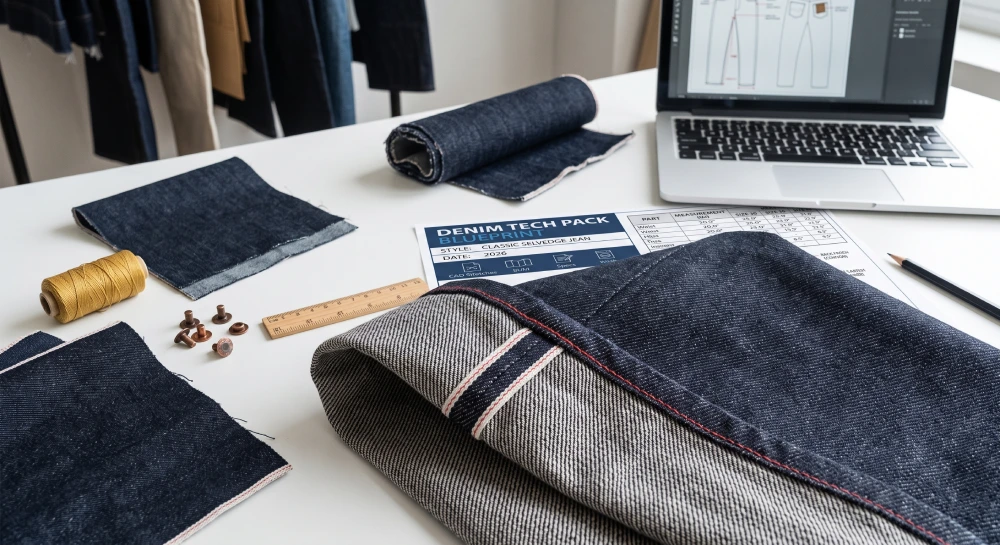
- Japan (Kuroki, Kurabo): World famous for slow-spun raw selvedge denim woven on vintage shuttle looms as well as their natural indigo-dyed products.
- Italy (Candiani): is noted for their lux ultra-soft stretch blends and designer sustainable denim fabrics.
- Turkey (Isko): Stretch denim innovation and circular recycled cotton blends manufacturer.
- China(Guangdong Region): Top-quality high-capacity manufacturers, Rich variety of fabric constructions, Cost-Effective and Fast Turn-around.
Customizing Trims & Hardware
Basic jeans become a categorization a brand asset with add trims. Custom Hardware Elements: High-End Brands Focus on the Details
- Zippers & Buttons — YKK for the best durability and heavy-duty custom-branded shank button
- Copper Rivets—real riveters on pocket corners and stress points, add an authentic vintage vibe.
- Back Patches: Create personalized leather back patches using real leather, imitation leather, or recycled paper jacron.
Step 4: Partnering with Factories to Start Denim Manufacturing
Finding Low-MOQ Manufacturers vs. Full-Scale Garment Factories
The manufacturing partner is the one that can make or break an up-and-coming apparel brand. Low MOQs, plus scalable production capabilities from partners, will be required for emerging brands to stay competitive in terms of supply chain flexibility.
Kaiping Lianwang Garment Co., LTD is a perfect example of an 8-year-old, valuable, highly adaptable manufacturing partner and operates its own +7000 square metre factory furnished with more than two hundred modern apparel machines and ten production lines out of Jiangmen (Guangdong Province, China).
Kaiping Lianwang has more than 20 years of experience in manufacturing and offers full OEM and ODM services across all denim categories for men, women and kids. With the help of their 15+ person R&D team, they assist up-and-coming brands to develop initial design concepts into ready-to-market products.
Navigating the Sample Pipeline: Fit Samples, Wash Samples, and PP Samples
You have to pass through 3 different sampling stages before you enter full production:
- Fit Samples: Utilising stock fabric, Fit samples determine pattern accuracy, structural seam placement and general garment silhouette.
- Wash Samples: Used to test chemical treatments, manual abrasion and color fading on base bulk fabric.
- Pre-Production (PP) Samples: Similar to production prototypes, except for the fact that they are final production-ready garments made with correct fabrics, custom trims, and real hardware.
Fast sampling cycles avoid long delays before launch. Take Kaiping Lianwang as an example: it takes only 10–20 days to complete a complex sample. In addition, their team replies to 30-minute first business inquiries as well as specification details within three hours.
Working with the Wash House: Traditional Stonewash vs. Eco-Friendly Laser & Ozone Finishing
The denim’s final color, texture and worn-in personality are defined at the wash house. Conventional stonewashing uses pumice stones in addition to higher volumes of water to wash indigo fibers & soften them.
However, modern brands have increasingly begun to embrace sustainable finishing technologies:
- Laser Finishing: Utilizes accurate laser beams to char vintage whiskers, fades, and distressing into fabric without applying water or chemicals.
- Bleaching with Ozone: Strips indigo dye using gasified oxygen, reducing water consumption by up to 80%
Responsible and low-carbon production has become the priority of many forward-looking factories. By working with energy-saving lighting together with the developed boiler steam exhaust recovery device, and supporting other waste heat, the efforts on input information data content are solved in Kaiping Lianwang factory.
Step 5: Inventory Planning to Start a Successful Denim Brand
Preventing Deadstock: How to Calculate Your Size Curve Ratio
Stock carry is a big reason why indie apparel brands often face financial issues. Choosing an appropriate size ratio in your waist sizing grid avoids inventory skewness with respect to the bodies.
This is what a normal standard curve ratio on men’s denim waist sizing looks like:
Waist Size: 28 : 30 : 32 : 34 : 36 : 38
Curve Ratio: 1 : 2 : 3 : 3 : 2 : 1
Total Units: 10% : 20% : 30% : 30% : 20% : 10%
Analyzing early pre-order data helps you fine-tune how to distribute your inventory. This way, you do not have loads of bulky stock in extreme sizes.
Managing Minimum Order Quantities (MOQ) and Supply Chain Lead Times
Supply chain turnaround times are critical to keep the cash flow steady. Conventional denim production cycles commonly reach up to 60 and even 90 days.
But an agile supply chain will have faster order fulfillment time. The lead time for mass production is only 25–35 days at Kaiping Lianwang.
Moreover, they conduct a total quality checking before shipping and offer a complete replacement guarantee for damaged products. It allows independent brands that do not want to risk running out of stock on their best-selling styles the ability to restock them quickly.
Step 6: Pricing and Launching Your Denim Brand
Denim Pricing Architecture: Calculating COGS and Retail Markups
To set sustainable pricing, take into consideration your Landed COGS. Landed COGS comprise factory cut-and-sew, fabric, custom hardware, ocean/air freight and duties at import.
In order to build a DTC business that is sustainably healthy, you need to establish a 4x to 5x retail markup on landed COGS:
- Factory Production & Fabric: $20.00
- Custom Hardware & Labels: $2.00
- Freight & Import Duties: $3.00
- Total Landed COGS: $25.00
- Target DTC Retail Price: $100.00 – 125.00 (delivering a robust 75%–80% Gross Margin)
Setting Up Your Shopify Store for DTC Denim Sales
Consumer fit uncertainty is the leading cause of online apparel returns, and your digital storefront needs to proactively combat it. Tools to use on your Shopify store that would improve conversion rates:
- Interactive Size Charts: include the measurements of the clothing as well as what body measurements are ideal.
- Video Fit guides: Evidence of different height and body types wearing a variety of waist sizes.
- Customer Review Apps: Enable verified purchasers to review product fit and stretch at the waistband.
Pre-Launch Marketing Strategy: Leveraging UGC, Influencer Gifting, and Social Proof
Therefore, it is vital to build anticipation for your website before launch time and encourage some traction/sales velocity early:
- Product Gifting For Influencers: Share early fit samples with specific fashion creators and denim fans in return for genuine unboxing reactions.
- User-Generated Content (UGC): Featuring people in your jeans wearing them through day-to-day life is more authentic social proof.
- By The Factory Content: Utilizing raw video footage of work in progress by the factory – chain stitching, wash house processing and fabric cutting to showcase craftsmanship.
Frequently Asked Questions About How to Start a Denim Brand
How long does it take to manufacture custom jeans from design to delivery?
Typical Run Time: 2–4 Months. When we say timeline, it can be tech pack writing, sourcing fabrics, creating fit samples, bulk production and shipping, etc.
In contrast, when you have agile supply partners in the ecosystem, it compresses this time frame. Kaiping Lianwang Garment Co., LTC processes samples in 10–20 days and bulk orders within 25–35 days, for instance.
What is the average profit margin for an independent denim brand?
General DTC denim brands typically hover in the 65% to 80% range on gross profit. Adjusted for ads, shipping costs, ecommerce platform fees, and reverse logistics, average net profit is generally 8% – 15%.
Dovetailing with jeans’ longevity due to both structural performance and timeless looks, their markdown rates come in lower relative to fast-fashion apparel categories such as accessories (50%), dresses (40%), or tops (39%)—seasonal reductions of these products can often be more than double those of standard silhouettes.
Having a denim brand is 50 percent creative vision and 50 percent supply chain discipline. With a clear market niche, a precise tech pack can definitely allow you to create an apparel business with scale and profits starting from great garment factories like Kaiping Lianwang Garment Co., LTD.

Recent Comments