
One of the smartest moves in e-commerce is to source denim — at scale. At the same time, it is rife with logistical landmines. And when it comes to the textile industry, where fabric shrinkage can greatly vary — a mistake elsewhere (needles mislabelled, hidden freight surcharges) can wipe out your profit margins.
An established framework is critical to building a long-term B2B apparel pipeline. So here’s your definitive guide for purchasing denim in bulk, keeping quality control in check, and ensuring that you keep your profits as high as they go.
Phase One: Plan Your Denim Sourcing Approach (White Label vs. Liquidations)
Selecting the wrong supply chain model ahead of making your first deposit could prove to be a disastrous choice. You have to synchronize your brand value proposition with the appropriate inventory strategy.
Which Isn’t Their Own: Was for Wholesale Distributors, Direct Factories and Stocklot Liquidators
There are important trade-offs between unit costs, customization and lead times for every sourcing channel:
- Liquidators: Liquidators offer you the lowest of low ($2 to $5 each). You, of course, lose control over the style, sizing ratios and fabric consistency. This model works well in discounted clearance channels, but it is a huge danger sign for established brands.
- Wholesale Distributors: Distributors keep inventory on-demand in regional warehouses. Lead times are quick (3–5 days), but unit prices are considerably higher, and custom branding options nearly don’t exist.
- Direct Factories (OEM/ODM): By working directly with a manufacturer, you can have full control over the design, weights of fabrics, custom washes and hardware.
Direct manufacturing has the best margins and offers long-term sustainability for scalable brands. Well-established brands like Kaiping Lianwang Garment Co., LTD have a lot of infrastructure to work with. With more than 20 years of manufacturing experience, over 7,000 square meters of factory area and working with many pieces of professional garment machinery equipment (330+ in total) to process complicated production runs with high-quality finished goods, direct factories can handle different garment needs.
| Sourcing Model | Typical Unit Cost | Lead Time | Customization | Best For |
| Stocklot Liquidators | Very Low ($2–$5) | 1–3 Days | None | Clearance / Discount Sellers |
| Wholesale Distributors | Medium ($12–$22) | 3–7 Days | Very Low | Fast-turnaround boutiques |
| Direct OEM/ODM Factory | Low ($6–$14) | 25–35 Days | Fully Custom | Scalable E-commerce Brands |
Understanding the Ratio of Sizes You Need and Ordering Ratios of Regional Cuts
Independent operators often end up making the mistake of taking a supplier’s “standard” size curve (ie 1-2-2-1 for S-M-L-XL). Generic ratios almost always end up as deadstock in smaller sizes and out-of-stock at launch in the most popular mid-ranges.
Market Demographic cuts are all over the Map. Young US consumers, as many shoe makers have learned to know by now and as long leg tubes contra angled waist Sexers may already suspect, often also need femur-wrists that are larger in diameter than anything remotely satisfactory for an Asian or European demographic. Be careful not to overstock on odd sizes; you should only demand custom breakdown ratios based on your internet data by region. For those selling mainly in North America, a 1-2-3-2-1 ratio (28–30 – 32–34 – 36) is more representational of what consumers are actually purchasing.
Step #2: Vet Wholesale Jeans Suppliers Whilst Dodging Costly Scams
The B2B garment industry has more than enough untrustworthy third-party providers and poorly equipped factories. You need to determine before sending them money via a wire transfer who they (suppliers) really are.
[Supplier Verification Blueprint]
├─ Step A → Capacity Check (150+ workers, 10+ lines)
├── Step B: T/A Audit (Sample of 10–20 days / Production between 25–35 Days)
└── Step C: Ensure Compliance & MSDS Verification
Overseas Manufacturers versus Local B2B Platforms: How to Evaluate Suppliers’ Credentials
Companies doing local B2B trading also usually treat themselves as the main producers. As a result, you pay an intermediary that is not needed.
Some of the traditional signs of real scale during audits for overseas suppliers are:
- Dedicated Workforce: Genuine direct factories have specialized internal departments. A facility that operates with a 150+ person production team, a 15+ person professional R&D team, and 10+ production lines can handle large-scale runs without outsourcing.
- Demonstrated Capacity: Search for manufacturers with a yearly production greater than 600,000 pieces. During peak seasons, high output guarantees that the production plant can work quickly to satisfy reorders.
- Joy of Responsive Communication: Speed of communication is key to supply chain agility. Best-in-class manufacturing partners ensure that within 30 minutes inquiries or emails are answered, and a quote + the product specifications come in 3 hours at the latest.
Identifying Fake Designer Denim and Risks to Intellectual Property
While it may seem harmless, purchasing “marked down” brand-name jeans from non-authorized liquidators is a gigantic legal risk to your whole operation. Customs officials regularly seize shipments that have violated marks of trademarked stitch patterns, branded rivets or back-pocket arcuate designs.
Be an OEM (White Label) or ODM (Custom Design) manufacturer to protect your business. Your supplier’s vertical integration power can ensure you get a crystal-clear one-to-one suite of services that will guide you seamlessly to turn the favorites that have caught your imagination into each creation in immaculate one to gallery ready designs without treading on existing patents.
Basic Sourcing Documents: MSDS Certificates and Environmental Compliance Test Reports
It involves heavy chemical usage in dyeing and washing operations. Global regulations have begun to establish harsher customs holds on imported apparel that has not been certified.
Tip: When looking for Chemical Dyes, always ask to see the Material Safety Data Sheets (MSDS) and that they comply with sustainable production.
Carbon-reduction strategies have rolled out amongst the leading manufacturers. From energy-saving lighting sources to boiler steam exhaust recovery systems, the manufacturer that implements these sustainable practices proves its dedication to modern standards of environmental protection. Moreover, enforcing applicable national quality requirement certificates and reports pre-shipment protects your brand from import compliance rejections as well.
Step 3: Master Quality Control of Factory Bulk Jeans Before Ordering
Denim is basically a highly technical garment. Understanding jeans’ physical characteristics avoids some expensive errors later on–repeat batch failures or rejected containers.
┌─────────────────────────────────────────────────────────┐
| Technical Denim Specifications                          |
├────────────────────────┬────────────────────────────────┤
│ Structural Integrity   │ 8–10 SPI / Bar-tack stress pts │
├────────────────────────┼────────────────────────────────┤
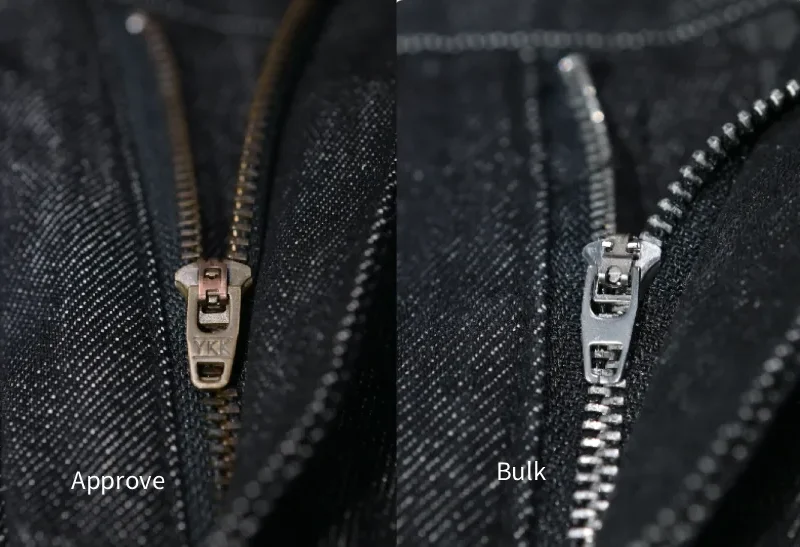
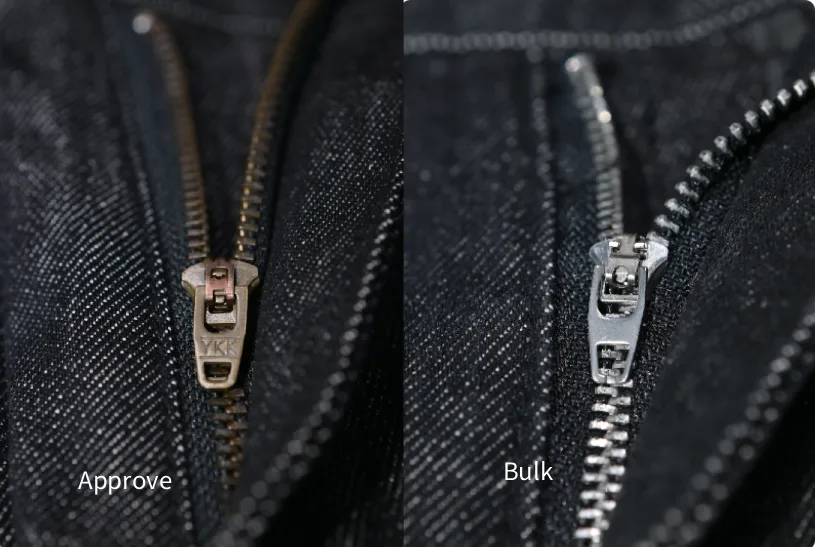
↪ Hardware Specification ║ Authentic Auto-Lock YKK Zippers │
├────────────────────────┼────────────────────────────────┤
│ Fleece Weight Variation│ Max ± 0.5 ounces               │
└────────────────────────┴────────────────────────────────┘
Detailing Specifications: Stitch Density, Crotch Reinforcement & YKK Zippers
Denim is made to last. In reviewing production samples, pay particular attention to three key structural features:
- Stitch Density: 8 to 10 Stitches Per Inch (SPI) for premium denim. Fewer stitches, on the other hand, weaken the seams and result in tearing earlier.
- Crotch Reinforcement: High-stress points will have double-folded flat-felled seams as well as heavy-duty bar-tack stitching on the crotch junction.
- Zipper Specifications: Use only auto-lock YKK metal zippers – usually #4.5 or #5 brass results in better quality. Poor quality unbranded zippers are responsible for the single biggest cause of customer returns in retail apparel, according to a recent study.
Denim Fabric Weights (Oz) and Manipulating Wash Shrinkage Changes
The weight of denim fabric is measured in ounces per square yard (oz/yd²). How you choose your weight determines seasonability and how durable it is.
- Lightweight (Under 12oz): Great for summer collections, casual trousers and stretch Jegging fits.
- Mid-weight (12 oz – 16 oz): Industry-standard for heavy-duty, everyday wear jeans for men and women.
- Heavyweight (16oz and above): Quilt weight denim – a favorite among heritage, raw and selvedge denim fans.
Wet processing (stone washing, acid washing, enzyme washing) has significant changes in fabric dimension, and therefore shrinkage must be controllable. A good factory implements wash methods to hold dimensional variance within a tight ± 2% specification.
Tech Pack Checklist Detailed on this Page: First Request for Samples and Second Performing Wear and Wash Tests
Leave without testing physical preproduction samples before you approve a bulk order. Now, a centralized factory will enable you, particularly in 10–20 days, to provide sample developing so that you can quickly conduct key quality tests.
[Sample Testing Workflow]
Sample (10–20-Day Dev) ➔ Measure Dimensions ➔ 5x Machine Wash Cycles ➔ Audit Shrinkage/Fading
When your sample arrives, conduct a rigorous 5-cycle commercial wash test:
- Before washing, measure waist, inseam, thigh and front rise.
- Tumble dry up to 5 times in warm water.
- If seam twisting, excessive shrinkage or rusting is present, re-measure.
The best manufacturers will always support their craft, offering free samples (where the sample cost is refunded directly once at least the bulk order clause threshold is reached).
Step 4: Calculate the True Landed Costs and Negotiate for Low Minimum Order Quantities
Many of these products come with a low factory unit price, which can be misleading. The key is to calculate your true Landed Cost per unit so you can safeguard your margins.
The Hidden Costs [Freight Forwarding & Import Duties, Denim Washing]
Early calculate these often-overlooked line items to prevent margin erosion—
- Washing Fees: Costs per unit are added for washing, such as intricate distressing, hand-scraping, and laser-whiskering. Make sure your supplier quotes you the latest price with exact product specifications right at the beginning.
- Import Tariffs of Denim: Different import duty categories for denim textiles based on fiber composition, such as 100% cotton vs. a blend of cotton-poly-spandex, etc.
- Door-to-Door Logistics: When it comes to door-to-door logistics, the prices you pay for freight can sometimes rise too much. As such, working with vendors that offer door-to-door guide solutions throughout shipment streamlines logistics and eliminates hidden demurrage charges.
Hack Factory: Merging Fabric Fabrications by Styles Fitting
Growing brands face a significant challenge with High Minimum Order Quantities (MOQs). The reason is that the minimum order quantities (MOQs) set by factories are, in turn, determined by what the textile mills need: they require large minimum orders to dye custom fabric runs.
You build on a workaround used within the industry to negotiate lower per-style MOQs: Fabric Aggregation.
Red Label Strategy: Request for the same fabric roll (12 oz 98% Cotton / 2% Spandex) used in three cuts: Slim Fit, Straight Leg, Relaxed Fit. The factory has more than enough qualifiable raw materials, while you get three styles for your shop without taking on the full inventory risk.
Step 5: Manage Inventory and Logistics for High Profit Margins
Profit margins are in the high range, so you leave nothing un-monitored up until its final delivery.
Type of Inspection: Pre-Shipment Inspection (PSI) Criteria Applicable for Bulk Apparel (AQL 2.5)
Exercise caution before making final payments without validating product quality. Acceptance Quality Limit (AQL) 2.5 Standards are used in almost all general inspections for professional supply chains.
┌─────────────────────────────────────────────────────────────────────────┐
│ Acceptable Quality Limit (AQL 2.5 Standard)                            │
├───────────────────┬─────────────────────────────────────────────────────┤
│ Critical Defects  │ 0% Allowance (Safety hazard/Wrong size)             │
├───────────────────┼─────────────────────────────────────────────────────┤
│ Major Defects     │ Max 2.5% (Show Holes / Broken zipper)              │
├───────────────────┼─────────────────────────────────────────────────────┤
│ Minor Defects     │ Max 4.0% (Uncut threads / Minor dye spot)           │
└───────────────────┴─────────────────────────────────────────────────────┘
Be it world-class manufacturers, make sure that all products are inspected before they ship them out. In addition, top-notch suppliers come with risk-alleviating promises: if defective or damaged goods fall off, they will be replaced.
Section 7: Liquidation Wrap-Up — How to Clear Out Excess Inventory and Odd Sizes
No matter how well it is planned, some odd sizes or slow-moving fits are bound to be left over. Let your working capital move by clearing aging inventory:
- Bundle Deals: Pair slow-moving sizes with your best-selling jackets or tees at a discount bundle.
- Flash Clearance Sales: When springing forward to the next collection, run a few targeted promotional campaigns to clear remaining stock from previous lines at cost price.
- B2B Bulk Offloading: Release permanent overstock to off-price regional liquidators, clearing out valuable real estate in your warehouses.
Frequently Asked Questions (FAQ)
How long is the production lead time on bulk custom denim?
Lead time for standard production after sample approval usually takes 25–35 days, depending on the complexity and volume of the order. Sample development alone generally takes about 10–20 days.
How to check whether an overseas factory is real?
We recommend factories with many years in operation (minimum 20+ years of manufacturing experience). They should feature large facilities (e.g., 7,000+ sq. meters), verifiable workforce numbers (150+ workers), specialized equipment (330+ machines), and provide abundant quality control and pre-shipment inspection reports.
What if my shipment is received with defective goods?
Establish clear defect policies before paying your deposit. Reliable suppliers lay out specific post-purchase protections, assuring the buyer that any damaged or defective product on delivery will be replaced on the spot.

Recent Comments